
For stainless steel, TIG and MIG can both produce sound welds. The better process depends on the joint: TIG (GTAW) favors precision, access to the weld pool and clean control on thin material or roots; MIG (GMAW) favors deposition rate, travel speed and repeatable production welding.
That distinction is more useful than the common claim that TIG is always “higher quality” and MIG is always “faster.” A qualified pulsed MIG procedure can make excellent stainless welds, while a poorly shielded TIG weld can lose corrosion performance. Process choice does not replace grade identification, filler selection, cleanliness, shielding, heat control or post-weld surface requirements.
TIG vs MIG at a glance
| Decision point | TIG / GTAW | MIG / GMAW |
|---|---|---|
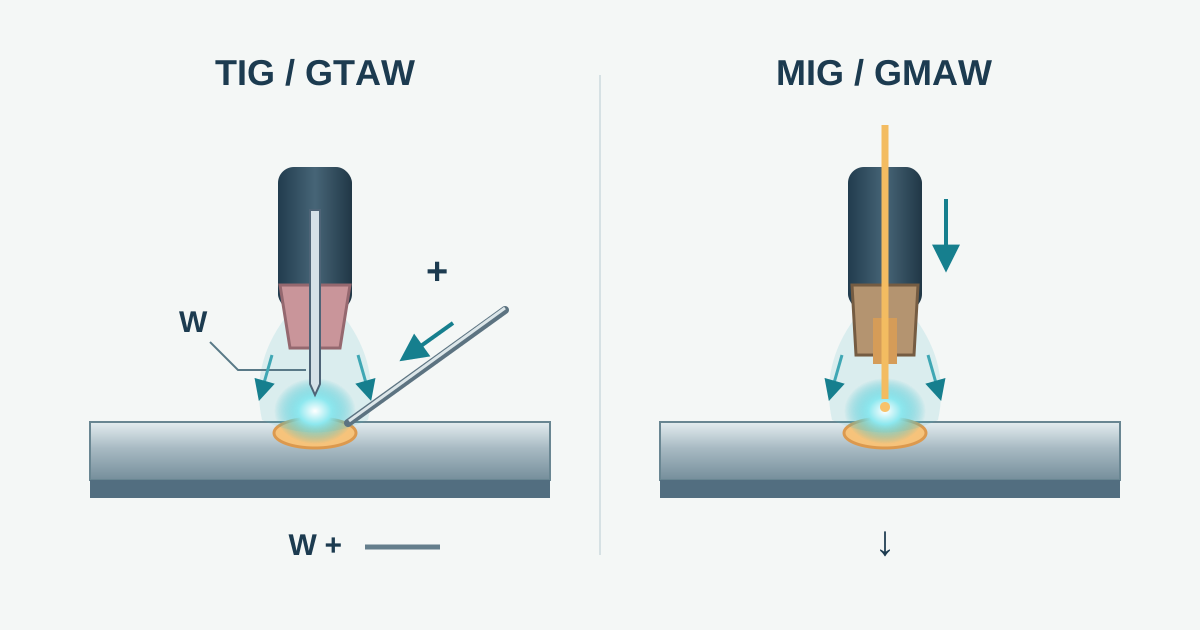
| Electrode | Non-consumable tungsten | Continuously fed consumable wire |
| Filler | Separate rod when filler is needed; some joints can be autogenous | Wire electrode is also the filler |
| Best fit | Thin sheet, roots, small precise joints, visible work | Long seams, repetitive fabrication, higher-deposition production |
| Deposition/productivity | Usually lower in manual work | Usually higher because wire is continuously fed |
| Heat control | Very direct operator control; useful on delicate joints | Strongly dependent on transfer mode; pulsed systems can control average heat well |
| Spatter | Normally very low when correctly run | Varies with transfer mode, gas and settings; pulsed/spray can be very clean |
| Operator technique | Higher manual coordination in hand welding | Continuous wire feed simplifies filler addition but parameter control still matters |
| Automation | Can be mechanized/automated | Well suited to mechanized and robotic production |
Scroll within the table to see all columns →
What actually changes between TIG and MIG?
TIG/GTAW creates the arc between a non-consumable tungsten electrode and the workpiece. When filler is required, it is added separately as rod or wire. The operator can closely control arc position, filler timing and current, which is valuable on thin sheet, tack-sensitive assemblies, pipe roots and visible welds.
MIG/GMAW feeds a consumable wire electrode continuously through the gun. Wire feed and electrical parameters are linked to deposition and arc behavior. That continuous feed gives MIG its production advantage on longer joints and repeated parts.
Thin stainless sheet: TIG is precise, but pulsed MIG can be productive
TIG is often the straightforward choice for thin stainless because the welder can add filler only when needed and can control current precisely. It is well suited to short seams, corners and visible assemblies where burn-through, distortion and bead appearance require close control.
MIG should not be dismissed for thin gauge. Short-circuit, controlled short-circuit and pulsed processes can be productive when the power source, wire diameter, gas and joint fit-up are matched to the job. Pulsed MIG can reduce average heat compared with conventional spray transfer while maintaining stable transfer, but it is not a universal low-heat setting.
For very thin cosmetic work or low-volume fabrication, TIG often remains simpler to control. For repeated parts, fixtures and a qualified parameter window, MIG can win on throughput.
Pipe roots and full-penetration joints
TIG is widely used for stainless pipe roots because it gives clear control of the keyhole/root profile and works naturally with inert back purging. That is a process preference, not an absolute rule.
Modern controlled short-circuit GMAW processes are also used for stainless roots in qualified procedures. The decision must follow the governing WPS, joint access, required internal profile, purge strategy and service cleanliness.
Whichever process is used, the root condition matters. Heavy oxidation or “sugaring” on corrosion-sensitive stainless can reduce cleanability and corrosion resistance. An efficient inert back purge is common where the root surface must retain stainless performance.
Shielding gas is not interchangeable
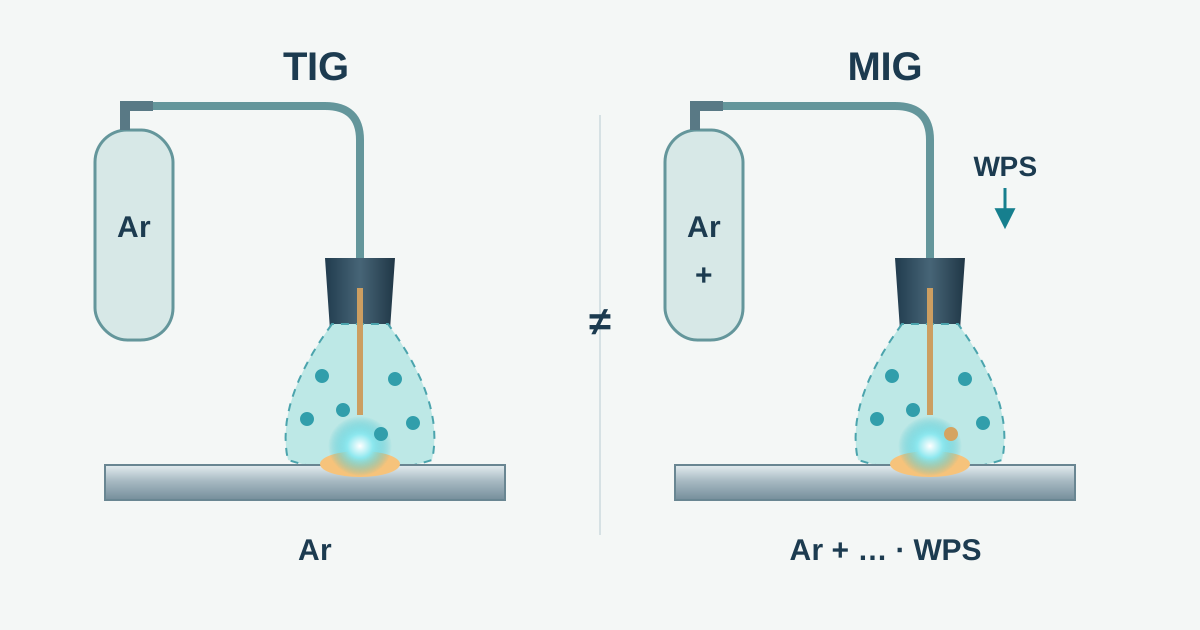
For TIG on common stainless work, argon is the standard starting shielding gas. Helium or argon-helium mixtures may be used where additional heat input or specific procedure behavior is required.
MIG uses a different gas strategy. Stainless GMAW commonly uses argon-rich blends with small additions of CO₂ or O₂, or helium-containing mixtures, depending on transfer mode and procedure. Miller notes that excessive CO₂ can add carbon to the weld and recommends keeping CO₂ low for stainless; its published examples include 98% Ar / 2% CO₂ and tri-mix variants.
Do not copy a carbon-steel MIG gas onto stainless without verification, and do not assume pure argon behaves the same in MIG as it does in TIG. Use the wire manufacturer’s data and qualified WPS.
Filler selection follows the base metal, not the process name
AWS A5.9/A5.9M:2022 covers bare stainless electrodes and rods used in GMAW and GTAW among other processes. The same alloy family can therefore appear as a TIG rod and as MIG wire, but the product form and classification must match the process.
For common austenitic work, ER308L is a frequent starting family for 304/304L and ER316L for 316/316L, subject to the WPS and service. Dissimilar joints, duplex grades, heat-resistant alloys and specialized corrosion service may require different filler logic.
The existing How to Weld Stainless Steel guide owns the broader filler-selection workflow.
Does TIG put less heat into stainless than MIG?
Not automatically. Heat input depends on current, voltage, travel speed, process efficiency, arc time and weld size. TIG gives the operator fine control, but a slow TIG pass can put substantial heat into a joint. A faster pulsed MIG pass may produce lower total heat per unit length in some applications.
For distortion control, compare the qualified procedure and actual joint rather than assigning a universal “hotter” or “cooler” label to the process.
Surface condition and corrosion performance
Stainless weld quality includes more than bead shape. Contamination from carbon-steel tools, inadequate shielding, excessive heat tint and poor root protection can reduce corrosion resistance with either TIG or MIG.
TWI notes that heat tint is associated with a chromium-depleted layer near the surface and can increase susceptibility to pitting/crevice corrosion. Where service requires high corrosion resistance, welding procedure and post-weld cleaning must define the acceptable surface condition.
Productivity: where MIG usually gains
MIG continuously feeds filler and generally achieves higher deposition in manual production welding. This reduces interruptions for adding rod and makes the process attractive for long seams, repeated assemblies and mechanized cells.
TIG can also be mechanized and highly productive in specialized systems, so the comparison is not simply manual TIG versus automated MIG. For a fabrication shop, compare complete cycle time: fit-up, tack time, arc time, repositioning, cleaning, rework and inspection.
Safety and fume control
Stainless welding can generate chromium- and nickel-containing fume; some operations can expose workers to hexavalent chromium. OSHA specifically identifies welding/hot work on stainless as a potential Cr(VI) source.
TIG often generates less particulate fume than GMAW under comparable circumstances, but it can still create ozone and shielding-gas hazards. MIG can produce more fume, especially at higher current and deposition rates. Local exhaust ventilation, procedure-specific exposure controls and applicable workplace rules are required regardless of process.
Which process should you choose?
| Job | Likely starting process | Why |
|---|---|---|
| Very thin visible stainless sheet | TIG | Fine puddle and filler control |
| Sanitary or high-quality pipe root | TIG, unless a qualified GMAW root procedure is specified | Root-profile and purge control |
| Long production seams | MIG | Continuous wire and higher deposition |
| Repeated thin-sheet assemblies | Pulsed/controlled MIG or TIG | Compare qualified parameter window and cycle time |
| Robotic stainless fabrication | Often MIG | Wire-fed process integrates well with automation |
| One-off precision repair | Often TIG | Localized operator control |
Scroll within the table to see all columns →
Bottom line
Choose TIG when precision, root control, thin material or visible finish dominates. Choose MIG when deposition rate, seam length and production throughput dominate. If both can meet the required quality, compare the qualified procedure and total production cycle rather than choosing by reputation alone.
For the complete stainless workflow—grade, filler, contamination, purge, heat tint and cleanup—see How to Weld Stainless Steel .