
Calculator
Choose a material and enter the dimensions of a flat rectangular sheet or plate. Results update immediately. Switching Metric / Imperial converts the entered dimensions; quantity stays unchanged. All imperial dimensions use inches, and weight uses pounds (mass).
Calculate pipe or tube weight → · Calculate steel bar weight →
Formula explanation
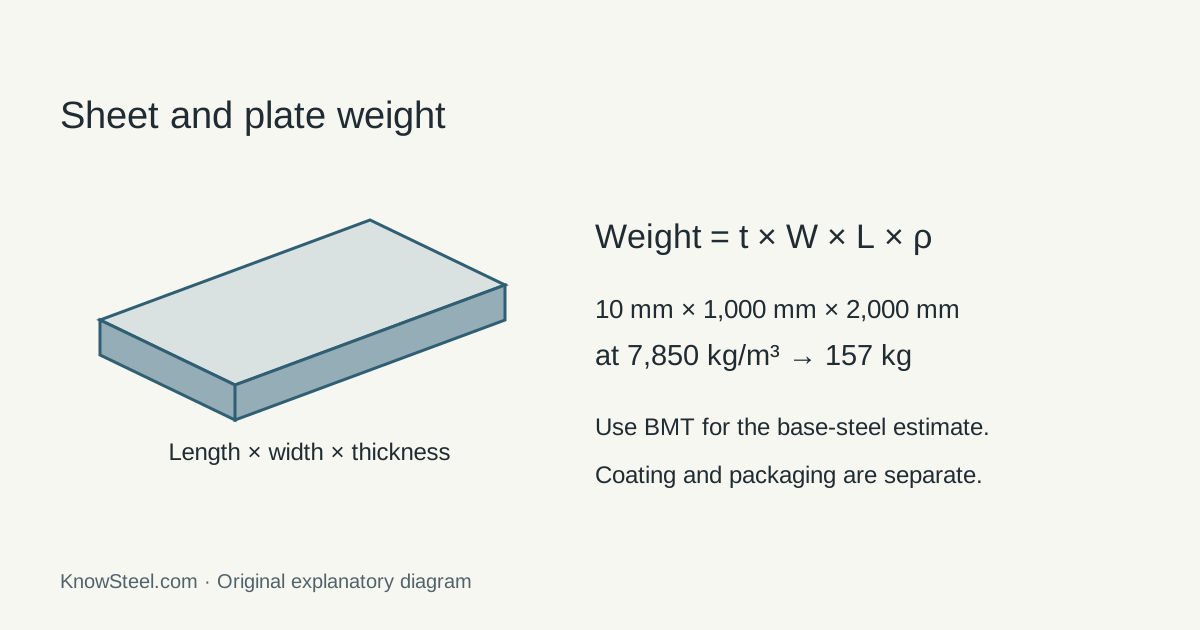
For millimetres, divide each dimension by 1,000 before multiplying. Multiply weight per piece by quantity for total weight. Weight per unit area is thickness in metres × density. Total area is width × length × quantity, measured on one face; it is not the combined area of both faces and edges.
Imperial inputs use 1 in = 25.4 mm and 1 lb = 0.45359237 kg. Area uses 1 ft² = 0.09290304 m². Calculations retain full numerical precision; displayed weight and area usually round to two decimals. Very small or large results use scientific notation. Display precision does not establish manufacturing accuracy.
Typical density table
| Material preset | Density (kg/m³) | Basis and limitation |
|---|---|---|
| Carbon Steel | 7,850 | Typical steel estimate; use actual grade data for precision. |
| Stainless Steel | 7,900 | Representative austenitic sheet value; ferritic and other grades differ. |
| Galvanized Steel | 7,850 | Base-steel estimate only; zinc mass is excluded. |
| Galvalume Steel | 7,850 | Base-steel estimate only; Al-Zn coating mass is excluded. |
| Aluminum | 2,700 | Representative 1050A value; other alloys differ. |
Scroll within the table to see all columns →
Sources: SSAB’s steel material reference gives an approximate steel density of 7.85 g/cm³. Outokumpu’s cold-rolled austenitic sheet declaration gives 7,900 kg/m³ at 20°C. Hydro’s 1050A datasheet provides the aluminum reference. These are estimating presets, not a claim that material families share one exact density.
Worked examples
Carbon-steel plate: 10 mm × 1,000 mm × 2,000 mm × 7,850 kg/m³ gives 157.00 kg per plate. Three plates weigh 471.00 kg, cover 6.00 m² of total one-face area and have a mass per area of 78.50 kg/m².
Stainless sheet: 2 mm × 1,000 mm × 2,000 mm at 7,900 kg/m³ gives 31.60 kg per sheet. Five sheets total 158.00 kg, with 15.80 kg/m² and 10.00 m² of area.
Imperial carbon-steel plate: 0.25 in × 48 in × 96 in at the carbon-steel preset gives 326.71 lb per plate, 10.21 lb/ft² and 32.00 ft². Two pieces total 653.41 lb and 64.00 ft².
Measurement notes
- Use actual thickness when available. A nominal steel gauge thickness is a lookup reference, not a tolerance or measured dimension.
- Use the full rectangular blank dimensions. Holes, edge trims and cutouts reduce the finished weight.
- For galvanized or Galvalume, obtain base-metal thickness separately from total coated thickness. A known total coating mass per area can be accounted for separately using the coating mass converter ; do not add it twice.
- For profiled sheet, use the developed flat blank width, not installed cover width. See the corrugated steel sheet guide .
- Quantity must be a positive whole number; thickness must be smaller than both planar dimensions. Empty, negative and non-finite values cannot produce an estimate.
- Weigh the actual material when planning lifting or checking acceptance. This dimensional estimate is not a lifting rating.
Before calculating material quantity, select a suitable thickness for the load, span and geometry; use the selected actual thickness in the weight calculation.
FAQ
Does steel sheet use a different weight formula from plate?
No. The same rectangular-volume calculation applies when thickness, width, length and density are known. The commercial naming boundary does not change the formula.
Why does my galvanized sheet weigh more than the result?
The galvanized preset estimates the steel substrate only. Zinc coating, actual thickness, grade and packaging can change the measured weight. Enter base-metal thickness and account for known coating mass separately.
Does this calculate stainless steel accurately for every grade?
No. The 7,900 kg/m³ preset is representative of austenitic sheet. The actual grade and temperature determine density; this tool is a reference estimate.
Can I enter a gauge instead of thickness?
First select the material in the gauge chart and find its nominal thickness. For a better weight estimate, use a measured thickness rather than treating the gauge value as exact.
Related tools and steel forms
For wound strip, use the Steel Coil Weight & Length Calculator . Read about hot-rolled sheet and coil , cold-rolled sheet feedstock and steel coil dimensions . Browse all Steel Tools .