
What is the density of steel?
For general steel-weight calculations, 7,850 kg/m³ — or 7.85 g/cm³ — is the most common density used for carbon and structural steel.
That is a useful engineering value, not a universal constant for every steel grade.
Steel density changes slightly with composition. Common stainless steels provide a clear example: 304 is typically about 7.9 g/cm³, 316 about 8.0 g/cm³, while ferritic 430 is closer to 7.7 g/cm³.
For estimating ordinary carbon-steel sheet, plate, sections or coil, 7,850 kg/m³ is usually appropriate. For a calculation tied to a specific alloy or stainless grade, use the density published for that material.
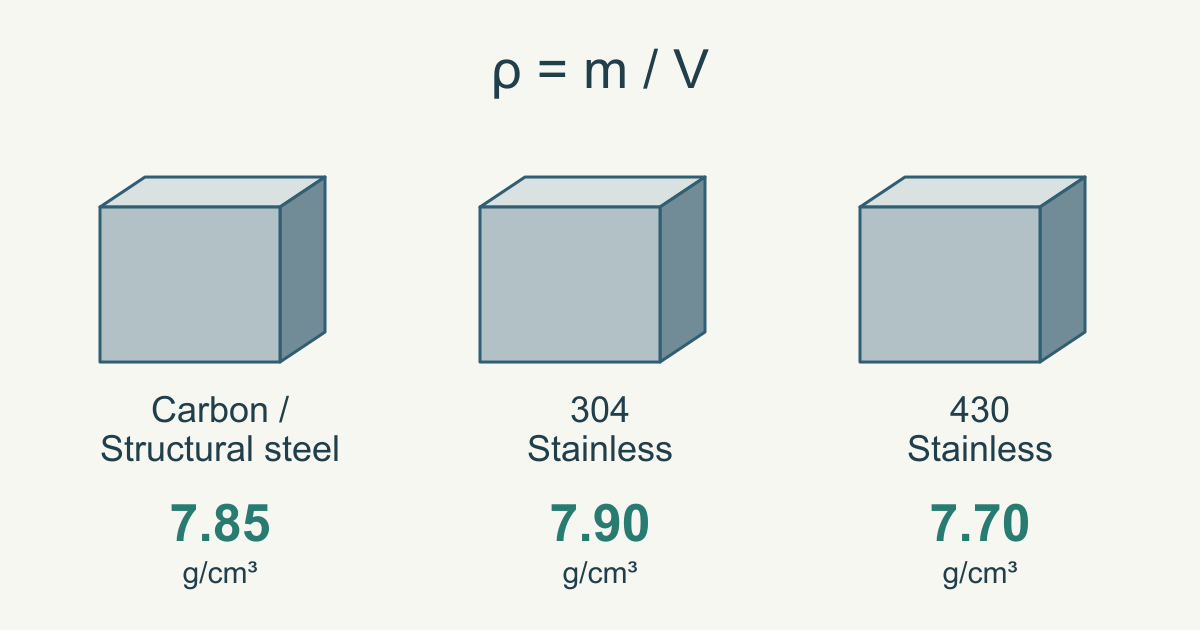
Steel density table
| Steel | kg/m³ | g/cm³ | lb/in³ |
|---|---|---|---|
| Structural / carbon steel — common estimating value | 7,850 | 7.85 | 0.284 |
| AISI 4140 alloy steel | 7,850 | 7.85 | 0.284 |
| 304 stainless steel | 7,900 | 7.90 | 0.285 |
| 316 / 316L stainless steel | 8,000 | 8.00 | 0.289 |
| 430 stainless steel | 7,700 | 7.70 | 0.278 |
| 17-4 PH stainless steel | 7,800 | 7.80 | 0.282 |
Scroll within the table to see all columns →
These are typical reference values. Material certificates and producer data take precedence when an exact value is required.
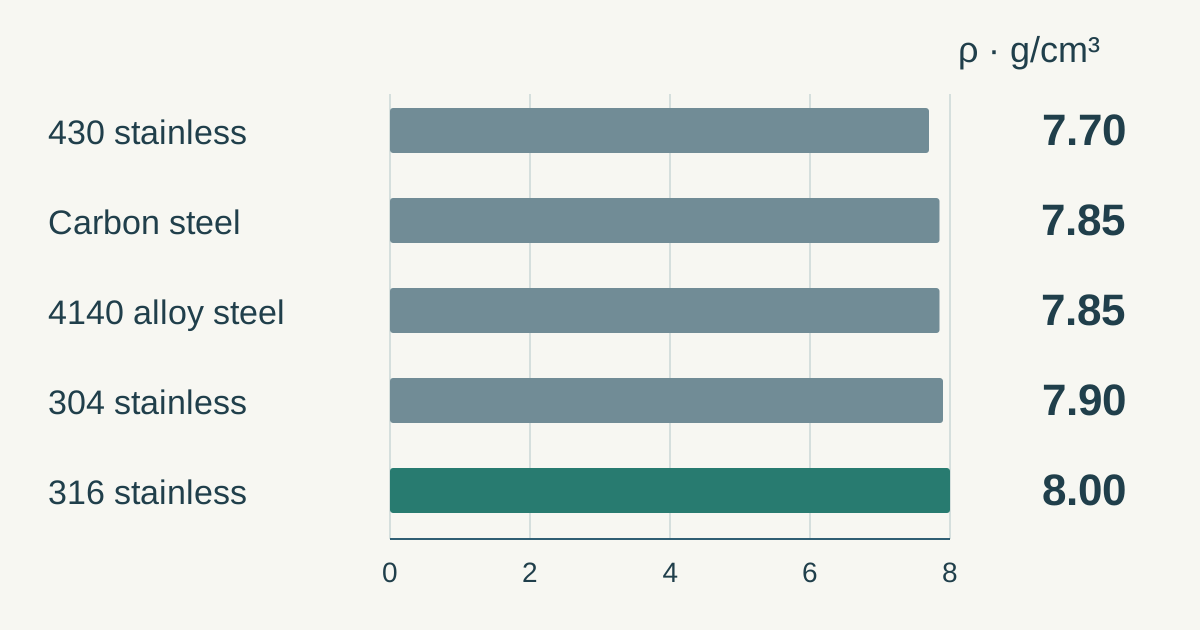
Why steel does not have one exact density
Steel is an alloy rather than a single chemical composition. Carbon, chromium, nickel, molybdenum, manganese and other alloying elements change the mass of a given volume of material.
The difference is modest across many commercial steels, which is why 7,850 kg/m³ works well as a general estimating value.
It still matters at scale.
A stainless grade with a density of 8,000 kg/m³ is about 1.9% heavier than material calculated at 7,850 kg/m³ when the dimensions are identical. Across a large plate order or a long coil, that difference can be significant.
Density should therefore be treated as a material property attached to the grade, not simply to the word “steel.”
Steel density units
Three units appear frequently in steel data:
kg/m³ is common in engineering calculations and SI-based specifications.
g/cm³ is convenient for material-property tables.
lb/in³ is common in US engineering references.
Useful conversions are:
1 g/cm³ = 1,000 kg/m³
7.85 g/cm³ = 7,850 kg/m³ ≈ 0.284 lb/in³
8.00 g/cm³ = 8,000 kg/m³ ≈ 0.289 lb/in³
The numerical value changes with the unit; the physical density does not.
How density is used to calculate steel weight
Density links volume to mass:
Mass = Density × Volume
For a rectangular steel sheet or plate:
Volume = Length × Width × Thickness
so:
Mass = Length × Width × Thickness × Density
If length and width are in metres, thickness is in millimetres and density is in kg/m³:
Mass (kg) = L × W × t × ρ / 1000
For carbon steel using 7,850 kg/m³, this becomes a useful shortcut:
Mass (kg) ≈ L(m) × W(m) × t(mm) × 7.85
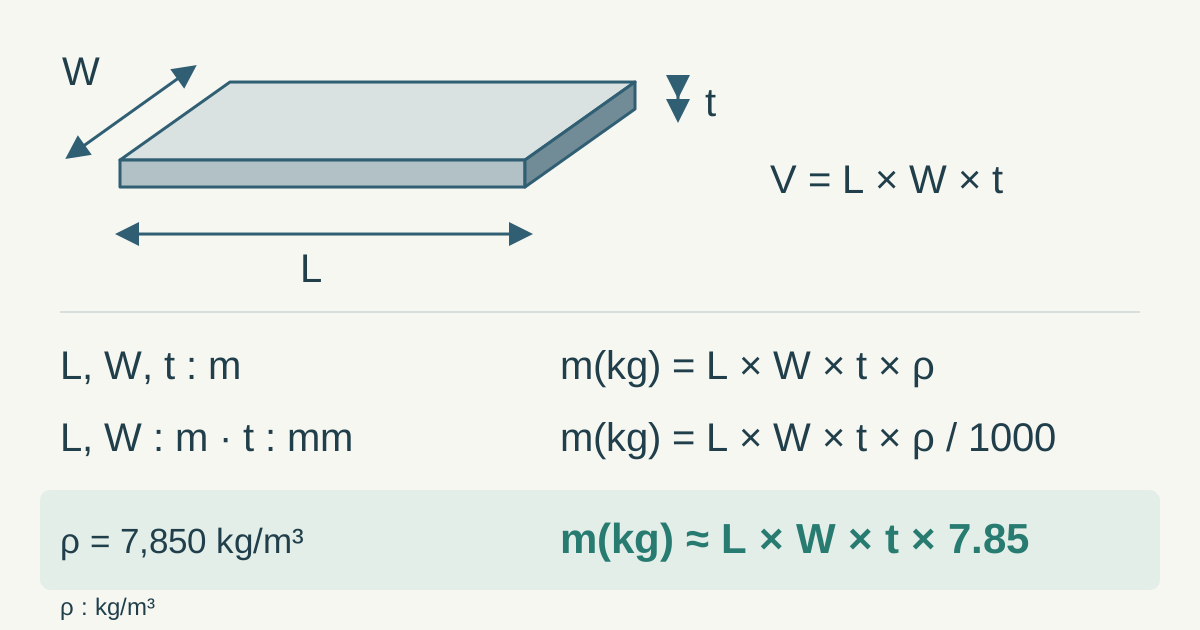
Example: weight of a 1 mm steel sheet
Consider a flat sheet measuring:
2 m long
1 m wide
1 mm thick
For carbon steel:
2 × 1 × 1 × 7.85 = 15.70 kg
Using the same dimensions:
304 stainless at 7.90 g/cm³ ≈ 15.80 kg
316 stainless at 8.00 g/cm³ ≈ 16.00 kg
430 stainless at 7.70 g/cm³ ≈ 15.40 kg
The geometry has not changed. The weight difference comes from density.
For practical calculations, use the Steel Plate & Sheet Weight Calculator .
Density and steel coil calculations
The same relationship applies to coil:
Mass = strip volume × density
For a known strip length:
Mass = length × width × thickness × density
Coil calculations become less direct when the known dimensions are outside diameter, inside diameter and width. The Steel Coil Weight & Length Calculator handles those relationships while keeping the density assumption visible.
For ordinary carbon-steel coil, 7,850 kg/m³ is a sensible default.
For stainless or another alloy, replace the default with the appropriate grade density.
What about galvanized and coated steel?
A density such as 7,850 kg/m³ describes the steel substrate.
Metallic coatings, paint and other surface layers add mass.
For a quick estimate, calculating the base steel from its dimensions and steel density is often sufficient. For purchasing, shipping or specification work where coating mass matters, account for the coating separately rather than changing the density of the steel substrate.
The same principle applies to galvanized, Galvalume and painted sheet: coating mass and base-steel density are separate quantities.
Which density should you use?
Use 7,850 kg/m³ when estimating ordinary carbon or structural steel and no more specific material value is available.
Use the grade-specific density when:
- the material is stainless steel or another defined alloy;
- the result feeds a precise engineering or purchasing calculation;
- a producer datasheet provides a density for the actual grade;
- a small percentage difference becomes important because the volume is large.
For shipping weights and commercial acceptance, calculated weight also remains subject to actual dimensions, thickness tolerances, coating mass and measured net weight.
For material families, see Carbon Steel , Stainless Steel and Alloy Steel . For product dimensions and coating context, see Steel Sheet & Plate , Galvanized steel coil and Prepainted steel coil: PPGI & PPGL .
Frequently asked questions
Is the density of steel always 7,850 kg/m³?
No. It is a widely used value for carbon and structural steel. Stainless and alloy grades can differ.
What is steel density in g/cm³?
A common value for carbon steel is 7.85 g/cm³. Stainless grades are commonly found roughly in the 7.7–8.0 g/cm³ range, depending on composition.
What is steel density in lb/in³?
7,850 kg/m³ is approximately 0.284 lb/in³.
Is stainless steel heavier than carbon steel?
Some grades are and some are not. 304 and 316 are slightly denser than the usual 7.85 g/cm³ carbon-steel assumption, while ferritic 430 is typically less dense.
Does density replace actual weighing?
No. Density gives calculated mass from nominal dimensions. Actual product weight also reflects dimensional tolerances, coatings, trimming and other production variables.