
Zinc-coated strip supplied as coil
Galvanized steel coil is steel strip with a zinc coating, usually applied continuously by hot dipping before the strip is rewound. The steel substrate carries the required mechanical properties. Zinc provides the surface protection. The order therefore needs both a steel grade and a coating designation.
This page decodes the delivered product. The galvanizing guide explains cleaning, coating and finishing operations.
Read the steel and coating separately
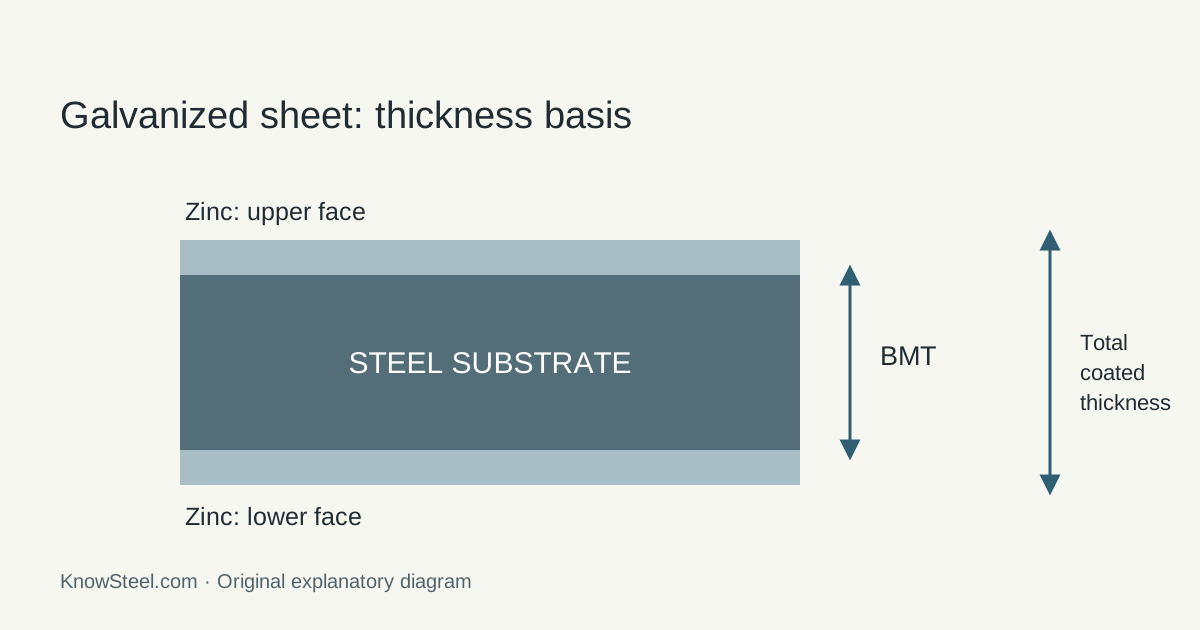
For weight and fabrication, distinguish base-metal thickness (BMT) from total coated thickness. A both-side coating mass is the combined coating on the two faces per unit sheet area. It does not mean that mass on each face or guarantee equal distribution.
G90 and Z275 in context
G90 under ASTM A653/A653M uses an inch-pound coating designation: 0.90 oz/ft² minimum triple-spot average, total both sides. The SI designation Z275 uses 275 g/m² on that basis. Z275 also appears in EN 10346 product literature, with requirements read in that system. GalvInfoNote 2.5, December 2017 provides the ASTM designation context.
The zinc converter gives 0.90 oz/ft² = 274.6366 g/m². That unit calculation explains the close numerical relationship; it does not check the standard’s single-spot, per-side or other acceptance requirements.
Triple-spot and single-spot are separate acceptance checks. Passing an average does not excuse an individual specimen below its required minimum; both-face totals also do not promise equal coatings on each face. Obtain results in the applicable standard’s sampling and unit system. G90 and Z275 are close by unit conversion, but that does not establish ASTM/EN designation equivalence.
ASTM A653/A653M-25a and the general requirements in A924/A924M-26 are the active public entries checked on 18 September 2026. The latter’s thickness basis includes base steel and metallic coating. If BMT is a design requirement, specify how it will be verified alongside the standard coated-thickness requirement. Use the agreed contract editions and full acceptance tables.
Grade systems and a specification example
EN 10346 includes forming and structural families. For example, DX51D+Z separates a forming grade from a zinc coating suffix; S350GD+Z identifies a structural coated grade. ASTM A653/A653M uses its own commercial, forming and structural designations; JIS G 3302 uses another system. SSAB’s EN coated structural reference identifies its structural grades and delivery options.
| Entry | Interpretation |
|---|---|
| DX51D+Z275 / EN 10346 | Forming grade plus the chosen zinc coating designation; state edition. |
| 0.80 mm BMT × 1,000 mm | Substrate thickness and coil width; specify tolerances and edges. |
| Minimized spangle; named surface quality | Appearance and surface acceptance requirements. |
| Skin passed; oiled; painting planned | No chemical passivation unless separately approved by the paint line; name oil, surface quality and pretreatment compatibility. |
| ID 508 mm; OD ≤ 1,500 mm; maximum 5 t net | Illustrative receiving-line limits; dry protective packing, coil winding/eye orientation agreed with the receiving line. |
| Inspection record with coil ID | Connect grade, coating test and dimensions to the delivered coil. |
Scroll within the table to see all columns →
These are example order fields, not stock availability. The steel coil decoder shows how inspection and handling fit into the complete order.
Spangle, passivation and oiling
Spangle is the visible crystallization pattern in a solidified metallic coating. Regular or minimized spangle describes appearance; coating mass requires measurement. Skin passing and surface quality requirements can matter when a smooth painted appearance is needed.
Passivation and oiling are separate choices. Chemical treatment can limit storage staining; oil may serve transport protection or forming. The supplied treatment must be compatible with subsequent painting, bonding or conversion coating. ArcelorMittal’s E20 product reference lists producer surface and treatment options.
Galvanized versus galvannealed
Galvannealed strip receives additional heating after zinc coating so iron diffuses into the coating. The resulting zinc-iron surface differs from conventional galvanized zinc. It is often selected for painted products, but coating powdering during demanding forming is a separate consideration. GalvInfoNote 1.3 explains that product and its forming behavior.
Forming, painting and exposure
For drawing or bending, select the substrate grade first, then check the coating response at the proposed strain and bend radius. Add lubrication, tooling and surface-mark limits to the process trial. For painting, specify cleaning, pretreatment, primer and finish as a compatible system; a passivated coil may require preparation different from an untreated paint-line substrate.
Compare galvanized and Galvalume for coating and exposure choices. For factory-painted steel, use the PPGI / PPGL reference . For profiled roofing, material approval sits within the complete panel system , including cut edges and fasteners.