
Slit strip and precision strip
Steel strip is flat steel specified by width, thickness, edge and delivered condition, often wound into a coil. Slitting cuts a wide coil into narrower bands. A precision-strip specification can add tighter dimensional and temper requirements beyond the fact that a coil has been slit.
ASTM A109/A109M-25 , checked active on 18 September 2026, covers cold-rolled carbon strip with closer tolerances than sheet and specified temper, edge or finish. Its SI scope lists width over 12.5 to 600 mm and thickness 7.6 mm and under. That is this standard’s product scope, not a global definition of steel strip. It also addresses wider products supplied by agreement but technically classified as sheet. The contract edition and full tables govern acceptance; ordinary slitting does not establish precision-strip compliance.
Slit, deburred and rounded edges
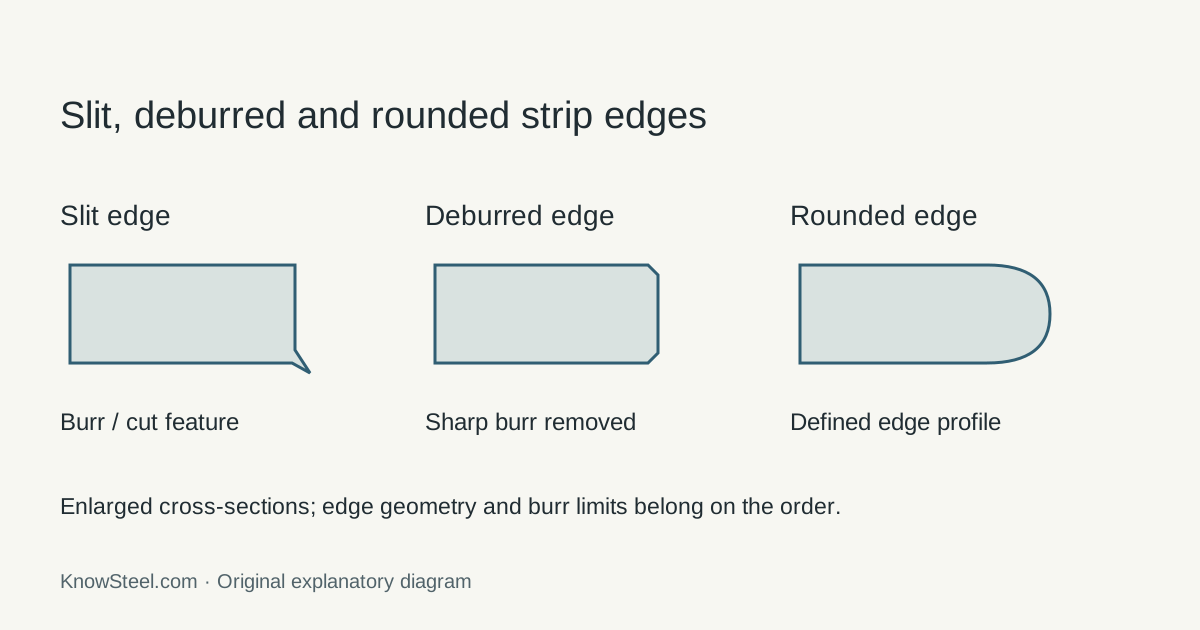
| Edge | Record | Reason |
|---|---|---|
| Slit | Maximum burr, burr orientation and permissible edge damage | Burrs affect feeding, contact surfaces and subsequent forming. |
| Deburred | Residual burr and allowable stock removal | Deburring changes the sharp cut feature and may change usable width. |
| Rounded | Edge profile or radius, dimensional limits | The edge may become a functional contact surface. |
Scroll within the table to see all columns →
Width tolerance and camber
Width tolerance governs fit through guides and the amount of metal entering a die. Camber is lateral curvature measured over an agreed strip length. It differs from out-of-plane flatness and coil set, which is retained curvature from winding.
A useful inspection sketch marks the straight reference line, measured length and maximum lateral deviation. Record those together with the camber limit; a number without the measurement length is ambiguous. Burr inspection likewise needs a face and edge orientation.
Edge wave is an out-of-plane waviness along an edge; coil set is retained winding curvature; camber is curvature across the strip’s length in its own plane. Each needs an agreed measurement length, restraint/support condition and limit. A camber number cannot substitute for an edge-wave test.
On the slitting record, identify the parent heat/coil, daughter-coil number, slit position where relevant, burr face and winding direction. That makes it possible to relate a feed or edge defect back to the delivered strip instead of losing traceability when one coil becomes several.
Temper and surface
For spring strip, the delivered hardness/condition and later heat treatment matter. For drawing strip, forming properties take priority. Specify whether the material is annealed , full hard or another temper, and associate the required test with that delivered state.
Surface texture, coating and oil affect tooling and subsequent finishing. Keep visible-face requirements separate from edge acceptance. Cold-rolled coil explains the reduction and annealing sequence before strip finishing.
Coil handling and a worked width check
A slit coil must fit the uncoiler by ID, OD, width and net mass. Add winding direction, interleaving and packaging where they affect feeding. Labels should identify daughter coils after the parent coil is split.
Geometric example: six strips at 160 mm use 960 mm of a 1,000 mm parent width, leaving 40 mm for the agreed trimming/layout allowance. This arithmetic is a layout check; an actual slitting plan also accounts for incoming width, edges, knife setup and required strip tolerances.
For welded-tube feedstock, match strip width and edges to the forming/welding route. The finished tube specification still governs tube acceptance. Estimate available strip length using the coil calculator and net mass.