
Mill edge and slit edge describe the origin of a steel strip’s longitudinal boundaries. Later processing establishes the delivered finish. A supplier’s name or the coil delivery form leaves both details unresolved.
This comparison concerns the two long sides of flat steel. The steel-strip overview covers the broader product specification; coil slitting explains the production line.
1. Read edge names in their product context
For hot-rolled coil, BlueScope calls untrimmed rolling edges mill edges.
“Mill supplied” describes the source of the material. It leaves open whether that supplier trimmed the edges before delivery. Likewise, “cold rolled” identifies a processing route; it does not tell the reader which operation last formed each longitudinal boundary. Look for an explicit edge condition alongside the product description.
Slit edge indicates a longitudinal cut. Alleima lists slit and deburred conditions separately. Compare the complete descriptions when both contain “slit”.
2. Follow both sides of a daughter strip
MSCI’s process outline describes dividing a master coil into narrower strips. A simple plan-view example shows why the resulting strips can have different edge histories.
Imagine a parent strip with two retained rolling edges and two lengthwise cuts, producing three useful lanes. Assume no side trim. The middle lane has two newly cut boundaries. Each outside lane has one new cut and one retained parent boundary. Calling the complete output “slit material” therefore does not explain both sides of every lane.
Now add a trim cut inside each original outer boundary and remove those two narrow outer margins. All three useful lanes then have two cut sides. This conclusion follows from the stated layout. It does not establish whether a particular production run actually used that layout, or whether its cut edges meet an acceptance requirement.
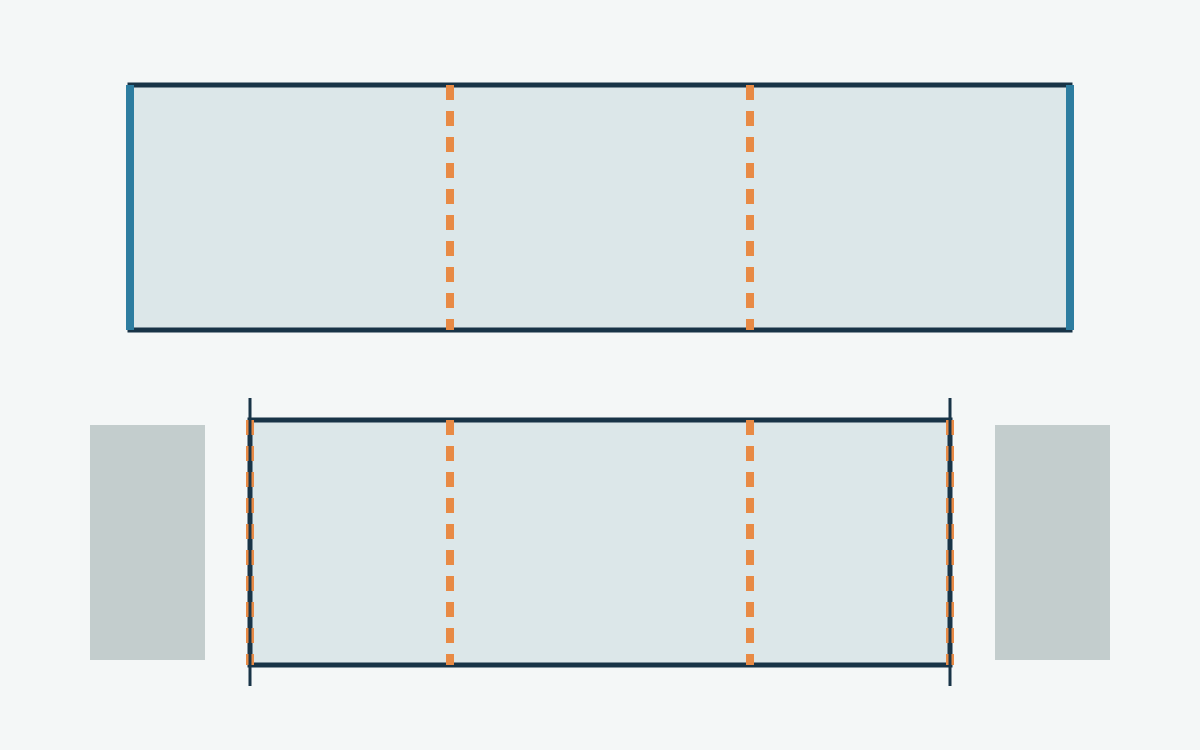
A daughter-coil identifier and its position in the parent layout can make the distinction traceable. A photograph of one side cannot establish the history of the opposite side. For a strip that was subsequently re-slit, start with its immediate parent and follow the latest cuts.
3. Separate longitudinal edges from transverse ends
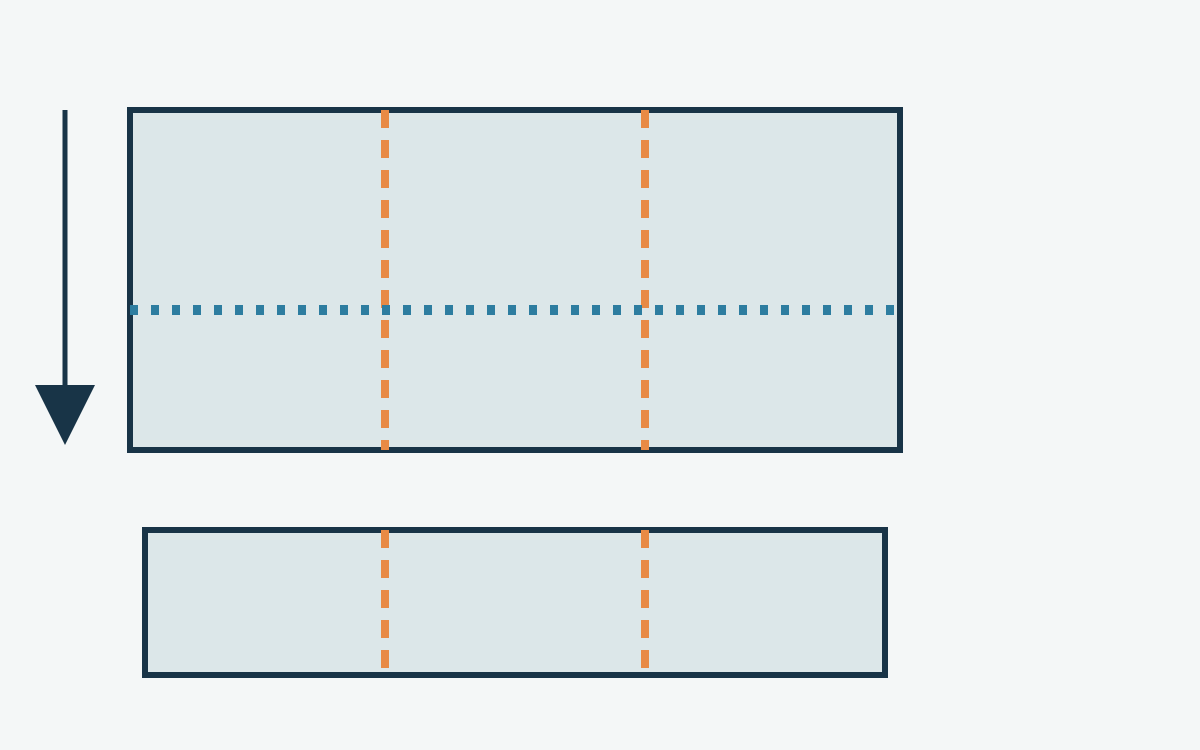
A lengthwise cut creates a side boundary along the strip. A cross-cut creates an end. Cutting coil into sheets can change the number and position of ends while leaving the two long-side histories unchanged.
Consider a sheet cut from the middle lane above. Its two longitudinal sides came from slitting; its two ends came from transverse cuts. A note saying “cut edges” without identifying the relevant sides leaves this distinction unresolved. Turning the sheet on a bench changes the observer’s left and right, so a drawing tied to the rolling or feed direction is clearer than a photograph labelled only “left edge”.
4. Keep origin, finish and acceptance separate
An edge name answers a limited question. Keep its scope separate from dimensional and condition results.
| Description | What it identifies | Still to establish |
|---|---|---|
| Supplier’s edge designation | The category reported for that product. | Meaning, actual condition and suitability. |
| Slit edge | A boundary formed by a longitudinal cut. | Its delivered burr and any subsequent finishing. |
| Deburred after slitting | An additional finishing stage. | The agreed final profile and dimensional results. |
| A width measurement | A result for the measured strip section. | Compliance with the applicable interval and method; other edge properties. |
Scroll within the table to see all columns →
BlueScope notes possible rolling discontinuities on untrimmed HA3 edges. That product warning gives no reason to assume that every mill edge is damaged or that every cut edge is defect-free. Visual appearance alone also leaves the processing history uncertain.
The width-tolerance explanation covers the permitted dimensional interval. An edge label supplies no numerical tolerance, camber limit or permission to ignore a burr. A cut-side description also cannot replace the steel grade designation and its records. No change in bulk grade or mechanical-property guarantee follows from the label alone.
5. Interpret a short label without over-reading it
Suppose one label says “mill edge” and another says “slit, deburred”. The first needs its product terminology and actual edge condition; the second records a cut followed by finishing. Neither label, by itself, establishes that the strip will fit a particular feeder or suit a particular forming operation.
For an ambiguous description, the useful clarification is a drawing or route record identifying both longitudinal sides and any later finishing. Keep width and condition results associated with the same delivered strip. The steel-strip reference provides the specification fields once the terminology is understood.
These examples explain names and geometry. They provide no knife-clearance, burr-height or handling procedure. Inspection must use the authorized safe access arrangement; do not approach moving strip or release a coil merely to identify an edge. Source notes identify the product scopes behind the terminology.