
Material overview
Prepainted steel combines a steel substrate, a metallic coating and an organic paint system. PPGI means prepainted galvanized steel; PPGL means prepainted Galvalume steel. The paint is applied after surface preparation, followed by curing and cooling.
Typical coil coating route
Clean → pretreat → primer → topcoat → oven cure → cool → recoil is a simplified route. On a conventional two-coat/two-bake line, the primer is cured and cooled before the topcoat is applied and cured; the short sequence does not imply that both wet layers always enter one oven together.
Coating structure
PPGI normally uses a galvanized substrate; PPGL normally uses a 55% aluminum-zinc-coated substrate. Record steel grade, metallic coating mass and paint requirements as separate order fields. The Galvalume guide explains the Al-Zn coating family.
On the exposed face, read the structure outward as base steel → metallic coating → pretreatment → primer → topcoat. The back coat is on the reverse face, over that face’s metallic coating and pretreatment, with a reverse primer where the specified system requires it.
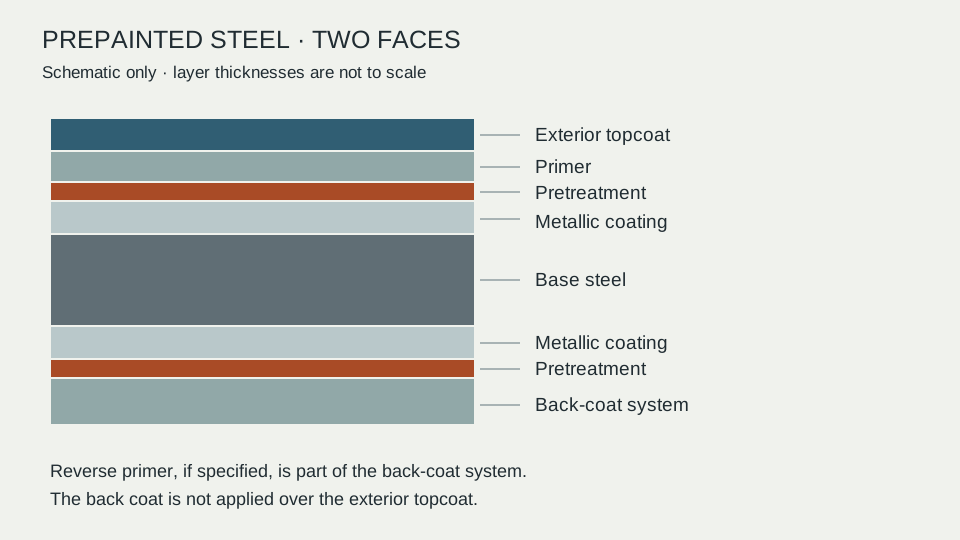
The primer supports adhesion and corrosion protection within the complete paint system. The topcoat supplies the exposed finish and much of its appearance and weathering behavior. The back coat is specified for reverse-face conditions and any bonding or foam adhesion requirements; it must not automatically be treated as an exterior topcoat. Select compatible pretreatment, primer and finish together.
Colors and RAL codes
RAL is a color-reference system. The familiar four-digit codes used for many coated building products belong to RAL CLASSIC; RAL has other collections too. For example, legacy PPGI/PPGL selections include RAL 1015, 3005, 5010, 6005, 7016, 7035, 9002 and 9010. These are examples, not a complete palette or a statement of stock availability.
A RAL code identifies a color reference. It does not specify paint chemistry, dry-film thickness, substrate, metallic coating, gloss, weather resistance or durability. RAL supplies separate physical references for different finish presentations; the color number alone is not a complete finish specification. Agree an approved physical sample, color tolerance, gloss and measurement conditions. Screen colors are not acceptance samples.
Plain terms such as white, blue, grey, red, brown, black and green are broader still. Replace a color-name-only description with an agreed reference and finish requirements, rather than assuming all “blue PPGI” is the same material.
Widths
Common catalogue examples include 600, 800, 900, 914, 1000, 1200, 1219, 1220 and 1250 mm. The legacy width-page inventory also lists 610, 820, 940 and 960 mm. These are nominal size examples, not a standard series, guaranteed availability or interchangeable dimensions. In particular, 1219 mm and 1220 mm must not be silently substituted.
Specify nominal width, tolerance, edge condition, any slit width and the final application. A coil may be slit before forming. For roofing and wall panels, feed width differs from effective cover width; consult the corrugated sheet dimensions guide before calculating installed coverage. The historical sizes are recorded in the site’s local migration audit rather than presented as certified dimensional limits.
Paint systems
The following distinctions concern resin families. Actual performance depends on formulation, pigmentation, curing, film thickness, primer and metallic substrate. There is no universal service life attached to the abbreviation alone.
| System | General distinction | Check for the application |
|---|---|---|
| PE / polyester | A broad family with different interior and exterior formulations. | Specified exposure class, forming requirements and product-specific weathering evidence. |
| SMP | Silicone-modified polyester combines polyester with silicone chemistry; flexibility can differ from conventional polyester. | Bend performance as well as color and gloss retention. |
| PU / polyurethane | Coil-coating systems using urethane chemistry, including polyester systems with isocyanate crosslinking. | The exact formulation, processing compatibility and weathering requirements. |
| PVDF | A fluoropolymer-based paint family used where exterior color and weathering performance matter. | Resin specification, pigments, gloss range, film build and complete-system evidence. |
Scroll within the table to see all columns →
The NCCA topcoat reference, revised April 2021 , explains these resin families. Compare the specified formulation and test evidence when selecting a system.
Dry-film thickness measures the cured organic film in micrometres. State whether a value applies to primer, topcoat, their combined exposed-face total, or the reverse system. Metallic coating mass, commonly stated in g/m², is a separate measurement and must identify its one-side or both-side basis.
Gloss describes surface reflection under specified measurement conditions. Flexibility concerns survival of forming without unacceptable damage. Weather resistance concerns changes during exposure, such as fading or chalking. Record a separate test method and acceptance criterion for each property.
Paint performance: separate controls
| Field | Measurement or control | Put on the specification |
|---|---|---|
| DFT | Cured organic-film build, separate from metallic coating mass. | Primer/topcoat/reverse-side thickness, tolerances and test method. |
| Gloss | Reflection under defined instrument geometry. | Target, allowable variation and measurement angle. |
| Color | Difference from an agreed reference under defined conditions. | RAL collection/code plus approved sample, lighting and color tolerance. |
| Adhesion / flexibility | Coating attachment and survival of bending/forming. | Test geometry, assessment criterion and condition after testing. |
| Weathering | Color/gloss retention, chalking and other changes during exposure. | Method, exposure duration/site, failure criteria and exact paint system. |
| Reverse-side system | Back-face protection and any foam/adhesive compatibility. | Primer/back-coat identity, DFT and intended underside exposure. |
Scroll within the table to see all columns →
A resin abbreviation or RAL code alone supplies none of the complete acceptance criteria.
Specification checklist
| Field | Record or confirm |
|---|---|
| Base steel grade | Grade, mechanical properties and forming requirements. |
| Metallic substrate | Galvanized for PPGI or the specified Al-Zn substrate for PPGL; verify product documentation. |
| Metallic coating designation | Designation, mass, measurement basis and applicable standard. |
| Thickness | Nominal value, tolerance and base-metal versus total-coated basis. |
| Width | Nominal and slit width, tolerances and edge condition. |
| Paint system | PE, SMP, PU, PVDF or other defined system and product specification. |
| Primer | Compatible primer identity and required film thickness. |
| Topcoat | Finish identity and agreed performance requirements. |
| Back coat | Reverse-face system, exposure and bonding requirements. |
| Dry-film thickness | Layer-by-layer and total values for each face, with tolerances and test method. |
| RAL / color | Collection, reference, approved sample and color tolerance. |
| Gloss | Target, tolerance and measurement geometry. |
| Surface protection | Temporary film if required, handling conditions and removal instructions. |
| Application | Exposure, forming, joining and required finished-component performance. |
| Relevant standard | Exact standard and edition, plus separate material and paint-test requirements. |
Scroll within the table to see all columns →
ASTM A755/A755M concerns hot-dip metallic-coated sheet prepainted by coil coating for exterior exposed building products. Do not treat it as blanket equivalence to a JIS, EN or base-steel designation. See steel standards for how to separate these fields.
A complete specification-writing example
Illustrative PPGL request: ASTM A755/A755M-18(2024), with ASTM A792/A792M Type 1 substrate, CS Type B, AZM150; required BMT 0.50 mm × width 1,200 mm, trimmed edges; reconcile coated-thickness acceptance with the applicable A924 requirements. Specify an approved polyester system for the stated exterior exposure: exposed primer 5 µm plus topcoat 20 µm; reverse primer 5 µm plus back coat 5 µm, each with supplier-agreed tolerances and methods. Color RAL CLASSIC 9002 to an approved sample; gloss, color tolerance, bend/adhesion and weathering criteria in the attached paint acceptance schedule. ID 508 mm, OD ≤ 1,500 mm, net coil mass ≤ 5 t, dry protective packing; material/coating inspection record tied to coil identity.
The dimensions and DFT values are illustrative order targets, not industry defaults, stock availability or proof of fitness. The acceptance schedule must contain the actual numeric limits and test conditions before ordering. For PPGI, replace the substrate line with a specified galvanized grade/coating and reconfirm paint compatibility. The A755/A755M-18(2024) entry remains active as checked on 18 September 2026; it is not a 2024 rewrite of every clause. Contract editions and full requirements control acceptance.
Applications and processing
Common applications include building and roofing components, transport, appliances, solar-energy components and furniture. Assess the finished system’s exposure and fabrication needs. Compare the underlying galvanized and Galvalume materials before considering the paint finish.
Use the steel coil reference for dimensional terminology and the Steel Types directory to compare material families.
Practical tools
Use the coating mass converter for mass-per-area units while keeping the metallic coating and paint system separate. Zinc designations apply to the appropriate galvanized substrate, not automatically to PPGL or paint thickness.