
What the name means
Galvalume® is a trademark associated with steel sheet carrying the conventional 55% aluminum-zinc alloy coating. The steel substrate and the metallic coating are separate materials: coating percentages do not describe the steel’s composition or strength. BIEC International identifies GALVALUME as a trademark of BIEC and some licensed producers, and identifies itself as the licensor of the technology.
Generic 55% Al-Zn-coated steel is a chemistry/technology description. A trade name identifies a commercial product; an ASTM number identifies a product-standard scope. Those labels are related but are not interchangeable.
Coating composition
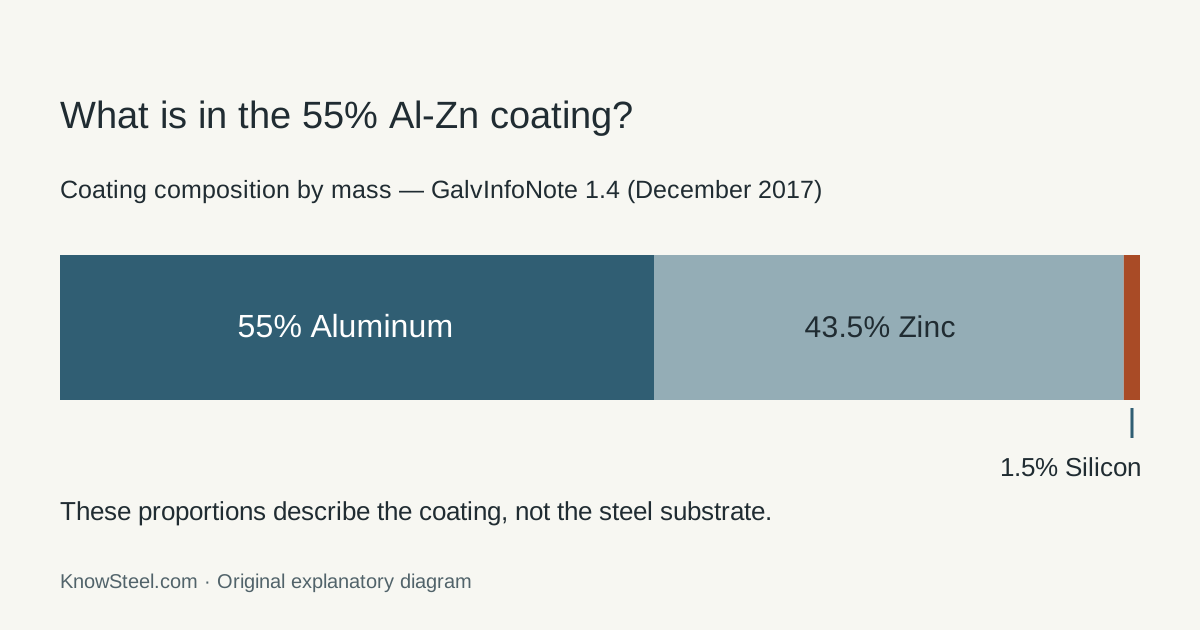
For the conventional coating, GalvInfoNote 1.4, revision 1.2 (December 2017) describes approximately 55% aluminum, 43.5% zinc and 1.5% silicon by mass. These descriptive proportions are not a substitute for contractual composition limits, and do not describe every coating type in today’s A792 scope.
Steel substrate and coating microstructure
The substrate supplies the specified mechanical properties. The solidified coating has aluminum-rich regions and zinc-rich regions between them. This is a distribution of phases within one metallic coating, not a separate sheet of aluminum laid over a sheet of zinc.
Aluminum-rich regions support barrier protection. Zinc-rich regions contribute sacrificial action where steel is exposed. Corrosion products and the exposure affect how the system develops over time. Silicon limits growth of the brittle iron-containing intermetallic layer during hot dipping, helping retain coating adhesion during fabrication; it is not simply an added steel-strengthening ingredient. These mechanisms follow the historical GalvInfo note above and refer to conventional 55% Al-Zn.
Simplified continuous hot-dip production
Prepare strip → clean and condition the surface → enter the molten alloy bath → control coating with gas wiping → cool and solidify → apply the specified surface treatment → recoil. The furnace and preparation route depend on the line and incoming substrate. GalvInfoNote 2.1 explains continuous sheet coating; 55% Al-Zn uses a related line arrangement with the appropriate bath.
Steel grade, thermal processing, coating control and surface treatment therefore solve different manufacturing requirements. Clear resin treatment can aid handling and reduce marking, but does not turn the product into a pigmented prepainted sheet.
How protection works at the face and edge
An intact face benefits from the coating barrier; a cut edge exposes steel. Adjacent sacrificial material can help protect the edge, but the result depends on sheet thickness, edge condition, wetting and drainage. A good result on a broad face does not guarantee a rust-free sheared edge or unlimited protection at a scratch.
Use evidence for the actual product and environment. This article assigns no general “times longer than galvanized” life multiplier. The coating comparison separates intact-face, edge, forming and exposure decisions.
Spangle, heat and appearance
Spangle is a visible solidification pattern. It does not measure coating mass, identify the substrate grade or certify the alloy recipe. Surface treatment and later handling also influence appearance.
The current A792/A792M public scope includes corrosion- or heat-resistance applications. It does not supply a universal maximum service temperature or a roof-energy rating. Solar reflectance, thermal emittance and high-temperature oxidation resistance are different properties. For a heat-reflective roof, obtain measured initial/aged performance for the exact exposed finish and assembly; for hot service, obtain product-specific temperature and duration limits. No unsupported temperature or energy-saving figure is assigned here.
Applications and relation to PPGL
Bare and painted roof/wall panels are established applications. Product suitability still depends on contact materials, underside exposure and installation.
PPGL commonly means prepainted steel with a Galvalume/Al-Zn substrate. Pretreatment, primer, topcoat and a reverse-side system add another protective and appearance specification. The prepainted coil page explains that layer stack.
Current ASTM Type 1 and Type 2 context
ASTM A792/A792M-25a, active when checked on 18 September 2026, covers Type 1: Al-Zn-Si and Type 2: Al-Zn-Mg-Si within its 55% aluminum-zinc family. The -25 scope already included this distinction. Thus “meets A792” alone does not establish conventional Galvalume chemistry or trademark status.
ASTM A1046/A1046M-25a addresses a separate Zn-Al-Mg coated-sheet family. Having magnesium in both descriptions does not merge their scopes. The Zn-Al-Mg material reference separates chemistry, designation and producer brand.
These links identify current public scopes; historical technical notes retain their dates. An order uses its contract-specified edition and applicable referenced requirements. For grade, coating designation, thickness and inspection fields, continue to the Galvalume coil specification page .