
Sheet, plate and coil
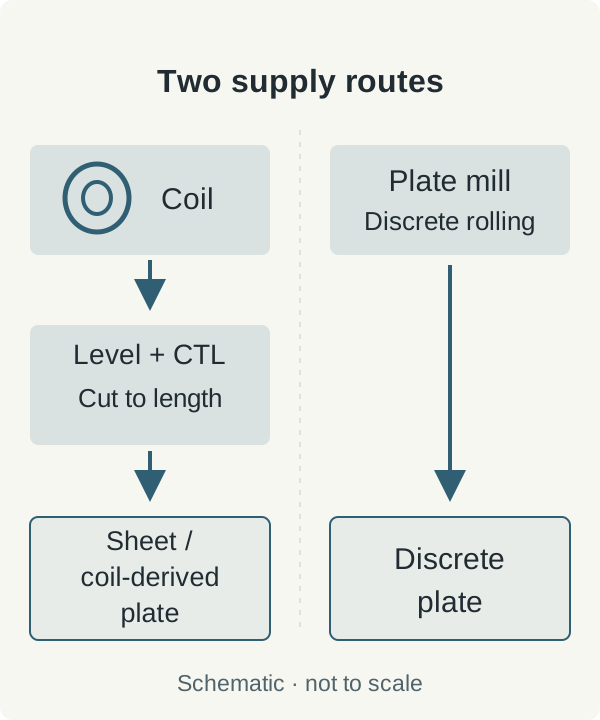
Steel sheet and plate are flat products delivered in pieces; coil is the wound supply form. There is no global sheet/plate thickness cutoff that applies to every standard system. State actual thickness, the product standard and supply route. A cut-to-length line can turn coil into sheet or coil-derived plate; a plate mill produces discrete plate through a separate rolling route.
Form, material and finish describe different dimensions of the order. Hot-rolled or cold-rolled steel can be supplied in coil or cut lengths. Galvanized and prepainted sheet add coating systems. Stainless sheet and plate identify an alloy family as well as a flat form. A coating or the word “plate” alone establishes neither grade nor structural suitability.
Cut-to-length or plate-mill product?
| Route | What happens | Acceptance focus |
|---|---|---|
| Coil-derived sheet | Uncoil → level → cut to length. | Length, flatness, squareness, edges and parent-coil traceability. |
| Coil-derived plate | Thicker strip is levelled and cut under an applicable product specification. | Confirm that the specification accepts this route and delivery condition; thickness alone does not make sheet comply with a plate standard. |
| Plate-mill plate | A plate mill rolls discrete plates, followed by the specified finishing or heat treatment. | Grade, delivery condition, thickness-dependent properties, surface and inspection. |
Scroll within the table to see all columns →
Levelling establishes an incoming shape; cutting and machining can release residual stress. Agree separately whether flatness is checked on the delivered blank or after the customer’s processing.
Thickness, BMT and flatness
Base-metal thickness (BMT) excludes the coatings. Total coated thickness (TCT) includes the specified coating stack; for a painted product, state explicitly whether paint is included in the quoted total. A micrometer reading on the finished surface cannot by itself establish BMT. A gauge number is a material-specific nominal reference, not an acceptance tolerance.
For ASTM continuous metallic-coated sheet, A924/A924M-26 scope 1.8 uses base steel plus coating as its thickness basis. If a drawing needs a particular BMT, reconcile that additional requirement with the product standard and the supplier’s measurement method; do not silently treat a standard nominal thickness as BMT.
For the design decision behind the thickness specification, see how to choose steel sheet thickness ; then confirm the thickness basis and tolerance.
See steel sheet thickness and tolerances for the distinction between nominal, measured and minimum thickness.
From drawing to material specification
| Drawing need | Material specification field | Acceptance question |
|---|---|---|
| A 1.0 mm formed wall | Product grade, thickness basis and tolerance | Which measurement position and tolerance document apply? |
| Blank fits a fixture | Width, length and squareness | What are the allowed deviations and measurement method? |
| Flat support surface | Flatness and delivery condition | Measured unrestrained on delivery, or after cutting/machining? |
| Safe, formable edges | Mill, trimmed or processed edges; burr limit | Which face carries the burr; is edge damage acceptable? |
| Painted visible face | Surface quality, roughness where functional, coating and oil | Will preparation remove the oil; which marks remain unacceptable? |
| Load-bearing plate | Grade, section, rolling/heat-treatment condition and inspection | Do the material record and tests match the designed condition? |
Scroll within the table to see all columns →
A product standard defines the material/product requirements; a dimensional standard supplies the applicable dimensional and shape tolerances. For example, EN 10130 and EN 10131 serve these respective roles for relevant cold-rolled sheet. Plate and metallic-coated sheet use other documents. ASTM A1008/A1008M-26 is a cold-rolled sheet specification; A568/A568M-25a supplies general requirements for applicable uncoated sheet. These are the active ASTM entries checked on 18 September 2026. Public scopes establish coverage, not every acceptance limit; the contract records its agreed editions and referenced requirements.
For the full workflow from these fields to an agreed order, use the steel sheet and coil specification guide .
How to specify a steel sheet or plate
Illustrative sheet specification: DC01 to EN 10130, cut-to-length cold-rolled sheet, 1.0 × 1,000 × 2,000 mm; annealed and skin passed, oiled, trimmed edges; EN 10131 dimensional/shape requirements with the selected tolerance class and surface quality recorded; bundle linked to the coil inspection record. SSAB’s DC01 product data verifies the grade/product-standard and EN 10131 context; its availability limits are producer-specific.
Illustrative discrete-plate specification: S355J2+N to EN 10025-2, 12 × 1,500 × 3,000 mm; normalised or normalising-rolled delivery under the specified +N requirements; EN 10029 dimensional/shape tolerance choices recorded; agreed edge preparation and EN 10163-2 surface class; heat/plate identity and agreed inspection certificate. SSAB’s S355J2+N plate data supports this grade, condition and plate-standard context. Its extra guarantees do not become requirements for every S355J2+N product.
These are specification-writing examples, not stock availability or completed design approval. The drawing must supply the final tolerance classes, tests and contract editions. Do not substitute a coil-derived product for discrete plate solely because nominal dimensions match.
From a drawing to a material quantity
Allow for trimming, cutting kerf and machining before estimating quantity. A finished 980 × 1,980 mm panel can start from a larger purchased blank; calculate incoming mass from the purchased dimensions. The plate weight calculator uses thickness × width × length × density, with coating, holes and packing considered separately.
Continue to steel coil for ID, OD and net mass, steel strip for slit edges and camber, or standards for the distinction between material, coating and test documents.