
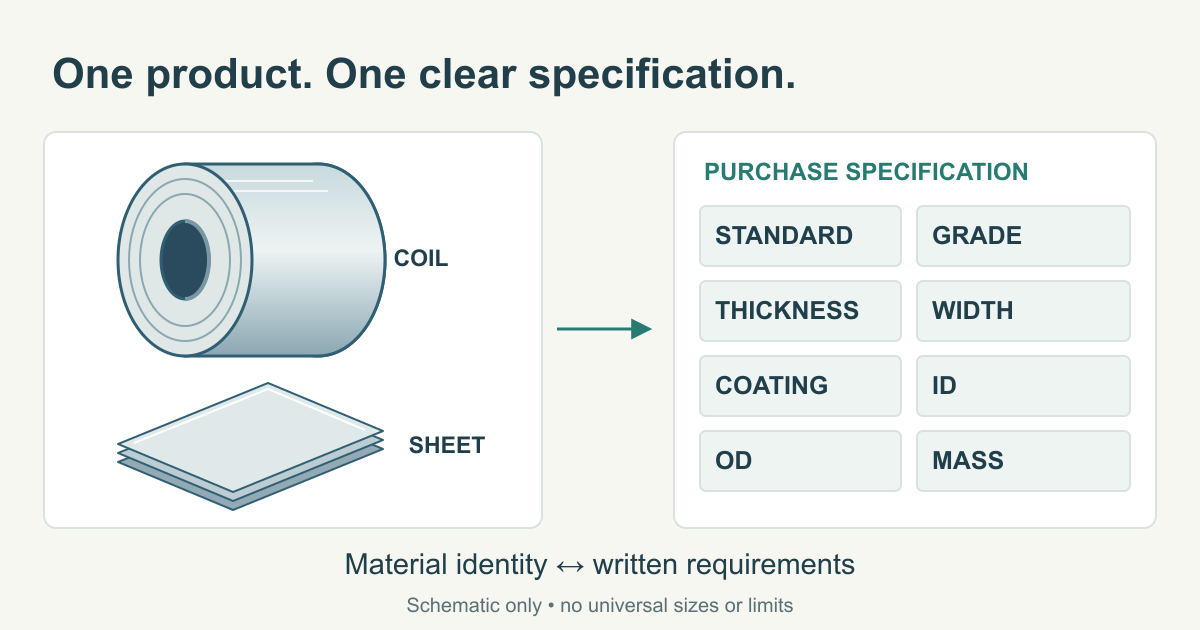
As an illustrative example, “galvanized steel coil, 0.8 mm × 1,000 mm, Z275” sounds specific, but it is still an incomplete purchase specification. The values are examples, not stock sizes or universal recommendations.
It does not identify the base-steel grade, the governing product standard, the thickness basis and tolerance, surface treatment, coil handling limits or inspection documentation. Two suppliers can therefore quote material that appears similar on paper but differs in formability, dimensions, coating condition or suitability for the receiving equipment.
A useful steel sheet or coil specification should let four teams interpret the same requirement consistently:
- the designer or process engineer;
- the purchaser;
- the steel mill or service centre;
- the receiving and quality team.
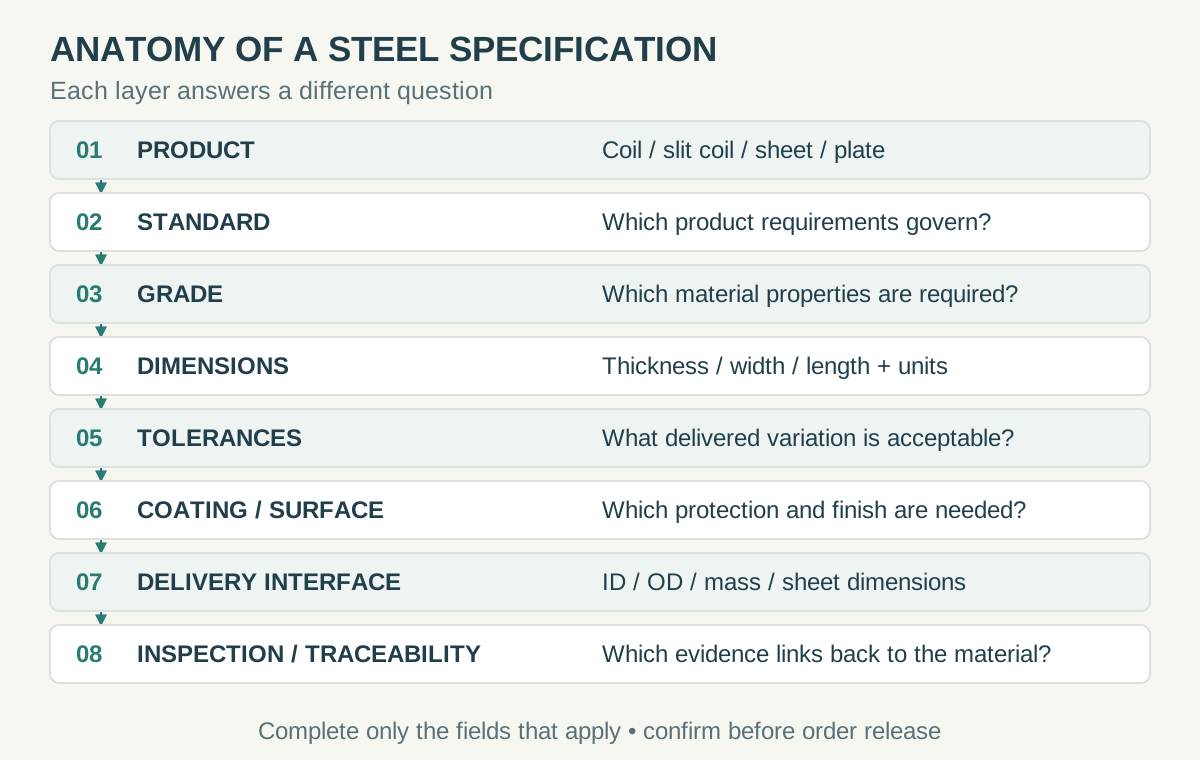
The practical approach is to build the specification in layers:
product → product standard → grade → dimensions → tolerances → coating and surface → delivery requirements → inspection documentation → traceability
Start with the product you actually need
Begin by identifying the delivered product rather than only the material family.
“Carbon steel” describes a material family. “Galvanized” describes a coating system. Neither one tells the supplier whether you need a master coil, slit coil, cut sheet or plate.
Record the supply form first.
| Supply form | Dimensions that normally matter | Additional questions |
|---|---|---|
| Master coil | Thickness, width, ID, OD and coil mass | Can the receiving line handle the coil? |
| Slit coil | Thickness, slit width, ID, OD and mass | Edge condition and camber may matter |
| Cut sheet | Thickness, width and length | Flatness, squareness and burr condition may matter |
| Discrete plate | Thickness, width and length | Plate standard, delivery condition and edge preparation may apply |
Scroll within the table to see all columns →
A coil specification should not simply be copied into a cut-sheet order after changing the quantity. The supply form changes both dimensional requirements and acceptance criteria.
For the distinction between coil, sheet and plate, see Steel Coil and Steel Sheet & Plate .
Steel sheet and coil specification checklist
A complete specification requires every field that can change whether the delivered material works in the intended process.
Use the following twelve-field structure as the main checklist.
| Field | What to state | Why it matters |
|---|---|---|
| 1. Supply form | Coil, slit coil, sheet or plate | Defines the delivered product |
| 2. Product standard | Standard and agreed edition | Establishes the applicable product requirements |
| 3. Grade | Exact grade or designation | Defines material properties within that standard |
| 4. Thickness | Nominal value, units and thickness basis | Prevents substrate / coated-thickness ambiguity |
| 5. Width / length | Nominal dimensions | Must fit processing and final blank requirements |
| 6. Tolerances | Applicable document and class where required | Nominal dimensions alone do not define acceptance |
| 7. Edge / shape | Mill edge, trimmed edge, flatness, squareness or camber where relevant | Affects downstream processing |
| 8. Metallic coating | Coating type and designation | Corrosion protection is separate from steel grade |
| 9. Surface / paint | Surface condition, oil, passivation, paint system or visible face | Affects forming, painting and appearance |
| 10. Coil handling limits | ID, maximum OD and maximum net mass | Determines compatibility with the receiving line |
| 11. Inspection | Required inspection document and test evidence | Defines the evidence supplied with the material |
| 12. Packaging / marking | Protection, labels, traceability and special handling | Maintains material identity through transport |
Scroll within the table to see all columns →
The checklist becomes shorter when a field genuinely does not apply.
For example, a cut sheet does not need a coil ID, while a coil entering an uncoiler may require ID, maximum OD and maximum mass to be stated independently.
A standard number is not a complete material specification
One of the most common purchasing errors is treating a standard number as if it were the material grade.
Different documents perform different jobs.
A product specification identifies a family of products and the requirements applicable to its grades.
A general or dimensional specification can establish dimensions, tolerances, tests or other common requirements.
An inspection-document standard defines the type of evidence supplied with the material.
For example, ASTM A1008/A1008M covers cold-rolled steel sheet product categories, while ASTM A568/A568M provides general requirements for applicable hot-rolled and cold-rolled sheet.
Writing only:
ASTM A568 steel
therefore does not identify the actual cold-rolled grade required.
The same principle applies when working with EN or JIS systems.
Use the Steel Standards directory to identify the function of each standard before building the order.
Keep the standards framework internally consistent
Start with one governing product route.
Then add the dimensional, inspection and purchaser-specific requirements that apply to that route.
Where requirements from different standards systems are intentionally combined, record exactly which requirement comes from which document and obtain supplier agreement before release.
Similar grade names, chemistry ranges or mechanical values do not by themselves create contractual equivalence.
Specify the grade for the application
After selecting the product family, state the actual grade.
“Cold rolled steel” still leaves unanswered whether the part requires:
- commercial forming performance;
- drawing or deep-drawing behaviour;
- structural strength;
- high-strength low-alloy performance;
- a particular stainless grade;
- another application-specific property.
A supplier should be able to identify the required grade directly from the order.
Coating and grade remain separate fields; see the zinc-coated product source notes .
Two galvanized coils with the same coating designation can use different substrate grades intended for different forming or structural requirements.
When material behaviour controls the design, specify the grade before cosmetic preferences or packaging.
State thickness with its measurement basis
Thickness is easy to write and easy to misunderstand.
For uncoated sheet, record:
nominal thickness + units + applicable tolerance
For coated sheet, determine how the governing product system defines the specified thickness.
Under ASTM A924/A924M general requirements for continuously hot-dip metallic-coated steel sheet, the specified thickness basis includes the base steel and metallic coating.
A design requirement expressed as base-metal thickness (BMT) is therefore a separate requirement that needs to be reconciled with the governing specification and agreed measurement method.
A finished micrometer reading on a coated product represents the finished section at the measurement point and should be interpreted according to the governing specification and measurement method.
For prepainted material, the finished section may include:
steel substrate
- metallic coating
- pretreatment
- primer
- topcoat or back coat
If the design requires a particular substrate thickness, state that requirement explicitly and define how compliance will be demonstrated.
For the design process that determines the required thickness, use:
How to Choose Steel Sheet Thickness for Your Application
Nominal dimensions need tolerances
The illustrative dimensions “1.00 mm × 1,000 mm” define nominal steel sheet dimensions. Steel sheet tolerances define the permitted variation; the example does not prescribe that size.
Acceptance also depends on the applicable tolerance system.
Tolerance requirements may depend on:
- product standard;
- thickness range;
- width;
- supply form;
- edge condition;
- tolerance class;
- purchaser-specific requirements.
For cut sheets, relevant acceptance fields can additionally include:
- length;
- flatness;
- squareness;
- edge condition.
For slit material, relevant fields can include:
- slit width tolerance;
- camber;
- edge condition.
Where the governing standard provides suitable requirements, reference the applicable document and class.
Where a project requires tighter or additional limits, record them as purchaser requirements and obtain supplier confirmation before order release.
The nominal dimension states the target; the acceptance requirement defines what can be delivered.
For the concepts behind the order fields, see nominal thickness, tolerance and BMT .
Use one unit system consistently
A specification can become ambiguous when metric and inch-pound requirements are combined without a clear basis.
Where a governing standard provides distinct SI and inch-pound systems, order and evaluate the material according to the selected system.
Use a consistent unit basis for:
- thickness;
- width;
- length;
- tolerances;
- coil ID;
- coil OD;
- mass;
- applicable mechanical-property requirements.
Unit conversion remains useful for communication and calculation.
The purchase specification should preserve the unit basis of the governing acceptance requirements.
Coil dimensions are equipment interfaces
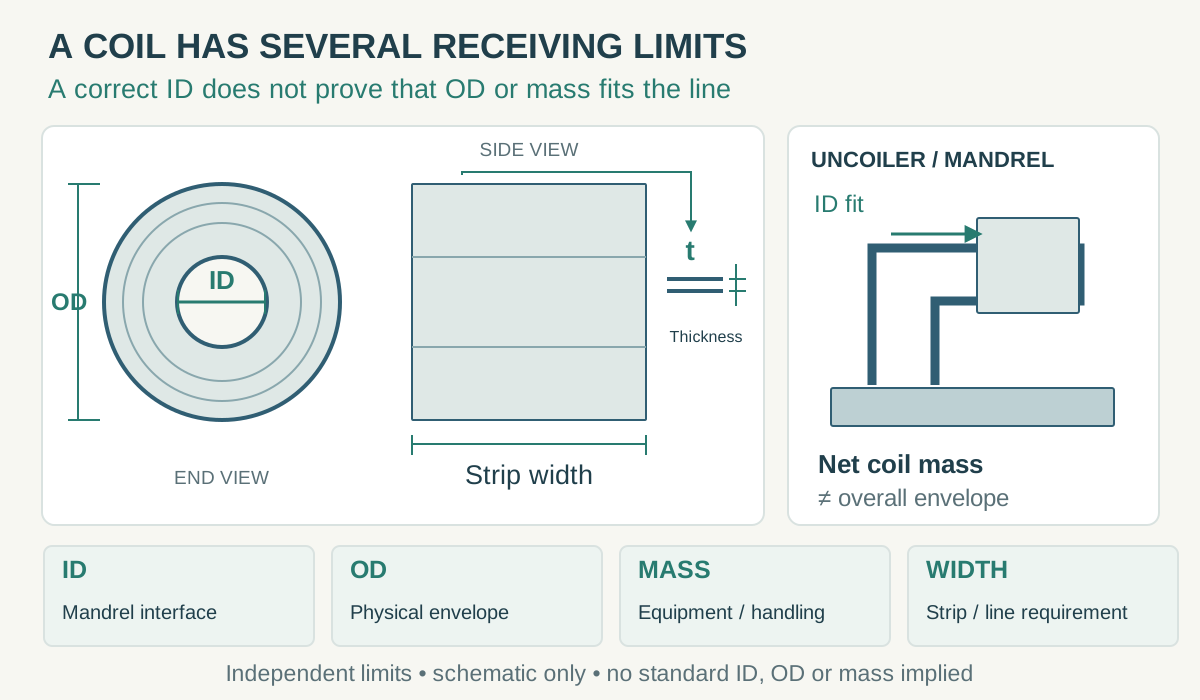
In a steel coil specification, strip dimensions and coil-envelope dimensions perform different jobs. Supplier size lists do not establish universal steel coil sizes; confirm the actual steel coil width and each receiving limit for the order.
Thickness and width describe the strip.
ID, OD and coil mass describe the interface with receiving, lifting, storage and processing equipment.
Treat them as separate requirements.
Coil ID
The inside diameter must be compatible with the uncoiler or mandrel configuration.
Confirm the available supplier ID against the receiving equipment.
Maximum OD
Outside diameter determines whether the wound coil fits the intended:
- uncoiler;
- cradle;
- storage system;
- wrapper;
- processing equipment.
Maximum net coil mass
Mass is another independent limit.
A coil can comply with the OD limit while exceeding:
- uncoiler capacity;
- crane capacity;
- lifting-device rating;
- storage or floor limits.
Record the maximum acceptable net coil mass where equipment capacity requires it.
For relationships between:
- thickness;
- width;
- length;
- mass;
- ID;
- OD
use the Steel Coil Calculator . Calculated relationships do not replace checks against equipment ratings.
Specify coating before appearance
For metallic-coated steel, separate three decisions:
- substrate grade;
- metallic coating system and designation;
- surface treatment or finish.
“Galvanized steel” alone does not define all three.
For prepainted steel, color is only one part of the specification.
Depending on the product and project, a prepainted specification can require:
- substrate grade;
- metallic coating;
- pretreatment;
- primer;
- exposed-face topcoat;
- reverse-side coating;
- color reference;
- gloss where relevant;
- dry-film requirements where applicable;
- protective film where required for fabrication.
A color designation does not by itself define coating chemistry, film build or service performance.
For the underlying material systems, see Prepainted Steel Coil , Galvanized Steel Coil and Galvalume Steel Coil .
Surface requirements should match the next process
Surface requirements should be written around the next manufacturing or service step.
For material that will later be painted, oil and surface treatment affect cleaning and preparation.
For a visible finished panel, surface appearance may become an acceptance requirement.
For stainless sheet, finish and protective film can influence both appearance and fabrication.
For metallic-coated products, temporary protection and surface treatment can affect storage and downstream processing.
Use measurable or identifiable requirements wherever the downstream process depends on them.
Where one face is visually or functionally critical, identify the inspection or exposed face.
Sheet orders and coil orders need different delivery fields
After the common material specification has been defined, complete the fields that depend on supply form.
For cut sheet
Consider:
- width;
- length;
- dimensional tolerances;
- flatness;
- squareness;
- edge condition;
- burr requirement where relevant;
- bundle mass;
- marking;
- surface-facing direction where necessary.
For coil
Consider:
- width;
- width tolerance;
- ID;
- maximum OD;
- allowable coil-mass range where required;
- edge condition;
- winding condition;
- marking;
- packaging and handling requirements.
For slit coil
Also consider:
- slit width;
- slit width tolerance;
- slit edge quality;
- camber;
- winding condition.
The delivery-form requirements convert the material specification into a product that can actually enter the customer’s process.
Decide inspection evidence before placing the order
Inspection documentation should be part of the order requirements.
EN 10204 defines types of inspection documents for metallic products.
Where a project requires a particular inspection document, specify:
- document type;
- material identification;
- required test evidence;
- traceability requirement
with the purchase order.
The inspection document complements the material specification.
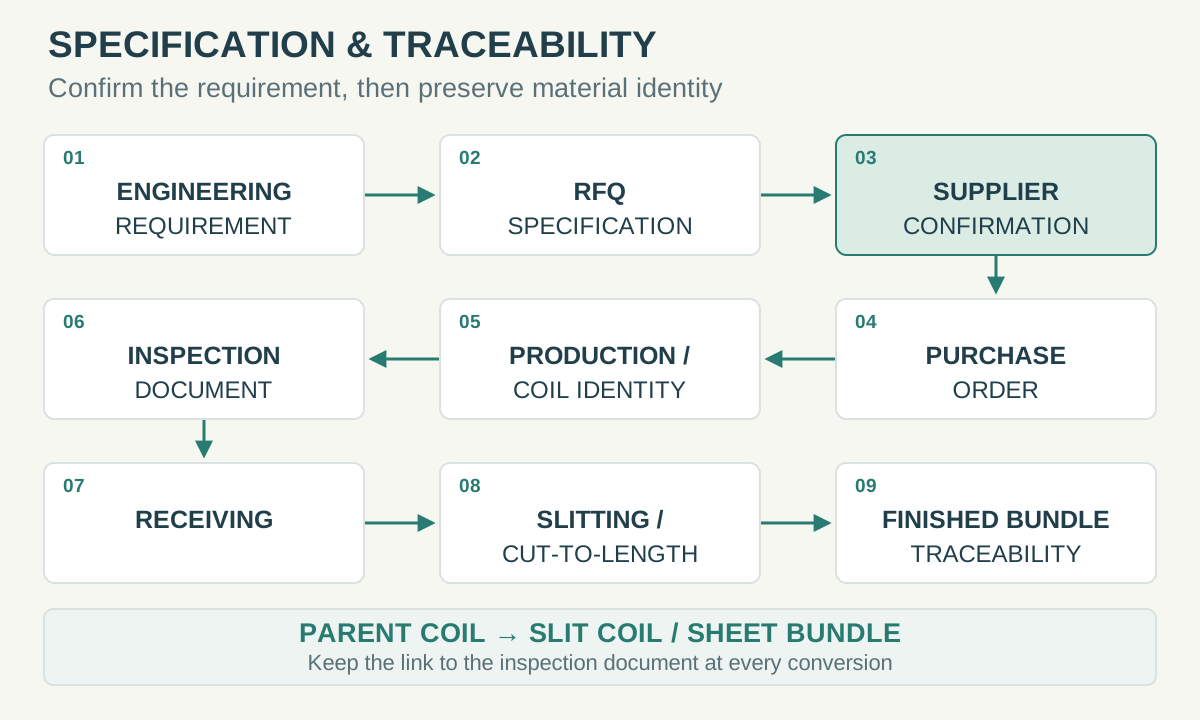
A useful traceability chain is:
purchase order → parent coil / heat identity → inspection document → receiving label → slit coil or cut-sheet bundle
When a master coil is slit or cut to length, preserve the required connection to the parent material.
Inspection evidence becomes useful when the delivered product can be matched reliably to the document.
Use a specification template instead of free-form descriptions
Use a repeatable sheet metal spec for RFQs and purchase orders.
Steel sheet / coil RFQ template
Product / supply form:
[master coil / slit coil / cut sheet / plate]
Product standard and edition:
[standard]
Grade / designation:
[grade]
Nominal thickness:
[value + unit]
Thickness basis:
[governing standard basis / agreed additional requirement]
Width:
[value + unit]
Length:
[for cut sheet]
Dimensional tolerance:
[standard / class / agreed purchaser requirement]
Edge condition:
[mill edge / trimmed / slit / specified processed edge]
Metallic coating:
[type + designation]
Surface treatment / finish:
[required condition]
Paint system:
[where applicable]
Coil ID:
[where applicable]
Maximum coil OD:
[where applicable]
Maximum net coil mass:
[where applicable]
Inspection document:
[where required]
Marking / traceability:
[requirement]
Packaging:
[requirement]
Quantity:
[total mass / number of sheets / number of coils]
This structure works for galvanized, cold-rolled, hot-rolled and stainless steel sheet specifications. Each product needs its own governing standard, properties and surface requirements.
Complete only the fields relevant to the actual product, standard, application and receiving process.
Example: galvanized coil specification
Use the following only as an illustrative specification structure, not an order ready for release. Fill in the actual grade, document editions and agreed limits before ordering:
Hot-dip galvanized forming-steel coil; specified grade to EN 10346; zinc coating Z275; ordered thickness 0.80 mm × width 1,000 mm; dimensional requirements to the applicable EN dimensional framework and selected tolerance requirements; agreed surface treatment; trimmed edges; coil ID and maximum OD matched to the receiving line; maximum net coil mass stated in the order; required inspection documentation defined; coil and document identification linked for traceability.
The values and coating designation are illustrative. The useful part of this example is the sequence:
product → product standard → grade → coating → thickness → width → tolerance → surface → coil interface → inspection
The sequence exposes missing fields before order release.
Example: cold-rolled cut-sheet specification
A cut-sheet order removes coil-envelope fields and adds sheet-specific acceptance requirements.
Illustrative structure:
Cold-rolled steel sheet; specified grade and product standard; 1.00 × 1,000 × 2,000 mm; applicable thickness, width, length, flatness and squareness requirements identified; specified surface condition; trimmed edges; bundle mass and marking defined; required inspection evidence linked to the parent material.
The numbers are examples.
The key is to specify cut sheet as the delivered product.
The downstream processor should not have to infer the finished blank requirements from a master-coil description.
Ask the supplier to confirm the same fields
A supplier quotation becomes technically useful when it confirms the same specification fields used by the buyer.
Compare buyer requirements with supplier confirmation:
| Check | Buyer requirement | Supplier confirmation |
|---|---|---|
| Product / grade | Exact designation | Exact designation |
| Standard / edition | Agreed document | Confirmed |
| Thickness / basis | Defined | Confirmed |
| Width / length | Defined | Confirmed |
| Tolerance | Defined | Confirmed |
| Coating / surface | Defined | Confirmed |
| Coil ID / OD / mass | Equipment limits | Confirmed |
| Inspection | Required document | Confirmed |
| Packaging | Required condition | Confirmed |
Scroll within the table to see all columns →
Resolve substituted, missing or qualified fields before the purchase order becomes the production instruction.
Common specification mistakes
“Galvanized steel, Z275”
This identifies a coating designation but does not identify the complete substrate grade, dimensions, tolerances or delivery requirements.
“0.8 mm steel”
This does not define product form, grade, tolerance or the applicable thickness basis for a coated product.
“ASTM / EN equivalent”
Cross-standard comparison requires checking the requirements relevant to the application.
Record the actual agreed product standard and grade in the order.
“508 mm ID” (illustrative)
An ID requirement defines one equipment interface.
Maximum OD and mass remain separate receiving and handling limits.
“RAL 9016 prepainted steel” (illustrative)
A color reference alone does not define:
- substrate;
- metallic coating;
- paint system;
- film requirements;
- gloss;
- reverse-side coating.
“3.1 certificate required”
Connect the inspection-document requirement to:
- the ordered material;
- required tests;
- material identity;
- traceability chain.
Mixed metric and imperial acceptance limits
Keep the governing dimensional and tolerance requirements tied to their intended unit system.
Use conversions for communication and calculation without silently changing the contractual acceptance basis.
Final specification check
Before sending an RFQ or purchase order, answer five questions.
What exactly is the delivered product?
Coil? Slit coil? Cut sheet? Plate?
Which standard and grade define the material?
Identify both.
Which dimensions and tolerances determine acceptance?
Nominal dimensions alone are incomplete.
Which coating, surface and handling requirements affect processing?
Specify the requirements that affect downstream production or service.
Which records prove that the delivered material matches the order?
Define inspection documentation, marking and traceability.
When these questions have clear answers, engineering, purchasing, supplier production and receiving inspection are working from the same definition.
That is the purpose of a steel specification.
FAQ
What information do I need when ordering steel coil?
At minimum, identify the supply form, product standard, grade, thickness, width, tolerance basis and quantity. Add coating, surface condition, coil ID, maximum OD, maximum coil mass, inspection and packaging requirements where they affect the product or receiving process.
Is a steel grade the same as a steel standard?
No. A product standard can contain several grades or product categories. State the applicable standard and the specific grade or designation required.
Do I need to specify both coil ID and OD?
When the receiving equipment has limits for both, specify both. ID defines the mandrel interface, while OD defines the wound-coil envelope. Coil mass is another independent handling and equipment limit.
Does a coating designation define steel thickness?
No. Coating designation and product thickness are separate specification fields. Interpret the thickness basis according to the governing product specification and any additional agreed substrate-thickness requirement.
What is more important: nominal thickness or tolerance?
They perform different jobs. Nominal thickness defines the target dimension; tolerance defines the acceptable delivered range under the applicable requirements.
When should an inspection document be requested?
Include it in the order whenever the project requires documented material or test traceability. Define the document type and maintain the link between the delivered coil or bundle and its documentation.