
Gauge to mm and inches
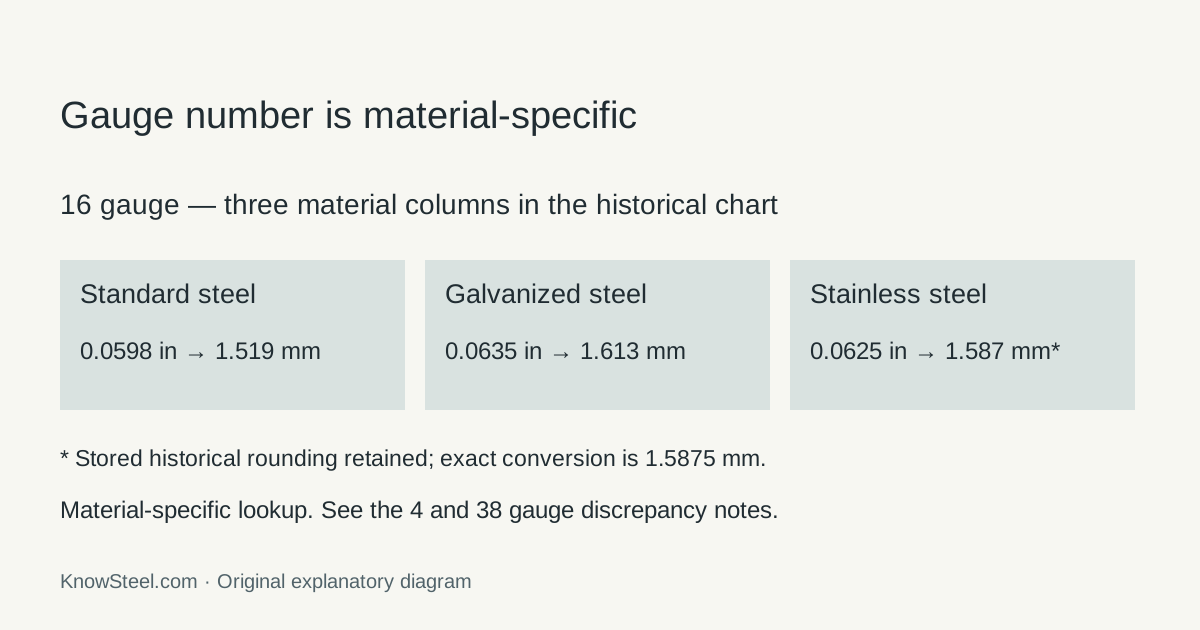
Gauge number is material-specific. In sheet metal, gauge is a designation in a nominal-thickness lookup system. The same number can mean different thicknesses: read down the selected material column.
For the underlying concept, see how sheet-metal gauge relates to actual thickness .
This reference uses the inch values from the legacy Hengze chart. Millimetres are calculated using 1 inch = 25.4 mm, rounded to three decimal places. These are nominal lookup values, not manufacturing tolerances.
For the distinction between a nominal lookup value and an acceptable measured range, see steel sheet thickness tolerances .
16 Gauge to mm / inches
Standard SteelNominal thickness
- Millimetres
- Inches
Choose a material and gauge. No interpolation.
| Gauge | Standard Steel mm / in | Galvanized Steel mm / in | Stainless Steel mm / in | Aluminum, brass, copper* mm / in |
|---|---|---|---|---|
| 3 | 6.0730.2391 in | — | — | 5.8270.2294 in |
| 4 † | 5.6950.2242 in | — | 5.9540.2344 in | 5.1890.2043 in |
| 5 | 5.3140.2092 in | — | 5.5550.2187 in | 4.6200.1819 in |
| 6 | 4.9350.1943 in | — | 5.1590.2031 in | 4.1150.162 in |
| 7 | 4.5540.1793 in | — | 4.7630.1875 in | 3.6650.1443 in |
| 8 | 4.1760.1644 in | — | 4.3660.1719 in | 3.2640.1285 in |
| 9 | 3.7970.1495 in | 3.8910.1532 in | 3.9670.1562 in | 2.9060.1144 in |
| 10 | 3.4160.1345 in | 3.5100.1382 in | 3.5710.1406 in | 2.5880.1019 in |
| 11 | 3.0380.1196 in | 3.1320.1233 in | 3.1750.125 in | 2.3040.0907 in |
| 12 | 2.6570.1046 in | 2.7530.1084 in | 2.7790.1094 in | 2.0520.0808 in |
| 13 | 2.2780.0897 in | 2.3720.0934 in | 2.3800.0937 in | 1.8290.072 in |
| 14 | 1.8970.0747 in | 1.9940.0785 in | 1.9840.0781 in | 1.6280.0641 in |
| 15 | 1.7090.0673 in | 1.8030.071 in | 1.7860.0703 in | 1.4500.0571 in |
| 16 | 1.5190.0598 in | 1.6130.0635 in | 1.5880.0625 in | 1.2900.0508 in |
| 17 | 1.3670.0538 in | 1.4610.0575 in | 1.4270.0562 in | 1.1510.0453 in |
| 18 | 1.2140.0478 in | 1.3110.0516 in | 1.2700.05 in | 1.0240.0403 in |
| 19 | 1.0620.0418 in | 1.1580.0456 in | 1.1100.0437 in | 0.9120.0359 in |
| 20 | 0.9120.0359 in | 1.0060.0396 in | 0.9530.0375 in | 0.8130.032 in |
| 21 | 0.8360.0329 in | 0.9300.0366 in | 0.8740.0344 in | 0.7240.0285 in |
| 22 | 0.7590.0299 in | 0.8530.0336 in | 0.7920.0312 in | 0.6430.0253 in |
| 23 | 0.6830.0269 in | 0.7770.0306 in | 0.7140.0281 in | 0.5740.0226 in |
| 24 | 0.6070.0239 in | 0.7010.0276 in | 0.6350.025 in | 0.5110.0201 in |
| 25 | 0.5310.0209 in | 0.6270.0247 in | 0.5560.0219 in | 0.4550.0179 in |
| 26 | 0.4550.0179 in | 0.5510.0217 in | 0.4750.0187 in | 0.4040.0159 in |
| 27 | 0.4170.0164 in | 0.5130.0202 in | 0.4370.0172 in | 0.3610.0142 in |
| 28 | 0.3780.0149 in | 0.4750.0187 in | 0.3960.0156 in | 0.3200.0126 in |
| 29 | 0.3430.0135 in | 0.4370.0172 in | 0.3580.0141 in | 0.2870.0113 in |
| 30 | 0.3050.012 in | 0.3990.0157 in | 0.3180.0125 in | 0.2540.01 in |
| 31 | 0.2670.0105 in | 0.3610.0142 in | 0.2770.0109 in | 0.2260.0089 in |
| 32 | 0.2460.0097 in | 0.3400.0134 in | 0.2590.0102 in | 0.2030.008 in |
| 33 | 0.2290.009 in | — | 0.2390.0094 in | 0.1800.0071 in |
| 34 | 0.2080.0082 in | — | 0.2180.0086 in | 0.1600.0063 in |
| 35 | 0.1910.0075 in | — | 0.1980.0078 in | 0.1420.0056 in |
| 36 | 0.1700.0067 in | — | 0.1780.007 in | 0.1270.005 in |
| 37 | 0.1630.0064 in | — | 0.1680.0066 in | 0.1130.00445 in |
| 38 | — | — | 0.1570.0062 in | 0.1010.00396 in |
Scroll the table ↔ · Headers stay visible · — means unavailable, not zero.
Choose a gauge to highlight its row.
The converter, chart and CSV use the same stored values. The source inch value is authoritative for this legacy dataset. Millimetres are calculated using exactly 25.4 mm/in; displayed and stored values use conventional decimal half-up rounding to three decimal places. For example, stainless 16 gauge: 0.0625 in × 25.4 = 1.5875 mm → 1.588 mm.
How to read this table
Each cell shows millimetres first, inches below. The unit labels stay with the column headings while you scroll. Choose a gauge above to highlight a row; the entire chart remains available.
For example, the legacy chart gives 16 gauge standard steel as 0.0598 in, equivalent to 1.519 mm after rounding. In the galvanized column, 16 gauge is 0.0635 in, or 1.613 mm. Material selection changes the answer.
* The aluminum, brass and copper grouping is retained from the legacy chart. Confirm the applicable gauge convention for the actual alloy and product. A blank means the source did not supply a value. No engineering tolerance or universal gauge-system authority is implied.
Units and rounding
Inch-to-millimetre conversion is exact at 25.4. Rounding a displayed value does not increase the accuracy of the source. For dimensional acceptance, use an actual thickness, the applicable tolerance and the measurement method from the governing specification.
Do not calculate intermediate gauges by linear interpolation. Gauge steps are a lookup sequence rather than equal intervals.
Choosing a thickness is a separate step from converting a gauge. Use the sheet thickness selection guide to assess load, span, geometry and allowable deflection.
Common questions
What is 16 gauge steel in mm?
In this legacy reference, standard steel is 1.519 mm, galvanized steel is 1.613 mm and stainless steel is 1.588 mm. Always name the material alongside the gauge.
Does a larger gauge number mean thicker sheet?
In the listed systems, a larger gauge generally means thinner sheet. Gauge numbers are not measurements in millimetres.
Can I use the chart as a tolerance specification?
No. It gives nominal reference values. Obtain the thickness tolerance and inspection rules from the relevant product specification.
Download and sources
Download the reference CSV . It includes the source inch values, converted millimetres and notes for each material.
From thickness to coil length
Once you know the actual thickness, use the coil calculator with measured weight and strip width to estimate the available length.
Related steel tools and materials
For cut sheets, use measured thickness in the Steel Plate & Sheet Weight Calculator . Read the galvanized steel overview for the distinction between base metal and coating. For stainless material selection, Outokumpu’s stainless steel reference explains why properties vary by grade. Browse all Steel Tools .