
Sheet-metal gauge is a size designation, not a universal unit of thickness.
A gauge number only becomes useful when you know the material and the gauge or product convention behind it. In the common sheet-metal gauge tables, a higher number usually means a thinner sheet, but the steps are not evenly spaced.
That is why “16 gauge” by itself does not define one physical thickness.
If you already know the material and gauge number and only need the corresponding value, use the Sheet Metal Gauge Thickness Chart . This page deals with the question behind the table: what does the gauge number actually represent?
What does sheet-metal gauge represent?
Gauge is best understood as a position in an established list of stock sizes.
That is also how the historical U.S. Bureau of Standards described the idea. Its 1931 Circular 391 explained that sheet and plate stock could be based on specified thickness or weight per unit area, and that the resulting stock-size list constituted a gauge.
The same publication documented several different gauge systems in use. It even noted that the same type and grade of sheet could sometimes be made to more than one stock-size list.
This historical source describes customary practice rather than a current steel product standard, but it explains an important point that still matters:
a gauge number has to be interpreted in its own system.
A value such as 1.5 mm is a direct dimension. A value such as 16 gauge is a designation that has to be looked up.
Why does a higher gauge number usually mean thinner sheet?
Many familiar sheet-metal gauge sequences run in the opposite direction from thickness:
lower gauge number → thicker sheet
higher gauge number → thinner sheet
The numbering came from established stock-size and weight conventions rather than from a modern linear measurement scale.
As a result, the spacing between gauge numbers is not a fixed thickness increment.
For example:
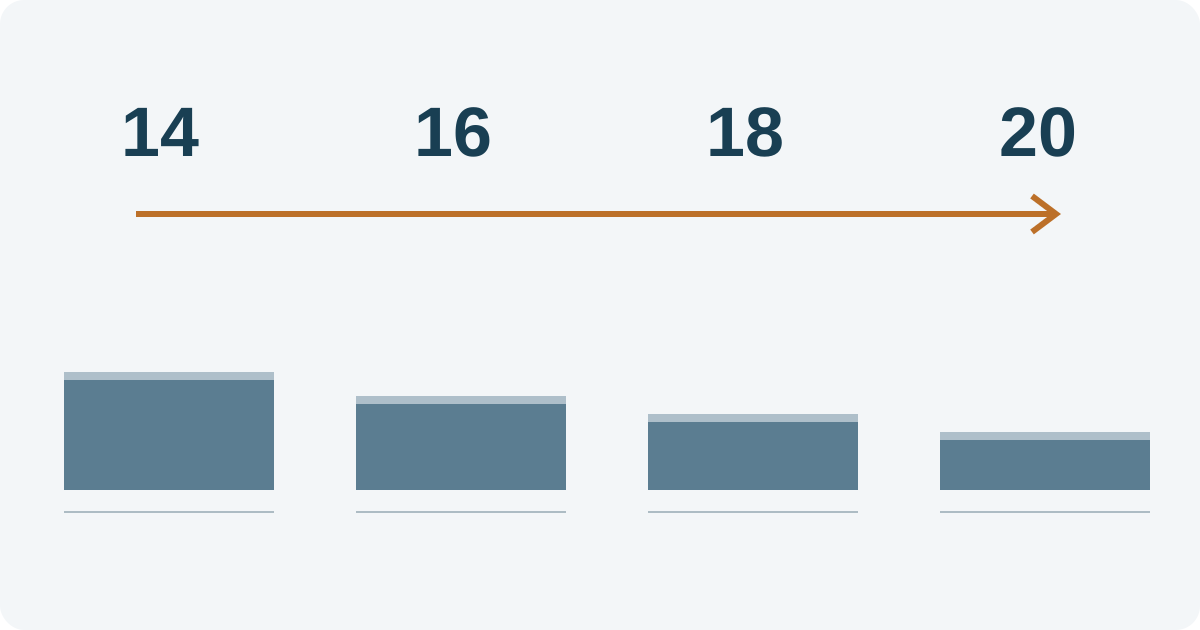
14 → 16 → 18 → 20
describes progressively thinner stock within a given gauge system, but the thickness change between 14 and 16 is not necessarily the same as the change between 16 and 18.
Do not calculate an unlisted gauge by taking the arithmetic midpoint between two neighbouring thicknesses. Use the applicable gauge table.
The same gauge number can mean different thicknesses
Material matters.
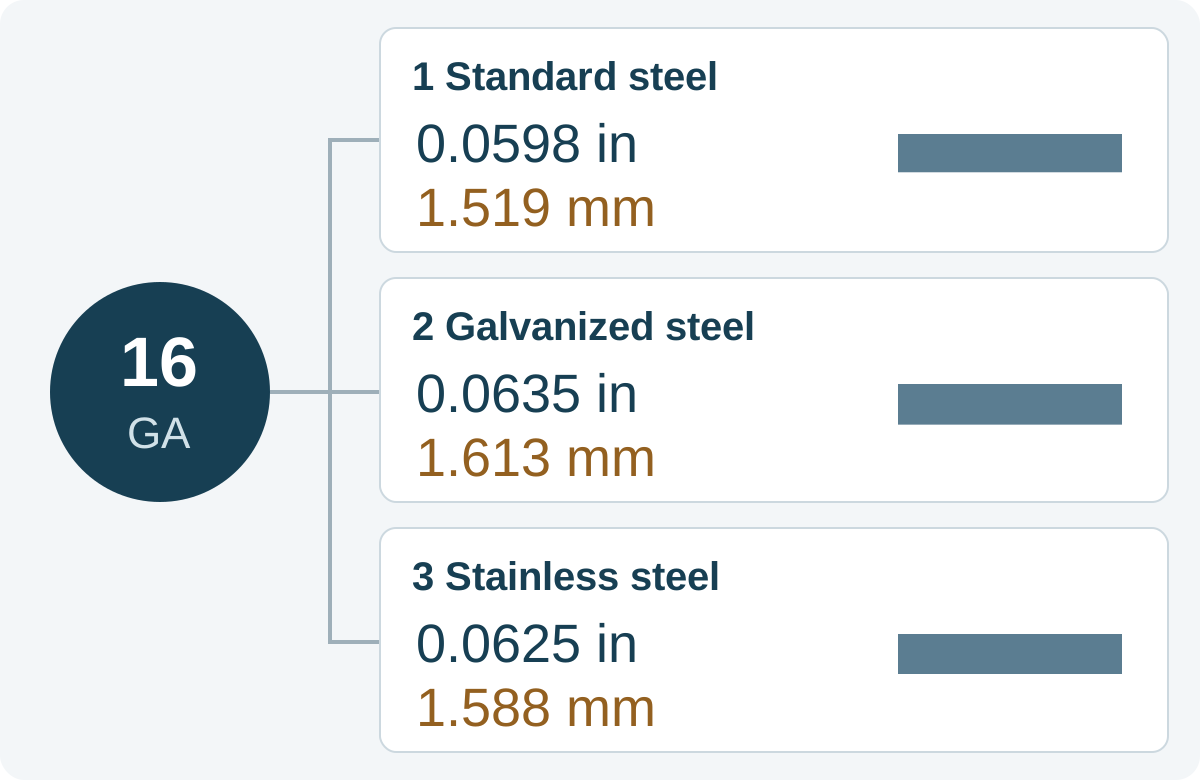
The current KnowSteel legacy reference dataset gives these values for 16 gauge:
| Material | Nominal thickness | Millimetres |
|---|---|---|
| Standard steel | 0.0598 in | 1.519 mm |
| Galvanized steel | 0.0635 in | 1.613 mm |
| Stainless steel | 0.0625 in | 1.588 mm |
These are lookup values from the site’s existing gauge dataset. The millimetre values are calculated from the stored inch values using 25.4 mm per inch.
They are not manufacturing tolerances, and they should not be treated as a universal definition of 16 gauge for every steel product.
The useful lesson from the table is simply this:
a gauge number without a material or defined convention is incomplete.
For the complete dataset and its known source limitations, see the Gauge Thickness Chart and the gauge dataset methodology .
Why can two gauge charts disagree?
Not every chart is based on the same gauge convention.
A clear historical example is the U.S. Standard Gauge table established in federal law. In that table, No. 16 sheet and plate iron or steel is listed at approximately 0.0625 in.
The KnowSteel legacy standard-steel column, by contrast, lists 0.0598 in for 16 gauge.
Those figures should not be forced into one supposedly universal conversion. They come from different gauge conventions.
The distinction is not merely historical terminology. U.S. federal regulations still distinguish between systems such as:
- U.S. Standard Gauge (USSG);
- Manufacturers’ Standard Gauge (MSG);
- American Wire Gauge (AWG).
This is why a technically useful gauge chart should identify its material and source convention rather than present the number as a universal unit.
It is also why copying a gauge value from an unrelated table can produce a plausible-looking but incorrect specification.
Gauge is different from nominal, actual and minimum thickness
Gauge is only one of several thickness-related terms that can appear on drawings, purchase orders and product literature.
| Term | Meaning |
|---|---|
| Gauge | A designation in a defined gauge or product convention |
| Nominal or ordered thickness | The stated reference thickness used to order or describe the product |
| Actual thickness | A physical measurement at a particular location |
| Minimum thickness | A lower thickness requirement defined by a specification or design method |
| BMT | Base-metal thickness, excluding coatings according to the applicable product definition |
Scroll within the table to see all columns →
These terms answer different questions.A gauge chart can tell you the nominal lookup value associated with a gauge designation. It cannot tell you how far the delivered material is allowed to vary from the ordered thickness.
That is a tolerance question.
For applicable carbon, structural and HSLA sheet products, ASTM A568/A568M is one example of a general-requirements standard that includes dimensional tolerances and allowances. The individual material specification still matters and takes precedence where its requirements conflict with the general specification.
See Steel Sheet Thickness and Tolerances Explained for the distinction between nominal, measured and acceptable thickness.
Coated sheet adds another thickness definition
With galvanized, aluminum-zinc coated or prepainted steel, thickness can refer to more than the steel substrate alone.
A coated product may contain:
steel substrate → metallic coating → pretreatment → organic coating
The applicable product specification determines which layers are included in the stated thickness.
For example, ASTM A924/A924M defines thickness for products within its scope as the total thickness of the base steel plus the metallic coating.
Other product systems may state base-metal thickness (BMT) separately.
Those definitions are not interchangeable.
If a drawing, quotation or datasheet gives only a gauge number for coated sheet, establish the thickness basis before comparing it with another product.
How to specify sheet thickness without ambiguity
Gauge is still useful when reading old drawings or working within a product range that routinely uses gauge terminology. The problem starts when the designation is assumed to carry information that it does not contain.
For a clear engineering or purchasing specification, identify four things:
-
Material and product
State the steel family, grade or product type.
-
Declared thickness
Give the required decimal thickness in millimetres or inches when possible.
-
Thickness basis
For coated material, define whether the value is base-metal thickness or another product thickness.
-
Applicable specification and tolerance
State the product standard or contractual requirement that governs acceptance.
The idea is not new. The 1931 Bureau of Standards circular advised specifying an equivalent decimal thickness or weight together with a gauge or stock-size number because several gauge systems were already in use.
Modern specifications make the same practical need even clearer: dimensions, material requirements and tolerances belong to the actual product specification, not to a generic gauge chart.
For a complete ordering workflow, see How to Specify Steel Sheet and Coil Correctly .
16 gauge vs 18 gauge: what does the comparison tell you?
Within the same material and gauge system, 16 gauge is normally thicker than 18 gauge.
That comparison does not tell you everything about the finished part.
Gauge alone does not establish:
- steel grade;
- yield strength;
- panel stiffness;
- allowable load;
- allowable span;
- corrosion resistance;
- coating durability.
A formed 18 gauge panel can have very different stiffness from a large flat sheet. A different steel grade can change strength without changing the gauge designation.
If the real question is how thick the sheet should be for an application, use How to Choose Steel Sheet Thickness .
If the question is simply how thick a particular gauge is, use the Sheet Metal Gauge Thickness Chart .
A quick check when you see a gauge number
When a drawing or quotation gives a gauge designation:
- identify the material;
- identify the gauge or product convention;
- find the corresponding decimal thickness;
- define the thickness basis if coatings are involved;
- apply the product specification and its tolerance requirements.
For engineering calculations, use the thickness value required by the governing design method or product specification rather than treating the gauge number itself as a design value.
Frequently asked questions
Is gauge the same as thickness?
No. Gauge is a designation within a defined gauge or product convention. Thickness is a physical dimension expressed directly in units such as millimetres or inches.
Why does a higher gauge number mean thinner metal?
That relationship comes from established gauge sequences rather than a linear thickness scale. In commonly used sheet-metal gauge systems, higher numbers generally correspond to thinner stock.
Is 16 gauge always the same thickness?
No. The material and gauge convention must be known. The KnowSteel reference, for example, lists different 16 gauge values for standard steel, galvanized steel and stainless steel.
Can a gauge chart be used as a thickness tolerance?
No. A gauge chart provides nominal lookup values. Manufacturing tolerances and acceptance limits come from the applicable product specification or contractual requirement.
Should a drawing use gauge or decimal thickness?
Gauge can be useful when it is part of an established product convention, but a declared decimal thickness together with the material and applicable specification is less ambiguous for engineering and purchasing.