
Coil Calculator
Coil Weight Formula
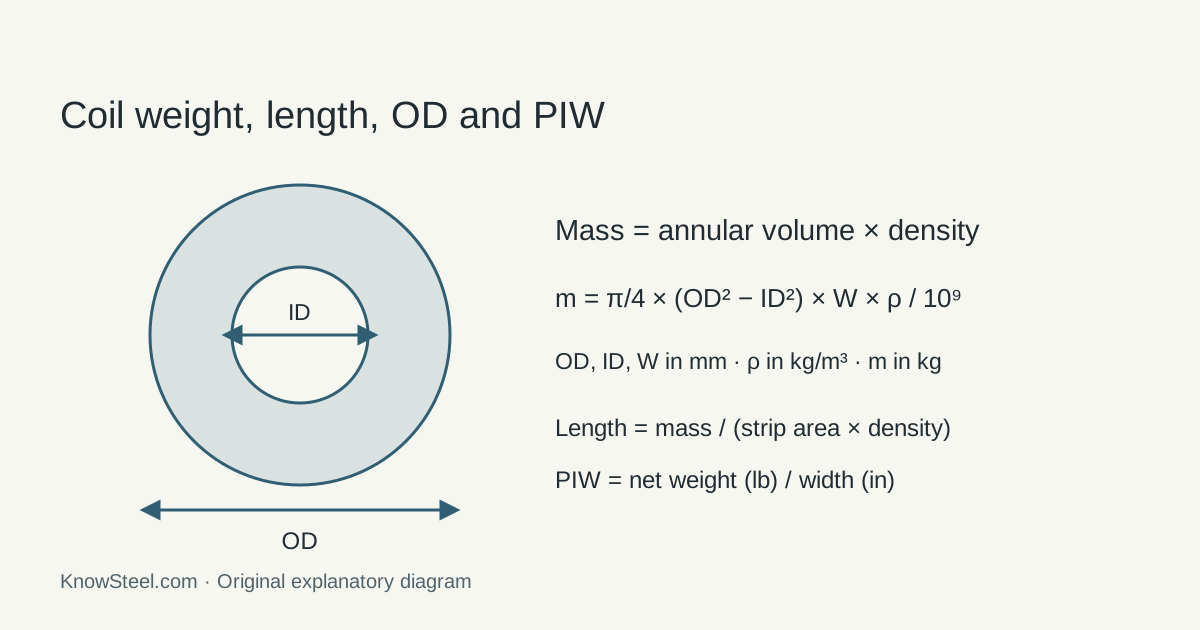
The cross-section of a tightly wound coil is approximated as an annulus. Multiplying its area by the strip width gives the material volume. Multiplying by density gives the estimated mass. The division by 10⁹ converts cubic millimetres to cubic metres.
The model assumes a circular coil with no air gaps. Outside diameter must be greater than inside diameter. Measure in consistent units; the calculator normalizes imperial inputs before applying the formula.
Worked example
Weight: with OD = 1,200 mm, ID = 508 mm, W = 1,000 mm and ρ = 7,850 kg/m³, the estimated coil weight is 7,287.08 kg.
Coil Length Formula
This treats the strip as a rectangular section. It does not require coil diameters. A small change in thickness changes the estimated length, so use the measured or specified thickness appropriate to the task.
Worked example
Length: for 5,000 kg of strip, 0.5 mm thick and 1,000 mm wide at the same density, the estimated length is 1,273.89 m.
Coil Outside Diameter Formula
The outside diameter is obtained by rearranging the weight formula. Thickness is required to check that there is enough material for at least one complete wrap. You can also derive OD from strip length and thickness; substituting the length formula cancels thickness. At a fixed mass, ID, width and density, changing thickness does not change the ideal OD. Packing gaps and winding practice can change a real coil’s diameter.
Worked example
OD: 5,000 kg, ID = 508 mm, width = 1,000 mm, thickness = 0.5 mm and density = 7,850 kg/m³ give 1,033.95 mm outside diameter.
Calculate coil outside diameter ↑
PIW Formula
Metric inputs are converted to pounds and inches first. PIW describes how mass is distributed across the coil width; it does not require thickness, diameters or density.
Worked example
PIW: a 20,000 lb coil at 48 in width gives 416.67 lb/in.
Measurement Checklist
- Use net steel weight, excluding pallet and wrapping, for length calculations.
- Enter actual thickness rather than a gauge number. Consult the gauge reference when interpreting a nominal designation.
- Confirm the density assumption for the material.
- Check diameters across a representative circular section.
- Keep the estimate separate from lifting, load-rating and acceptance decisions, which require their own verified data.
The displayed results round to two decimals. This is display precision, not a claim that the inputs or material are accurate to that precision.
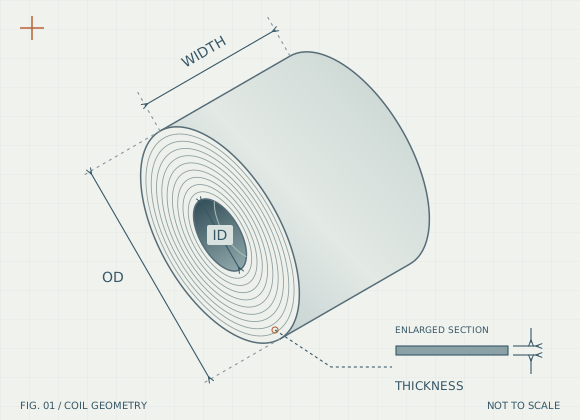
Common Coil Calculation Questions
How do you calculate steel coil weight?
Multiply the annular cross-sectional area by strip width and material density. With OD, ID and width in millimetres and density in kg/m³, divide by 10⁹ to obtain kilograms. The result assumes a circular, tightly wound coil without air gaps.
How do you calculate the length of a steel coil?
Divide net coil mass by thickness × width × density, using consistent units. For the SI calculation, convert thickness and width to metres first. Use actual or specified thickness; a gauge number alone is not a thickness input.
How do you calculate coil outside diameter?
Rearrange the annular weight equation: OD = √[ID² + 4m × 10⁹ / (πWρ)] for mass in kg and dimensions in mm. Enter net mass, ID, width and density; thickness verifies that the coil contains at least one full wrap.
What is PIW in steel coils?
PIW means pounds per inch of width: net coil weight in pounds divided by strip width in inches. A 20,000 lb coil with 48 in strip width has a PIW of about 416.67 lb/in. It is not weight per unit strip length.
Does steel thickness affect coil OD?
At fixed net mass, ID, width and density, thickness cancels from the ideal OD equation. At fixed strip length and ID, a thicker strip increases ideal OD. This calculator uses thickness to reject quantities too small for one complete wrap; real packing gaps also affect OD.
What density should I use for steel?
The default 7,850 kg/m³ is a typical carbon-steel estimate. Use grade-specific information when available: other alloys and coatings can change the effective density. You can edit density; it stays in kg/m³ when units change.
Why does calculated coil weight differ from actual coil weight?
The model uses ideal geometry and one uniform density. Real coils vary with actual dimensions, grade, coating, winding gaps and shape. Check whether a reported weight is net or includes packaging, and use verified weighing data for acceptance.
Related Tools and References
Use the Steel Plate & Sheet Weight Calculator for rectangular blanks instead of a wound coil. The steel coil reference explains width, ID and product forms; hot-rolled and cold-rolled steel describe common strip feedstock. Return to Steel Tools .