
Calculator
Enter net master-coil mass and width, then add slit widths and positive whole-number quantities. Left and right edge trims are separate. Optional thickness and density estimate parent length; they do not change width-based daughter mass allocation. Units convert entered widths, thickness and mass.
Geometry and formulas
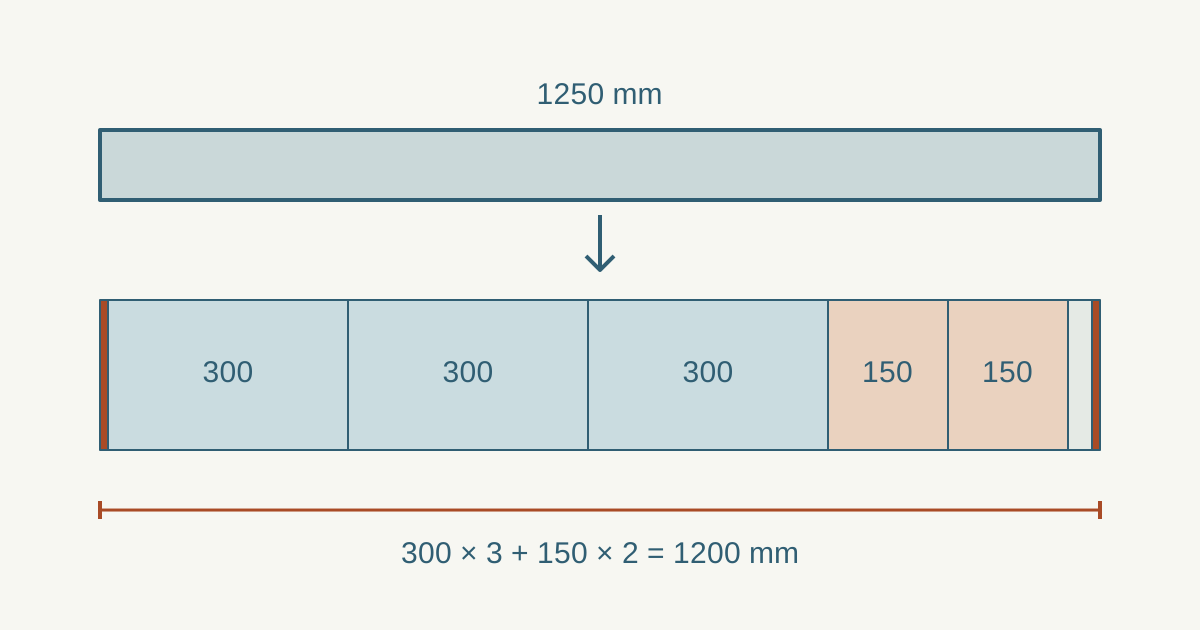
Each daughter is assumed to retain the full parent length, with uniform mass per unit width. Daughter weight = master weight × slit width / master width; group weight multiplies by quantity. Width utilization excludes edge trim and remaining width. Daughter groups + trim + unallocated material reconcile to the entered net mass.
W(used) = W(slit) + e(left) + e(right)
W(remaining) = W(master) − W(used)
U = W(slit) / W(master) × 100%
m(daughter) = m(master) × w / W(master)
Dimensions in mm, length in mm; internal mass in kg. 1 in = 25.4 mm, 1 ft = 0.3048 m, 1 lb = 0.45359237 kg. Multiply kg/m by 0.3048 / 0.45359237 to obtain lb/ft. Results retain calculation precision; the panel displays English-style decimal points and thousands separators.
Worked examples
Master coil width: 1,250 mm; Master coil weight: 10,000 kg.
- 300 mm × 3 → 2,400 kg × 3 = 7,200 kg.
- 150 mm × 2 → 1,200 kg × 2 = 2,400 kg.
- Slit width used: 1,200 mm; Width utilization: 96%.
- Edge trim: 0 mm; Remaining width: 50 mm / 400 kg.
- Reconciled total weight: 7,200 + 2,400 + 0 + 400 = 10,000 kg.
- Left edge trim 10 mm + Right edge trim 10 mm → Estimated trim weight 160 kg; Remaining width 30 mm / 240 kg; 9,600 + 160 + 240 = 10,000 kg.
Density assumptions
Carbon steel 7,850; stainless steel 7,900; galvanized base steel 7,850 kg/m³. Alloy and tool steel use 7,850 kg/m³ where offered. These are estimating presets: grade, chemistry and temperature matter. A custom positive density overrides the preset.
| Material | Density (kg/m³) |
|---|---|
| Carbon Steel | 7850 |
| Stainless Steel | 7900 |
| Galvanized Steel | 7850 |
Scroll within the table to see all columns →
Measurement and limitations
This is a plan checker, not an automatic cutting optimizer or machine setup prescription. Blade clearance, burr, width tolerance, camber, minimum trim and equipment limits need process review. Slitting shears material: no saw kerf is assumed. Head/tail crops, weld removal, unequal daughter lengths, damaged material and packaging are excluded. Preserve parent heat and coil IDs and assign daughter IDs with width, measured mass and processing record.
Reference data
SSAB — Steel density · Outokumpu — Austenitic sheet density .
FAQ
Does remaining width count as a finished daughter coil?
No. It is unallocated material until included as a slit group. The proportional diagram shows each strip for up to 200 daughters, then combines each group at the same total width scale; the table always preserves quantities and weights.
Are these values certified for lifting or purchasing acceptance?
No. Check actual grade, tolerances, processing loss and measured mass. These calculators provide estimates, not load ratings or certification.
Related tools and references
Steel Coil: Types, Dimensions & Specifications · Steel Strip · Cold-rolled steel coil · Hot-rolled steel coil · Steel Coil Weight & Length Calculator · Steel Tools