
What cold rolling changes
Cold-rolled steel coil is made by reducing previously hot-rolled strip below its recrystallization temperature. Cold reduction controls thickness and changes the mechanical condition. For forming sheet, annealing restores ductility before a finishing pass establishes the delivered surface and shape.
Typical cold-rolled route
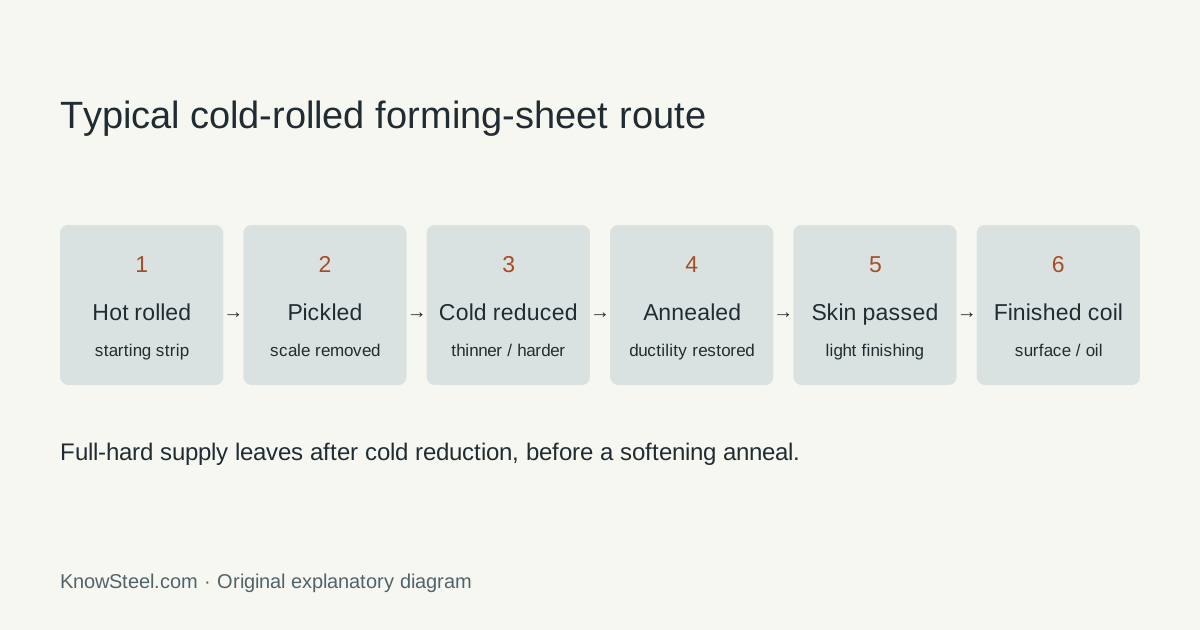
Hot rolled → pickled → cold reduced → annealed → skin passed → finished coil. Pickling removes mill scale. Rolling reduces the steel section. Annealing treats the cold-worked structure. A light skin pass controls surface texture and forming behavior; levelling and oiling complete the ordered finish.
thyssenkrupp’s packaging-steel route illustrates batch/continuous annealing and temper rolling in a specific product context; its reduction figures are not general forming-sheet limits.
Hot rolled identifies the earlier rolling route. HRPO removes scale and adds oil without cold reduction. Full-hard cold rolled has been cold reduced without a following softening anneal. Annealed cold rolled has subsequently been thermally treated for the ordered properties. The word “cold” therefore does not, by itself, identify a formable delivered condition.
Full hard versus annealed forming coil
| Condition | Where it sits in the route | Next operation |
|---|---|---|
| Full hard | Cold reduced, without a subsequent softening anneal | Further thermal processing or a process expressly designed for that hard condition. |
| Annealed and skin passed | Annealed after reduction, then lightly finished | Forming to the specified grade, thickness and surface requirements. |
Scroll within the table to see all columns →
Full hard is not a synonym for high-strength structural steel. It describes a cold-worked condition. A coating line with in-line annealing may take full-hard substrate and develop the final forming properties before galvanizing. See the galvanizing route for that separate operation.
Finish, oil and dimensional control
Surface finish includes texture and quality requirements for the visible face. An appliance panel to be painted may need tighter surface acceptance than a concealed formed part. Identify the exposed face, permissible marks and any roughness target.
Oil protects and lubricates within the agreed handling system. Name the oil or compatibility requirement when the next operation is painting, bonding or forming. Clean the material according to that operation’s process.
Thickness and width tolerances, flatness and edges belong on the order. For slit stock, include burr and camber . Nominal thickness controls the starting calculation; actual thickness variation affects yield and weight.
For functional roughness, specify the measured parameter, range, instrument cutoff and measurement direction; a finish name alone does not define an Ra limit. For flatness, define whether acceptance concerns coil after uncoiling or levelled cut lengths. Record trimmed/slit edges, burr orientation and usable width so a nominally correct coil can actually feed the tool. SSAB’s DC01 data illustrates product-specific dimensions, oiling and EN 10131 tolerance context; it is not a universal availability envelope.
Grades and product standards
ASTM A1008/A1008M, EN 10130 and JIS G 3141 are common sheet-specification starting points. DC01 is an EN forming designation; SPCC is a JIS designation. Keep each in its own system. EN 10131 addresses dimensions for relevant cold-rolled uncoated products.
The ASTM A1008/A1008M-26 public scope is the active entry checked on 18 September 2026. It identifies sheet families, not all acceptance limits. Read the full contract edition together with applicable A568/A568M general requirements . DC01, SPCC and an ASTM designation do not establish interchangeable chemistry, tests or forming guarantees. The standards hub links the product and dimensional documents.
Forming and coated substrates
Cold-rolled forming stock is used for enclosures, appliance parts and stamped components. The grade should match the strain path and bend geometry. Surface, oil and tools influence how the component runs through the press.
Cold-reduced substrate also underlies many galvanized and prepainted products. The finished galvanized coil has its own coating and delivery specification; PPGI adds pretreatment and paint.
Example order fields: DC01 / EN 10130; 1.0 × 1,000 mm; annealed and skin passed; trimmed edges; specified surface quality and oil; EN 10131 dimensional class; coil handling limits. Complete those choices for the actual drawing rather than ordering “1 mm CR” alone.