
304 is the best-known general-purpose austenitic stainless steel. It appears in sheet and coil, kitchen equipment, tanks, appliances, architectural components and countless fabricated parts.
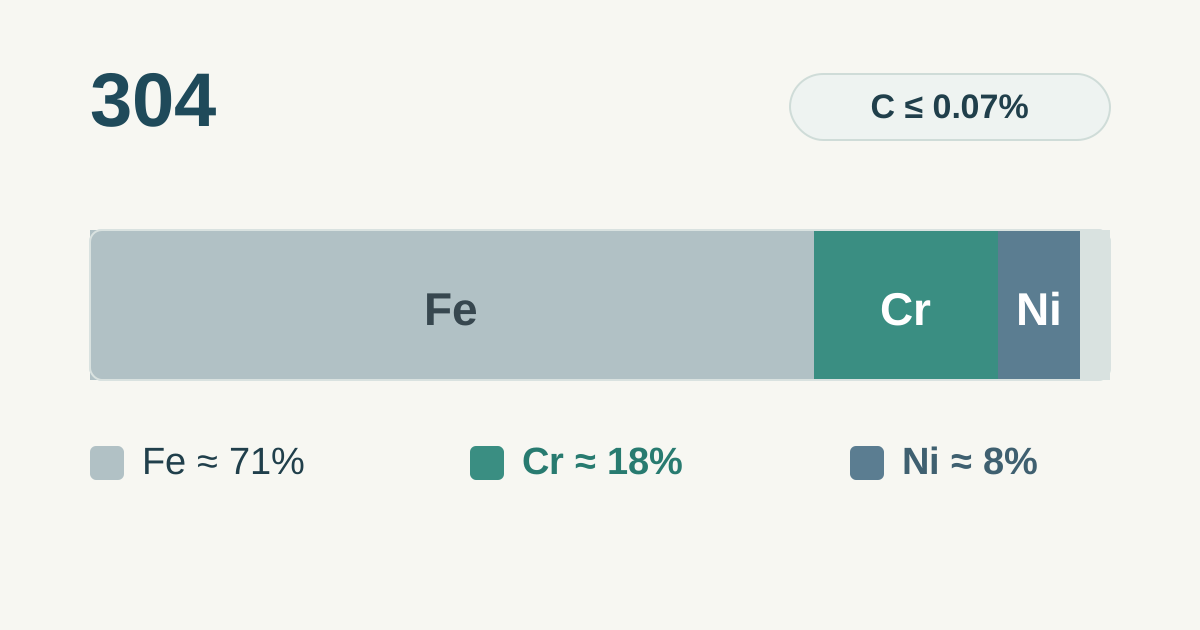
The familiar 18/8 description comes from its roughly 18% chromium and 8% nickel composition. In North American specifications the grade is commonly identified as Type 304 / UNS S30400; EN 1.4301 / X5CrNi18-10 is a common European cross-reference. These designations help identify the material, but the standard named on the order still controls the actual chemistry, mechanical properties, dimensions and delivery requirements.
304 is popular because it combines useful corrosion resistance with good forming and welding characteristics. Its limits are equally practical: chloride exposure can cause localized corrosion, and cold working can make an otherwise low-magnetic material respond more strongly to a magnet.
For the wider stainless family, see Stainless Steel .
304 stainless steel at a glance
| Item | Reference |
|---|---|
| Family | Austenitic stainless steel |
| ASTM / AISI type | 304 |
| UNS | S30400 |
| Common EN cross-reference | 1.4301 / X5CrNi18-10 |
| Common shorthand | 18/8 stainless steel |
| Typical producer chemistry | About 18.1% Cr and 8.1% Ni |
| Common flat-product forms | Cold-rolled coil and sheet, hot-rolled coil and sheet, plate, precision strip |
Scroll within the table to see all columns →
What does “304” actually identify?
304 is a chromium-nickel austenitic stainless grade. Chromium supports the thin passive film that gives stainless steel its corrosion resistance. Nickel helps stabilize the austenitic structure and contributes to the grade’s ductility and forming behavior.
That microstructure separates 304 from ferritic grades such as 430 and martensitic grades such as 410. It also explains why annealed 304 behaves differently in forming and magnetism.
The grade number is only part of a usable specification. A purchase order for sheet, plate or coil still needs the product standard, dimensions, tolerances, surface finish and any required inspection documentation.
Chemical composition of 304 stainless steel
For flat-product S30400 references, the following limits are commonly used. Product form matters: long-product standards can differ slightly, so the governing specification should be checked before these numbers are used for acceptance.
| Element | Mass % |
|---|---|
| Carbon, C | ≤ 0.07 |
| Silicon, Si | ≤ 0.75 |
| Manganese, Mn | ≤ 2.00 |
| Phosphorus, P | ≤ 0.045 |
| Sulfur, S | ≤ 0.030 |
| Chromium, Cr | 17.5–19.5 |
| Nickel, Ni | 8.0–10.5 |
| Nitrogen, N | ≤ 0.10 |
| Iron, Fe | Balance |
Scroll within the table to see all columns →
A producer’s typical melt chemistry will normally sit inside those limits rather than at the limits themselves. Outokumpu, for example, publishes approximately 0.04% C, 18.1% Cr and 8.1% Ni for Core 304/4301.
That distinction matters: a typical composition describes a representative product; a specified range defines acceptance under a particular standard.
See the 304 stainless steel data basis .
Is 304 the same as 18/8 stainless steel?
Usually, 18/8 is a shorthand way of referring to 304-type stainless steel. The numbers refer to chromium and nickel contents of roughly 18% and 8%.
It is useful language for recognition, especially in consumer products, but it is not a full engineering designation. It does not define thickness tolerance, finish, strength, certification or the complete chemistry limits.
The same caution applies to 18/10 markings on cutlery and hollowware. In that context, 18/10 is not a separate engineering grade that should be assumed to outperform a properly specified 304 product.
304 vs 304L
304L is the low-carbon variant of the same general chromium-nickel family. It is commonly identified as UNS S30403 and is often cross-referenced to EN 1.4307.
The key difference is carbon:
304: C ≤ 0.07%
304L: C ≤ 0.030%
Lower carbon reduces the tendency to form chromium carbides during certain thermal exposures, which is why 304L is often selected when welding and intergranular corrosion are important considerations.
The “L” means low carbon. It does not mean higher chloride resistance, and it does not turn 304L into a substitute for a more highly alloyed grade where the environment requires one.
Physical properties
The values below are representative room-temperature data for 304 / 1.4301 flat products.
| Property | Representative value |
|---|---|
| Density | 7.9 g/cm³ · 7,900 kg/m³ · 0.285 lb/in³ |
| Elastic modulus at 20°C | 200 GPa · about 29 × 10⁶ psi |
| Thermal expansion, 20–100°C | 16.0 × 10⁻⁶ /K |
| Thermal conductivity at 20°C | 15 W/(m·K) |
| Specific heat at 20°C | 500 J/(kg·K) |
| Electrical resistivity at 20°C | 0.73 Ω·mm²/m |
Scroll within the table to see all columns →
For weight calculations across different steel grades, see Steel Density .
Mechanical properties depend on the specification
There is no single yield-strength number that describes every 304 product. Product form, thickness, condition and governing standard all matter.
A current producer datasheet shows the difference clearly:
| Basis | Product form | 0.2% proof / yield strength | Tensile strength | Elongation |
|---|---|---|---|---|
| EN 10088-2 | Cold-rolled coil and sheet | 230 MPa min. | 540–750 MPa | 45% |
| EN 10088-2 | Hot-rolled coil/sheet and plate | 210 MPa min. | 520–720 MPa | 45% |
| ASTM A240 basis | Cold rolled, hot rolled and plate | 170 MPa / 25 ksi min. | 485 MPa / 70 ksi min. | 40% |
Scroll within the table to see all columns →
These rows are not interchangeable design values. They show why the standard and product form belong on the drawing or purchase order. For flat stainless products, ASTM A240/A240M is one important specification.
Corrosion resistance and its limits
304 performs well in many indoor environments, mild outdoor exposures and general food, beverage and process applications. Its chromium-rich passive surface is the reason.
The weak point is localized attack in sufficiently aggressive environments, especially where chlorides, deposits or tight crevices are present. Temperature, acidity, surface condition and cleaning practice can change the result significantly.
That is why a single “safe chloride ppm” for 304 is rarely useful. A cool, clean, freely draining surface is a very different service condition from a warm crevice where salts concentrate.
For coastal, marine or process environments with meaningful chloride exposure, 304 should be evaluated rather than assumed. A molybdenum-bearing grade such as 316 stainless steel may be more appropriate, but that is a separate selection decision.
For pitting, crevice corrosion, contamination and rust staining, see Does Stainless Steel Rust? .
Forming, welding and magnetism
304 is widely used for bending, pressing and drawing because it forms well. Cold work also raises its strength and can transform some austenite into martensite.
That transformation explains why a formed 304 part may respond to a magnet more strongly at a pressed corner, sheared edge or heavily worked area than on a flat annealed surface.
In practical terms, annealed 304 is usually described as non-magnetic or very weakly magnetic. A magnet is therefore a poor grade-identification test: processing history can change the response without changing the material designation.
304 also welds readily in common fabrication practice. Where sensitization after welding is a concern, 304L is frequently considered, subject to the actual product specification and service conditions.
For the family comparison and the effects of forming and weld ferrite, see why stainless steel can be magnetic .
Common uses of 304 stainless steel
| Application | Why 304 is used | What still needs checking |
|---|---|---|
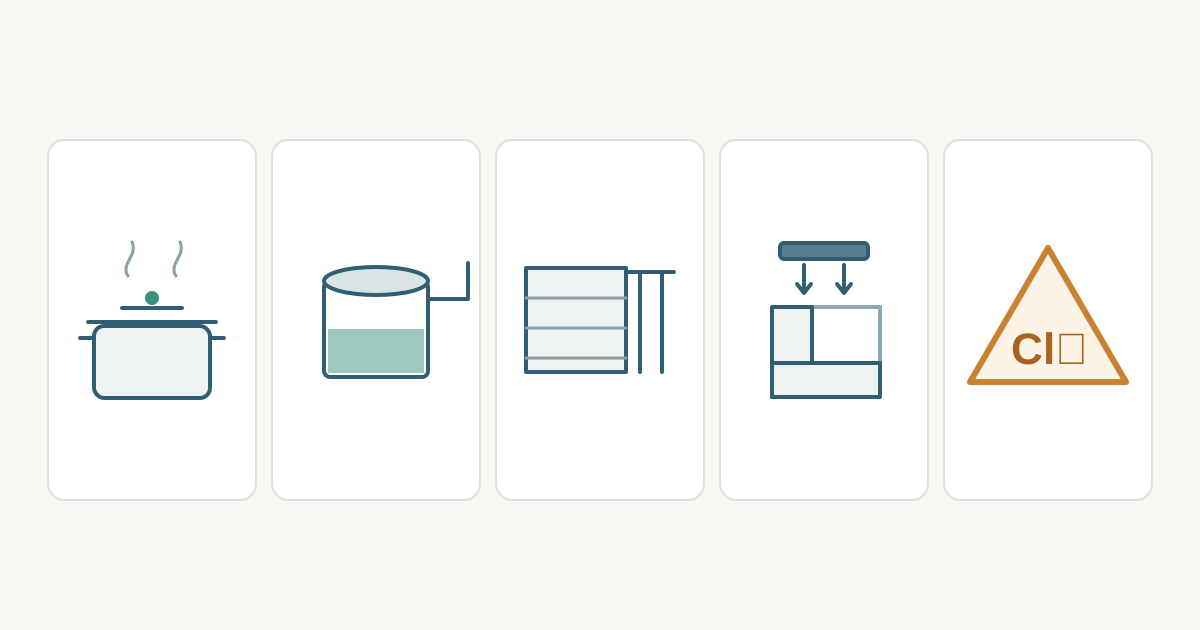
| Kitchen equipment and appliances | Formability, appearance and cleanability | Cleaning chemistry and chloride exposure |
| Food and beverage equipment | Fabricability and corrosion resistance in many mild services | Process chemistry, sanitary design and regulatory requirements |
| Storage tanks and fabricated vessels | Weldability and broad availability | Stored medium, temperature and deposits |
| Architectural sheet, handrails and frames | Appearance and atmospheric resistance | Coastal salts, finish and cleaning access |
| Pressed and formed sheet parts | Good cold-forming behavior | Work hardening, springback and final strength |
Scroll within the table to see all columns →
Is 304 stainless steel “food grade”?
304 is widely used in food and beverage equipment, but “food grade” is not a material certificate by itself.
The alloy is only one part of the decision. The finished equipment may also need to meet food-contact regulations and sanitary-design requirements, while weld quality, surface finish, drainage, crevices, cleaning chemicals and the process medium all affect service performance.
So a claim such as “made from 304” is useful material information, but it does not automatically certify every finished product for every food-contact use.
How to specify 304 sheet, plate or coil
A clear order should state more than “304 stainless steel.” For flat products, define:
- Product form — sheet, strip, coil or plate.
- Applicable standard and grade — for example Type 304 / UNS S30400 under the agreed specification, or the applicable EN designation.
- Dimensions and tolerances — thickness, width, length or coil dimensions, with the governing tolerance basis.
- Surface finish — mill finish, brushed, polished or another defined finish.
- Delivery or processing condition — where it affects forming, strength or fabrication.
- Inspection documents and testing — when certificates, traceability or additional tests are required.
Cross-standard grade names are useful for comparison, but substitution should be based on the complete requirements rather than the number alone.
For a fuller ordering workflow, see How to Specify Steel Sheet and Coil Correctly .
Frequently asked questions
What is 304 stainless steel?
304 is a general-purpose austenitic chromium-nickel stainless steel. Type 304 is commonly associated with UNS S30400 and is widely used in sheet, coil, plate and fabricated components.
Is 304 stainless steel the same as 18/8?
304 is commonly described as 18/8 stainless steel because its chromium and nickel contents are roughly in that range. 18/8 is a shorthand description, not a complete material specification.
What is the difference between 304 and 304L?
304L has a lower permitted carbon content. That reduces the risk of sensitization and intergranular corrosion after certain thermal exposures such as welding, while the applicable product standard still defines the full requirements.
Is 304 stainless steel magnetic?
Annealed 304 normally has very low magnetic response, but cold working can form martensite and make formed, sheared or heavily worked areas more magnetic. A magnet is not a reliable grade-identification test.
Can 304 stainless steel rust?
Yes. 304 is corrosion-resistant, not corrosion-proof. Chlorides, crevices, deposits, contamination, temperature and surface condition can cause localized corrosion.
Is 304 stainless steel food grade?
304 is widely used in food and beverage equipment, but the alloy name alone does not certify a finished product for every food-contact use. Regulatory requirements, sanitary design, fabrication, surface condition and the actual process environment also matter.