
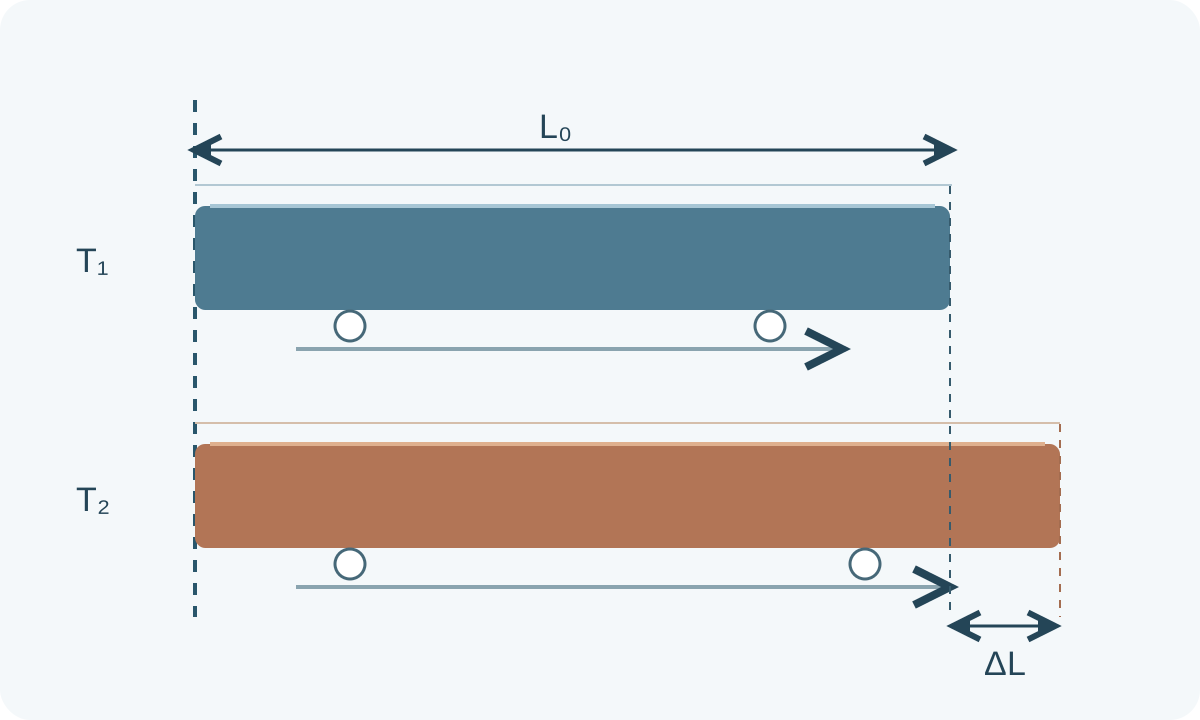
Steel normally expands as it heats and contracts as it cools. For a freely moving member at a reasonably uniform temperature, the useful calculation is ΔL = ᾱL₀ΔT. The coefficient must match the steel and the temperature interval. A structural-steel approximation cannot automatically be transferred to stainless steel, a furnace component or a fire analysis.
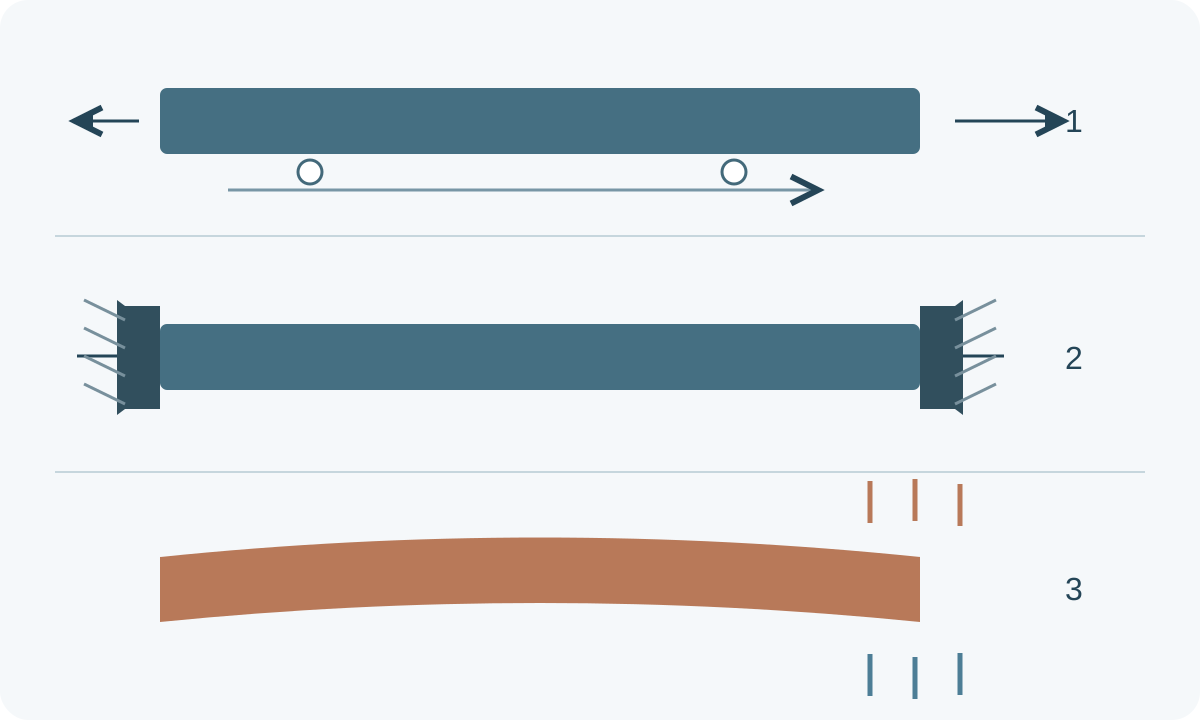
The result predicts free length change. Restraint, temperature gradients and connection details determine how that movement becomes displacement, distortion or force in an assembly.
What the expansion coefficient means
Linear thermal expansion describes change in length; it does not measure strength or thermal conductivity. The mean coefficient ᾱ over an interval is the length change divided by the specified reference length and temperature change. An instantaneous coefficient describes the local rate at one temperature. Check both the interval and the reference-length convention before using a table or curve.
A value of 12 × 10⁻⁶/K means about 12 micrometres per metre for each kelvin change under a constant-coefficient approximation. The units /K, /°C and mm/(mm·°C) have the same numerical basis for temperature differences. A mean value for 20–100°C is not a value established for every possible operating temperature.
Choose a coefficient with a stated scope
| Material or basis | Coefficient | Temperature basis | Use and limit |
|---|---|---|---|
| Common structural-steel approximation | 12 × 10⁻⁶/K | Conventional structural-design input | SCI GN 3.01 reports this design value. Confirm the applicable project rules; do not extrapolate it into fire design. |
| Outokumpu Core 304/4301, austenitic | 16.0 × 10⁻⁶/K | Mean, 20–100°C | Named producer product; physical-property data, not a universal acceptance guarantee. |
| Outokumpu Core 441/4509, ferritic | 10.0 × 10⁻⁶/K | Mean, 20–100°C | Named producer product; retain the same interval when comparing with 304/4301. |
Scroll within the table to see all columns →
These stainless examples show why a single “stainless steel coefficient” is inadequate. They do not establish values for every austenitic or ferritic grade. Confirm composition, product condition and temperature coverage from the actual supplier or design basis. For the broader material context, see 304 stainless steel .
Calculate free movement and keep units consistent
Take an unconstrained, uniformly heated length of Core 304/4301, L₀ = 3,000 mm at 20°C, reaching 100°C. Use the table’s mean coefficient:
- ΔT = 100 − 20 = 80°C, equivalent to 80 K.
- ΔL = 16.0 × 10⁻⁶ × 3,000 × 80 = 3.84 mm.
- Final length = 3,003.84 mm.
For Core 441/4509 with the same starting length and temperatures, ΔL = 10.0 × 10⁻⁶ × 3,000 × 80 = 2.40 mm. The difference in free growth is 1.44 mm. Joining the two materials constrains their movement, so that difference alone cannot give an interface force.
The output length unit follows L₀. Entering metres gives metres; entering inches gives inches. Convert the temperature coefficient as well when using Fahrenheit: ΔT°F = 1.8ΔT°C and ᾱ/°F = ᾱ/°C ÷ 1.8. Thus 16.0 × 10⁻⁶/K is about 8.89 × 10⁻⁶/°F. The interval 20–100°C becomes 68–212°F, a change of 144°F. Never add 32 to a temperature difference.
Handle changing coefficients and different reference temperatures
For a wider interval, obtain interval-specific mean data or a validated thermal-elongation curve. A table headed “mean from 20°C” retains that reference even when its endpoint is 400°C. Multiplying its 20–400°C mean by 400 − 100 does not establish the movement from 100 to 400°C.
Let r(T) = [L(T) − L₂₀]/L₂₀ be relative elongation from 20°C. The movement between T₁ and T₂ is ΔL = L₂₀[r(T₂) − r(T₁)]. If only the length L₁ at T₁ is known, first use L₂₀ = L₁/[1 + r(T₁)]. Means referenced to 20°C give r(T) = ᾱ₂₀→T(T − 20), provided units and definitions agree.
This subtraction uses a common length datum. Do not splice curves with different reference states or silently substitute an instantaneous coefficient for an interval mean. At high temperatures, changing properties and phase transformations require the relevant material model; a room-temperature constant is insufficient.
Distinguish free expansion from restrained stress
In an ideal straight, fully restrained uniaxial bar with uniform temperature change, constant E and α, and linear-elastic behavior, the thermal stress magnitude is |σ| = Eα|ΔT|. Heating creates compression and cooling creates tension relative to the stress-free starting state. This model excludes support movement, slip, initial stress, yielding, buckling and creep.
For an illustrative E = 200,000 MPa, α = 12 × 10⁻⁶/K and ΔT = 50 K, the ideal stress magnitude is 120 MPa. This is neither allowable stress nor a verified connection force. Real restraint stiffness and temperature-dependent properties change the response. Stability or yielding may invalidate the elastic model before its predicted stress is reached.
Young’s modulus supplies the elastic stiffness input. Structural capacity and fire resistance need separate checks of strength, stability, connections, loading and the governing design provisions.
Translate movement into a joint or assembly requirement
A member’s calculated free growth does not specify the required joint gap. Identify the fixed point, the lengths feeding movement into each joint, installation temperature, service extremes, tolerances, bearing or fastener travel and the joint manufacturer’s working range. A centrally fixed member may distribute movement toward both ends; the actual restraint arrangement controls that split.
Air temperature may differ from steel temperature in sunlight or near process heat. Temperature variation through thickness or across an assembly can cause curvature and twisting. Adjacent materials can also expand differently. Check the full hot-to-cold movement range and installation setting together; do not use a heating-only example as a complete detail.
Measure and report the property
ASTM E228-22 covers linear expansion measurement using push-rod dilatometers.
A useful test record identifies grade, product condition, specimen direction and dimensions, reference temperature and length, heating/cooling history, measurement interval, calibration, repeatability and uncertainty. State whether the reported result is mean or instantaneous. Use the complete applicable method for acceptance testing; a generic handbook value is not a batch measurement.
Inputs to record before using the answer
- Identify the material, product condition and coefficient source.
- Define the length datum and actual steel-temperature interval.
- Match coefficient type, units and reference convention.
- Calculate free movement, including contraction where relevant.
- Assess restraint, gradients, adjacent materials and available travel.
- Check the assembly against its design rules and record assumptions.
For material selection beyond expansion, use the stainless steel grade guide . Corrosion resistance, fabrication and service requirements remain part of that decision.