
316 is a molybdenum-bearing austenitic stainless steel used when corrosion resistance matters more than it does in many general-purpose 304 applications. Sheet, coil and plate made from 316 appear in chemical and food-processing equipment, pharmaceutical systems, coastal architectural hardware, tanks, valves and other fabricated parts.
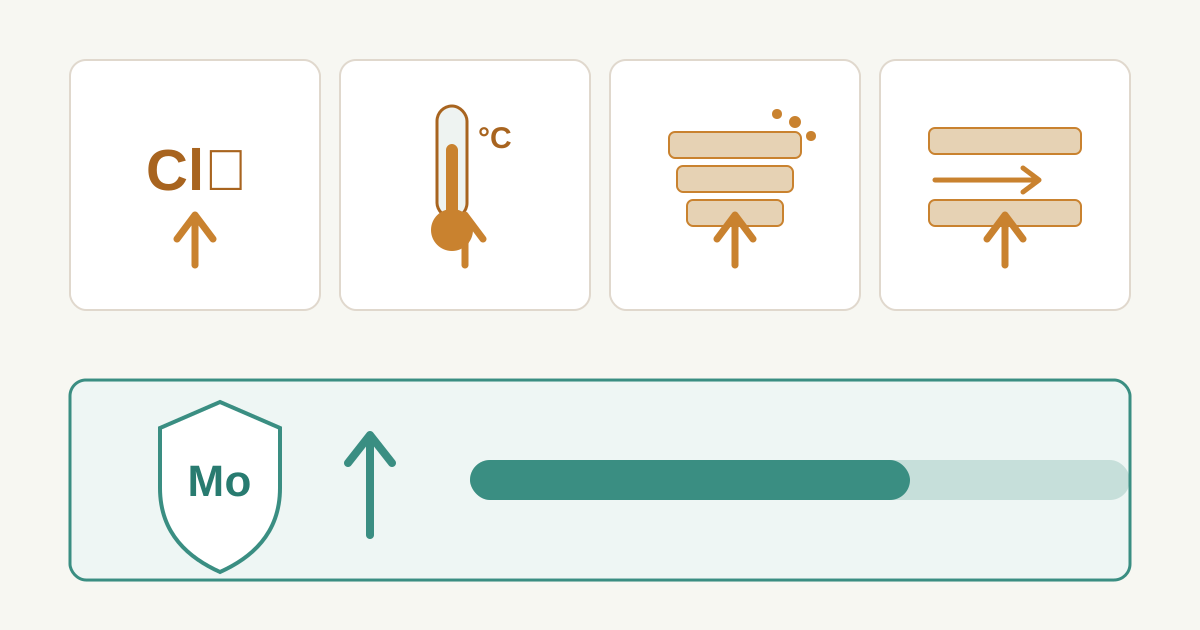
The common North American designation is Type 316 / UNS S31600. A widely used European cross-reference is EN 1.4401 / X5CrNiMo17-12-2. The defining addition is molybdenum: Type 316 normally contains 2–3% Mo, which improves resistance to localized corrosion such as pitting and crevice attack in many chloride-containing environments.
That does not make 316 corrosion-proof or automatically suitable for seawater immersion. Temperature, chloride concentration, crevices, deposits, surface finish, cleaning and stress all change the result.
For the wider alloy family, see Stainless Steel . For the general-purpose chromium-nickel grade, see 304 Stainless Steel .
316 stainless steel at a glance
| Item | Reference |
|---|---|
| Family | Austenitic stainless steel |
| ASTM / AISI type | 316 |
| UNS | S31600 |
| Common EN cross-reference | 1.4401 / X5CrNiMo17-12-2 |
| Defining alloy addition | 2–3% molybdenum in the S31600 reference range |
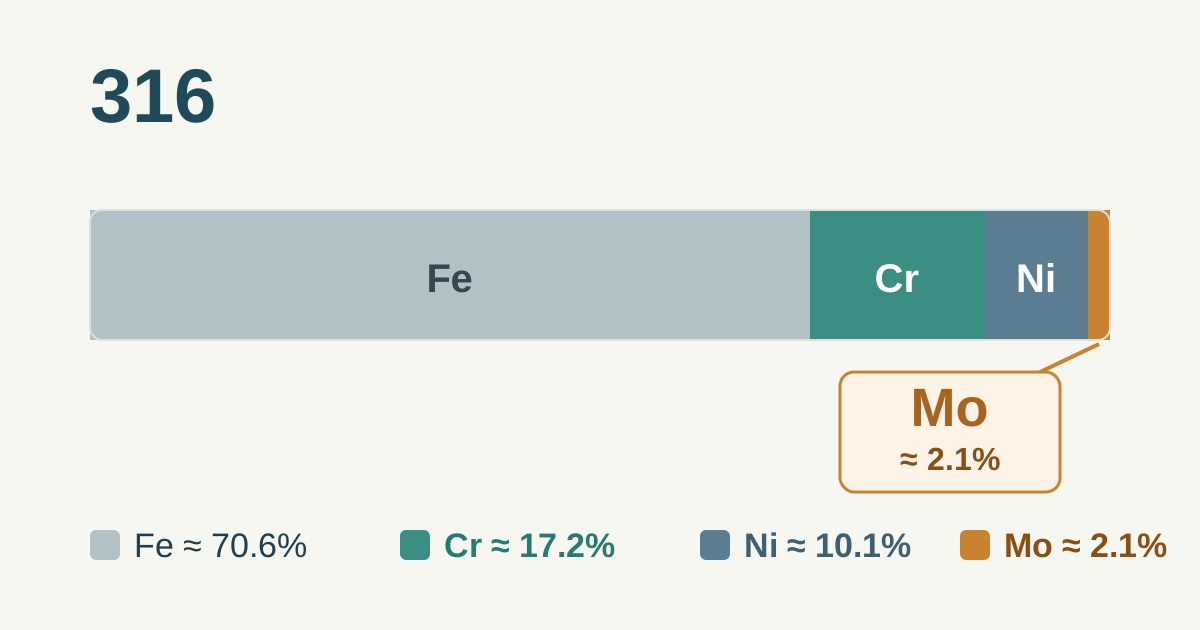
| Typical producer chemistry | About 17.2% Cr, 10.1% Ni and 2.1% Mo |
| Common flat-product forms | Cold-rolled coil and sheet, hot-rolled coil and sheet, plate, strip |
Scroll within the table to see all columns →
What makes 316 different?
Like 304, 316 is an austenitic chromium-nickel stainless steel. Its practical distinction is the addition of molybdenum.
Chromium supports the passive oxide film that gives stainless steel its basic corrosion resistance. Nickel helps maintain the austenitic structure. Molybdenum makes that passive system more resistant to local breakdown in many chloride-bearing environments, which is why 316 is often selected for more aggressive service than 304.
The improvement is real, but it is not unlimited. A warm salt solution trapped under a gasket is much more severe than clean rainwater on a freely washed exterior panel. Grade selection therefore has to consider the service condition, not just the alloy number.
Chemical composition of Type 316 / UNS S31600
The table below is a practical S31600 / Type 316 reference for ASTM-oriented flat products. EN 1.4401 has its own chemistry limits, so these numbers should not be used as acceptance criteria for every product sold as “316.”
| Element | Mass % |
|---|---|
| Carbon, C | ≤ 0.08 |
| Silicon, Si | ≤ 0.75 |
| Manganese, Mn | ≤ 2.00 |
| Phosphorus, P | ≤ 0.045 |
| Sulfur, S | ≤ 0.030 |
| Chromium, Cr | 16.0–18.0 |
| Nickel, Ni | 10.0–14.0 |
| Molybdenum, Mo | 2.00–3.00 |
| Nitrogen, N | ≤ 0.10 |
| Iron, Fe | Balance |
Scroll within the table to see all columns →
A producer’s typical chemistry should sit within the relevant specification limits. Outokumpu, for example, publishes typical values of about 0.04% C, 17.2% Cr, 10.1% Ni and 2.1% Mo for Supra 316/4401.
The distinction matters: a typical analysis describes a representative product; the specification defines what can be accepted.
See the 316 stainless steel data basis .
316 vs 316L: what does the L change?
316L is the low-carbon variant. It is commonly identified as UNS S31603 and is often cross-referenced to EN 1.4404 / X2CrNiMo17-12-2.
For ASTM-oriented chemistry, the key carbon limits are:
316: C ≤ 0.08%
316L: C ≤ 0.030%
Lower carbon reduces chromium-carbide precipitation during critical thermal exposure. In welded fabrications, that helps reduce sensitization and the associated risk of intergranular corrosion.
The “L” does not mean that 316L automatically has better pitting or crevice-corrosion resistance than 316. If chromium, molybdenum and nitrogen levels are comparable, their localized-corrosion resistance is broadly similar. The main reason for choosing 316L is the low-carbon welding and sensitization benefit.
Mechanical requirements can also differ by specification. Under an ASTM A240 basis, published producer data show minimum yield/tensile values of 205/515 MPa for 316 and 170/485 MPa for 316L, both with 40% minimum elongation. The purchase standard remains the controlling document.
Commercial material is also often supplied with dual 316/316L certification where the chemistry satisfies the low-carbon 316L limit and the tested mechanical properties also meet the applicable 316 requirements. Dual certification should be confirmed on the material test certificate rather than assumed from the product description.
Molybdenum, PRE and chloride resistance
A useful screening tool for pitting resistance is the Pitting Resistance Equivalent (PRE):
PRE = %Cr + 3.3 × %Mo + 16 × %N
Outokumpu reports a PRE of about 24 for its 316/4401 and 316L/4404 grades. This is higher than the typical PRE of the 304 family because 316 contains molybdenum.
PRE is a comparison index, not a service-life calculator. Two products with similar PRE values can behave differently when surface finish, inclusions, fabrication, deposits, oxygen availability, temperature or crevice geometry changes.
That is why “316 is safe up to X ppm chloride” is not a universal engineering rule. Chlorides are only one part of the exposure.
Is 316 really “marine grade”?
316 is often called marine grade stainless steel, and the phrase is useful as shorthand for its improved chloride resistance. It should not be read as “immune to seawater.”
In coastal architecture, 316/316L can give good service when the surface is smooth, exposed to rain or regularly washed, and salt deposits do not remain concentrated. Conditions become much more severe in splash zones, under deposits, inside tight crevices, or during permanent seawater immersion.
Natural seawater contains roughly 19,000–20,000 ppm chloride. In that environment, localized pitting and especially crevice corrosion can attack 316. Warm conditions make the risk higher.
For critical marine or high-chloride equipment, grade selection needs an engineering review of temperature, flow, oxygen, crevices, deposits, stress and maintenance. A more highly alloyed austenitic or duplex stainless steel may be required.
For a broader explanation of pitting, crevice corrosion and contamination, see Does Stainless Steel Rust? .
Physical properties of 316 stainless steel
The following values are representative room-temperature data for 316 / 1.4401 flat products.
| Property | Representative value |
|---|---|
| Density | 8.0 g/cm³ · 8,000 kg/m³ · about 0.289 lb/in³ |
| Elastic modulus at 20°C | 200 GPa · about 29 × 10⁶ psi |
| Thermal expansion, 20–100°C | 16.0 × 10⁻⁶ /K |
| Thermal conductivity at 20°C | 15 W/(m·K) |
| Specific heat at 20°C | 500 J/(kg·K) |
| Electrical resistivity at 20°C | 0.75 Ω·mm²/m |
Scroll within the table to see all columns →
For weight calculations, see Steel Density .
Mechanical properties depend on the standard and product form
A single “316 yield strength” number is not enough for design or acceptance. Product form, thickness, condition and specification matter.
| Basis | Product form | 0.2% proof / yield strength | Tensile strength | Elongation |
|---|---|---|---|---|
| EN 10088-2 | Cold-rolled coil and sheet | 240 MPa min. | 530–680 MPa | 40% |
| EN 10088-2 | Hot-rolled coil and sheet | 220 MPa min. | 530–680 MPa | 40% |
| EN 10088-2 | Plate | 220 MPa min. | 520–670 MPa | 45% |
| ASTM A240 basis | Flat products | 205 MPa / 30 ksi min. | 515 MPa / 75 ksi min. | 40% |
Scroll within the table to see all columns →
These rows are examples from different standards, not values to mix into one specification. For stainless plate, sheet and strip, ASTM A240/A240M is a key product standard.
For annealed ASTM A240 flat products, hardness is commonly limited to 95 HRB maximum (217 HBW maximum). That is a specification limit, not a single typical hardness value for every 316 product.
Forming, welding and magnetism
316 has the high ductility and work-hardening behavior expected of an austenitic stainless steel. It can be bent, pressed and drawn, although forming loads and springback should be considered in tooling and process design.
Weldability is generally good. Where welded sections are thick enough or service conditions make sensitization important, 316L is often preferred because of its lower carbon content.
Annealed 316 is normally non-magnetic in practical use or only very weakly magnetic. Cold work can increase its magnetic response, although the effect is generally much weaker than in similarly worked 304. Weld metal may also show a weak response because of ferrite. A handheld magnet therefore cannot reliably confirm whether a part is 316.
316 also work-hardens readily during machining. Cutting speed, feed, depth of cut and tooling should be selected for the actual machine, tool system, section size and material condition rather than taken from one universal parameter set.
For the family comparison and the effects of forming and weld ferrite, see why stainless steel can be magnetic .
Chloride stress-corrosion cracking is a separate risk
Pitting and crevice corrosion are not the only chloride-related mechanisms. Standard austenitic grades such as 316 can also be susceptible to chloride stress-corrosion cracking (SCC) when tensile stress, chlorides and elevated temperature occur together.
Industry guidance commonly flags temperatures above roughly 50°C / 120°F as a region where SCC deserves particular attention for standard 304/316-type austenitic steels. That is not a universal onset temperature: chloride level, stress, geometry and process chemistry matter.
For warm chloride process equipment, the material decision should therefore go beyond the simple question “is it 316?”
Common uses of 316 stainless steel
| Application | Why 316 is selected | What still needs checking |
|---|---|---|
| Chemical and petrochemical equipment | Useful resistance to many process environments and good fabrication properties | Exact chemical, concentration, temperature and stress |
| Food and beverage processing | Cleanability plus improved resistance in many salt- or cleaning-chemical exposures | Process medium, sanitation chemistry and regulatory requirements |
| Pharmaceutical process equipment | Corrosion resistance, fabrication and cleanable surfaces | Purity, finish, weld treatment and validation requirements |
| Coastal architectural fittings and fasteners | Better chloride resistance than basic Cr-Ni grades | Salt deposition, finish, rain washing and maintenance |
| Valves, flanges and fabricated piping components | Availability and broad process-industry use | Fluid chemistry, crevices, pressure/temperature code and gasket design |
| Pulp, paper and textile equipment | Molybdenum-bearing corrosion resistance with good formability | Bleaching chemicals, chlorides, temperature and deposits |
Scroll within the table to see all columns →
“316” identifies an alloy family, not a complete approval for any of these applications. Pressure equipment, hygienic systems and regulated products may require additional standards, qualification and documentation.
Is 316 stainless steel food grade?
316 is widely used in food and beverage processing, particularly where salts, cleaning chemicals or process conditions are more demanding than in many ordinary kitchen applications.
But food grade is not established by the alloy number alone. A finished item can also depend on food-contact regulations, sanitary design, weld quality, surface finish, drainage, cleaning procedures and the actual product being processed.
A certificate saying “316” verifies material identity only to the extent defined by that certificate and specification; it does not by itself certify the entire equipment design.
How to specify 316 sheet, plate or coil
A purchase order should define more than “316 stainless steel.” For flat products, state:
- Product form — sheet, strip, coil or plate.
- Grade and exact variant — 316 / S31600 or 316L / S31603, as applicable.
- Product standard — for example the agreed ASTM, ASME or EN specification.
- Dimensions and tolerances — thickness, width, length, flatness or coil dimensions under the chosen tolerance standard.
- Surface finish — such as 2B, No. 4, polished or another specified finish where relevant.
- Delivery condition and fabrication needs — especially when forming, welding or machining requirements matter.
- Inspection documentation — traceability, test certificates and any supplementary testing required by the project.
A cross-reference such as “316 = 1.4401” helps communication, but different standards do not become identical just because the grade names are often paired.
For the ordering workflow, see How to Specify Steel Sheet and Coil Correctly .
Frequently asked questions
What is 316 stainless steel?
316 is a molybdenum-alloyed austenitic chromium-nickel stainless steel. Type 316 is commonly associated with UNS S31600, while EN 1.4401 / X5CrNiMo17-12-2 is a common European cross-reference.
What does molybdenum do in 316 stainless steel?
Molybdenum improves resistance to localized corrosion, especially pitting and crevice attack in many chloride-containing environments. It improves resistance; it does not make the alloy immune to chlorides or seawater.
What is the difference between 316 and 316L?
316L has a lower maximum carbon content. The lower carbon level reduces sensitization and intergranular-corrosion risk after certain welding or thermal exposures. It does not automatically provide better pitting resistance than 316.
Is 316 stainless steel magnetic?
Annealed 316 is normally non-magnetic in practical use or only very weakly magnetic. Cold work can increase the response, but it is generally weaker than in similarly worked 304; weld ferrite can also contribute. A magnet is not a reliable grade test.
Can 316 stainless steel rust in salt water?
Yes. 316 can pit or suffer crevice corrosion in sufficiently aggressive chloride exposure, including seawater. Temperature, crevices, deposits, surface finish, flow and maintenance strongly affect performance.
Is 316 stainless steel food grade?
316 is widely used in food-processing equipment, but the grade name alone does not certify a finished product as food-safe. Regulatory requirements, sanitary design, fabrication, surface finish, cleaning and the service environment also matter.