
Short answer: stainless steel is not one magnetic category. Ferritic, martensitic and duplex stainless steels normally respond strongly to a magnet. Fully annealed austenitic grades such as 304 and 316 usually have low magnetic permeability and may show little attraction, but cold working, forming and welding can make parts of an austenitic component more magnetic.
A magnet therefore tells you something about microstructure and processing, not a complete grade identity.
For the five principal stainless families, see Stainless Steel .
Magnetism follows microstructure
The name “stainless steel” describes a corrosion-resistant alloy family, not one crystal structure. Its magnetic response depends mainly on which phases are present.
| Family | Typical examples | Typical magnetic response | Why |
|---|---|---|---|
| Austenitic | 304, 316 | Low in the annealed condition; may increase after cold work or welding | Austenite has low magnetic permeability; deformation can form martensite and weld metal can contain ferrite. |
| Ferritic | 430 | Strong | Ferritic microstructure is ferromagnetic. |
| Martensitic | 410, 420 | Strong | Martensitic microstructure is ferromagnetic. |
| Duplex | 2205 | Strong | Duplex steel contains substantial ferrite as well as austenite. |
| Precipitation-hardening | 17-4 PH | Usually strong | Many commonly used PH stainless grades have a ferromagnetic matrix. |
Scroll within the table to see all columns →
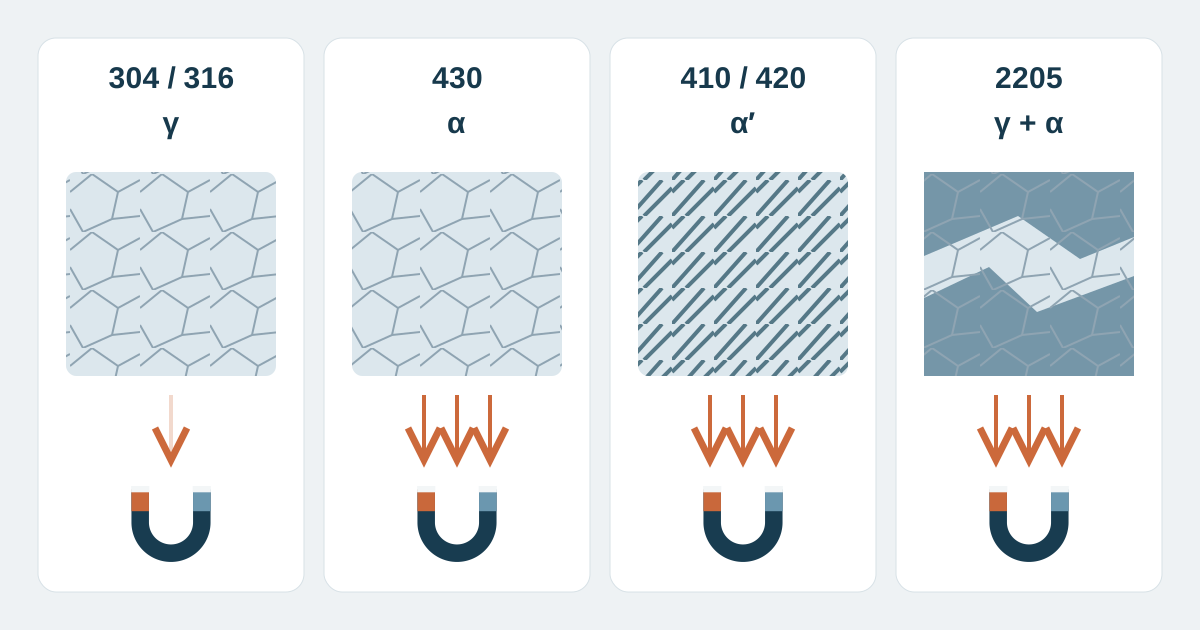
This is also why the statement “real stainless steel is non-magnetic” is wrong. A strongly magnetic 430 ferritic sheet can still be genuine stainless steel.
Why can 304 stainless steel become magnetic?
Annealed 304 is predominantly austenitic and normally has a low response to a hand magnet. Cold deformation can change that locally.
Bending, deep drawing, rolling, stamping, machining and severe shearing can transform some metastable austenite into strain-induced martensite. Martensite is ferromagnetic, so the worked region can attract a magnet more strongly than the untouched sheet.
A familiar pattern is a drawn sink or pressed component: a relatively flat area may show little attraction while corners and heavily formed zones show more.
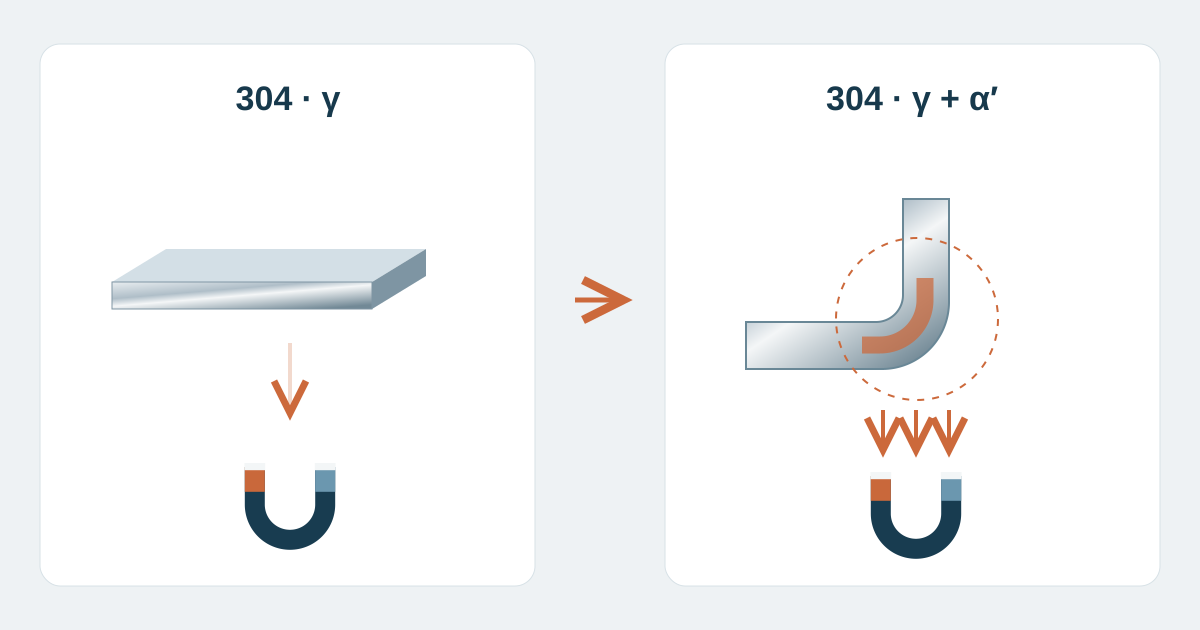
The amount varies with alloy chemistry and the severity of deformation. It is therefore unsafe to assign one fixed “304 magnet strength.”
Is 316 stainless steel magnetic?
Annealed 316 is also an austenitic grade and normally has low magnetic permeability. Cold work can increase its magnetic response, although the amount depends on composition and processing.
The practical point is the same as for 304: a small magnetic pull does not prove that 316 is counterfeit, and a weak pull does not prove that a part is 316.
If grade identity matters, use material certificates, positive material identification or another suitable verification method rather than a magnet alone. See 316 Stainless Steel and 304 Stainless Steel for the grade-specific context.
Why can a weld be more magnetic than the base metal?
Austenitic stainless weld metal is often designed to contain some ferrite because a controlled ferrite level can help reduce solidification cracking risk. That ferrite raises magnetic permeability in the weld compared with a fully austenitic base metal.
Cold work around a formed joint can add another source of magnetic response. A fabricated part may therefore show a stronger pull at the weld, bend, cut edge or machined area than on a nearby annealed face.
This variation is normal enough that a handheld magnet should not be treated as a pass/fail grade test.
Does magnetic stainless steel rust more easily?
Not because it is magnetic.
Magnetism depends mainly on microstructure. Corrosion resistance depends on alloy composition, passive-film condition, environment, surface condition and fabrication details. A ferritic grade can be magnetic and corrosion resistant; an austenitic grade can have low magnetic permeability yet still pit in an aggressive chloride environment.
For corrosion mechanisms, see Does Stainless Steel Rust? .
What a magnet test can and cannot tell you
| Observation | Reasonable interpretation | Do not conclude |
|---|---|---|
| Strong pull across the whole part | Ferritic, martensitic, duplex or another ferromagnetic stainless family is possible. | That the part is carbon steel or “not stainless.” |
| Little response on a flat annealed sheet | An austenitic grade is possible. | That it must be 304 or 316. |
| Stronger pull at bends or drawn corners | Cold-work-induced martensite may be present. | That the base material changed to another commercial grade. |
| Stronger pull at a weld | Ferrite in weld metal can raise local permeability. | That the weld is defective or the filler is automatically wrong. |
Scroll within the table to see all columns →
If two materials must be separated on a shop floor, a magnet can be one screening tool when the expected families are already known. It is not a substitute for traceability or chemical identification.
Low-magnetic applications need a permeability requirement
For MRI equipment, instrumentation, electrical hardware and other magnetically sensitive applications, “non-magnetic stainless” is too vague. A specification may need a maximum relative magnetic permeability and a defined material condition.
Annealed austenitic stainless steels can have relative permeability close to 1, but composition, cold work and weld metal can move the value upward. The allowed limit should therefore be stated for the finished condition that matters—not assumed from a grade name alone.
See the stainless magnetism references for the technical basis used here.
Practical checks before you reject a part
- Confirm the stated stainless family and grade from documentation.
- Test more than one location: flat area, bend, cut edge and weld can behave differently.
- Check whether the part was cold formed, straightened, machined or welded after solution annealing.
- If magnetic performance is a contractual requirement, measure permeability with the specified method rather than judging only by hand-magnet pull.
- If material identity is in doubt, use traceability records or appropriate PMI/testing.
Is 304 stainless steel magnetic?
Annealed 304 usually has low magnetic response, but cold working can form martensite and make bends, drawn corners, cut edges or machined areas more magnetic.
Is 316 stainless steel magnetic?
Annealed 316 is normally low-magnetic, but processing and weld structure can increase local response. A magnet alone cannot identify 316.
Which stainless steels are strongly magnetic?
Ferritic, martensitic and duplex stainless steels normally show strong attraction to a handheld magnet. Many precipitation-hardening grades are also magnetic.