
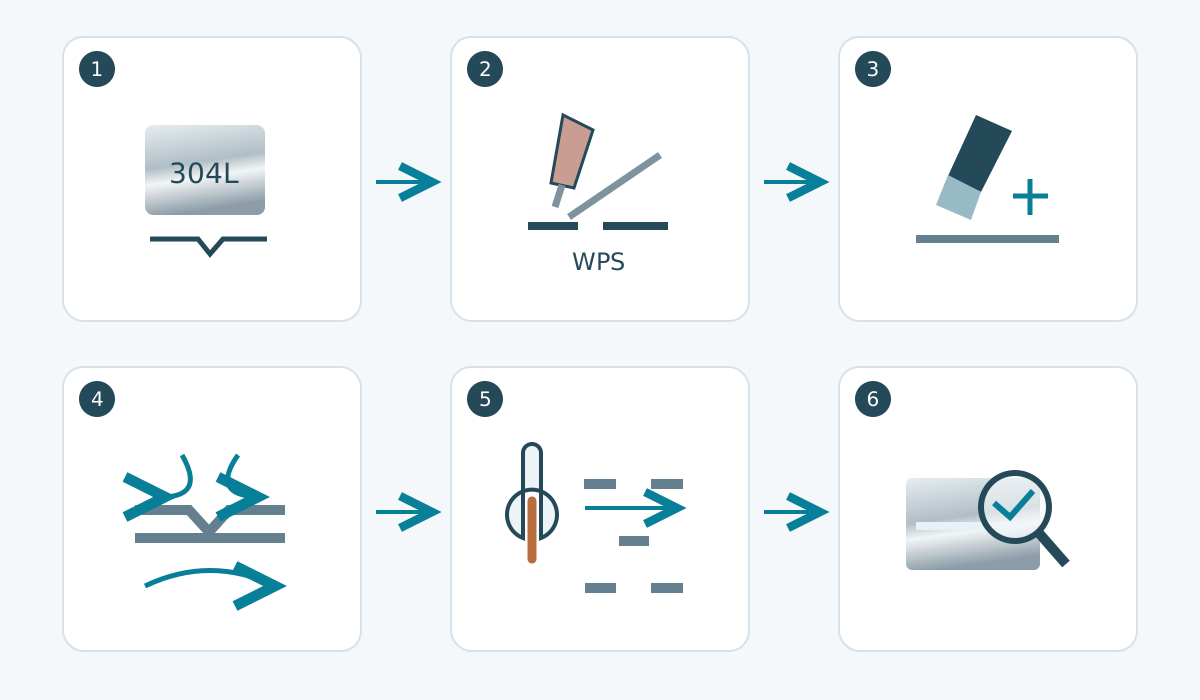
Good stainless welds depend less on a single “stainless setting” than on a controlled sequence: identify the alloy, choose a suitable process and filler, keep the joint clean, control heat and distortion, protect the molten metal from air, then restore the required surface condition after welding.
For structural work, pressure equipment, sanitary systems or other code-governed fabrication, the qualified welding procedure and project specification control. This guide explains the decisions behind that procedure rather than replacing a WPS.
1. Identify the stainless family before choosing a filler
Do not start from “it looks like stainless.” Austenitic 304/304L and 316/316L are readily welded with common arc processes, but ferritic, martensitic, duplex and precipitation-hardening grades have different thermal and metallurgical limits.
Confirm at least:
- base-metal grade and product form;
- thickness and joint geometry;
- whether the joint is stainless-to-stainless or dissimilar;
- service environment and corrosion requirement;
- applicable code or customer WPS/PQR requirements;
- required final surface and inspection level.
If the grade is unknown, establish material identity before selecting consumables. The broader family map is on Stainless Steel .
2. Choose TIG, MIG or another process for the joint
| Process | Where it fits well | Main control point |
|---|---|---|
| GTAW / TIG | Thin sheet, pipe roots, high-quality visible welds, precise work | Clean joint, stable shielding and controlled heat input |
| GMAW / MIG | Production welding, longer seams, higher deposition | Correct stainless wire, transfer mode and shielding gas for the qualified procedure |
| SMAW / stick | Field work, repair and access where gas-shielded equipment is less practical | Electrode classification, storage and slag/interpass cleaning |
| FCAW | Higher deposition and fabrication work where an approved stainless flux-cored consumable is suitable | Consumable/gas combination and fume control |
Scroll within the table to see all columns →
TIG is often preferred for thin stainless and root passes because it gives close control at low current. MIG is productive for longer seams and repeated fabrication. Process choice should follow the joint and qualified procedure, not a blanket rule that one method is always “best.”
3. Match the filler to the base metals and service
For common austenitic joints, these are useful starting points—not substitutes for the WPS or consumable manufacturer’s data.
| Base-metal combination | Common bare-wire / rod family | Why |
|---|---|---|
| 304 / 304L to similar austenitic stainless | ER308L | Common low-carbon matching family for 18Cr-8Ni stainless fabrication |
| 316 / 316L to similar austenitic stainless | ER316L | Retains the molybdenum-bearing weld-metal family used with 316L applications |
| Austenitic stainless to carbon or low-alloy steel | Often ER309L or another over-alloyed filler selected by procedure | Provides alloy margin against dilution from the carbon-steel side |
| Duplex stainless | Grade-specific duplex filler such as ER2209 for many 2205 procedures | Filler chemistry is balanced to support the required weld microstructure and properties |
Scroll within the table to see all columns →
The designation alone is not enough for every service. Dissimilar joints, elevated temperature, cryogenic service, severe corrosion, ferritic/martensitic grades and precipitation-hardening alloys may require a different consumable and thermal procedure.
AWS A5.9/A5.9M:2022 is the current AWS classification specification checked here for bare stainless steel welding electrodes and rods. For stainless structural assemblies, AWS currently lists D1.6/D1.6M:2017-AMD1. Contract documents still determine which code edition applies.
4. Keep carbon-steel contamination out of the joint
Stainless surfaces can pick up free iron from shared wire brushes, grinding media, tables, clamps, handling equipment and nearby carbon-steel work.
Before welding:
- Remove oil, marker residue, adhesive, moisture, oxide and dirt from the joint zone.
- Use clean tools and abrasives dedicated to stainless where contamination matters.
- Keep carbon-steel grinding dust away from prepared stainless parts.
- Prepare the joint geometry required by the procedure; do not compensate for a poor fit-up with excessive heat.
A clean weld can still fail corrosion expectations if the surrounding surface is contaminated with iron.
5. Protect both the face and the root from oxidation
Gas-shielded processes protect the arc and molten pool from air. On a one-sided full-penetration stainless weld, the root side may also require inert back purging.
Without adequate root shielding, heavy oxidation or “sugaring” can form. That rough oxidized surface is more than cosmetic: it can reduce corrosion performance and create a difficult-to-clean root.
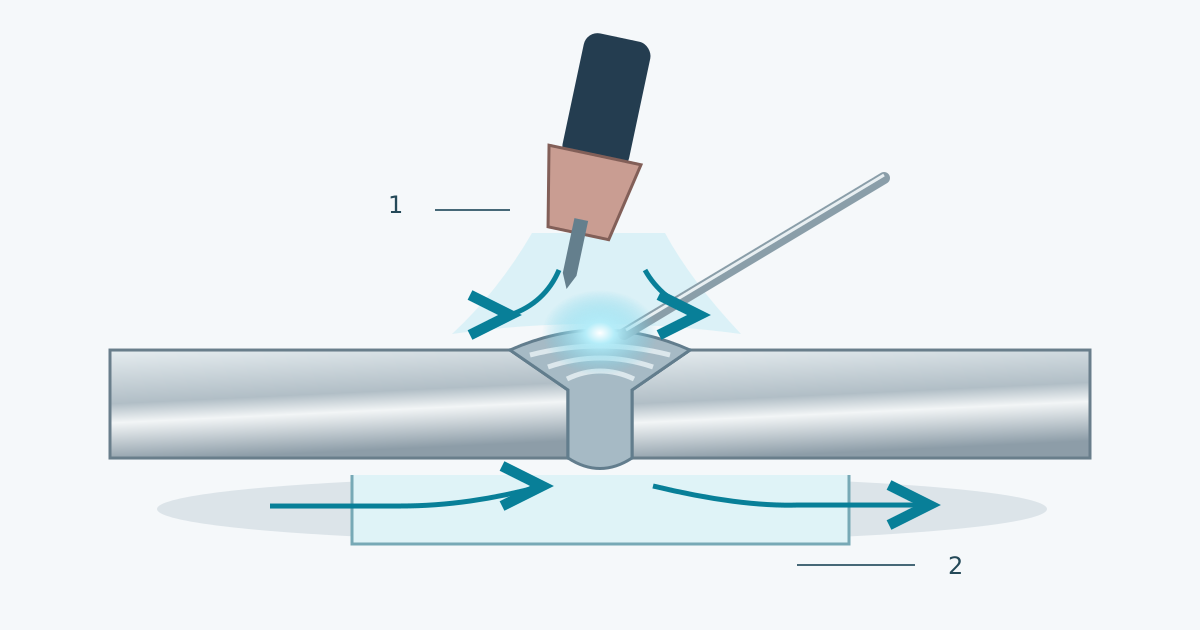
Use the shielding and backing gas specified for the process, consumable and WPS. Pure argon is common for TIG shielding and is widely used for backing, while qualified MIG procedures may use process-specific argon-rich mixtures. Do not transfer a carbon-steel MIG gas recipe to stainless without checking the approved procedure.
6. Control heat input and distortion
Austenitic stainless steels conduct heat less readily and expand more with temperature than carbon steel. Thin sheet can therefore distort quickly if a long weld concentrates heat in one area.
Practical controls include:
- fit and tack the joint accurately before continuous welding;
- use the lowest heat input that still produces the required fusion and profile under the qualified procedure;
- sequence short welds to spread shrinkage rather than accumulating it in one direction;
- use balanced welding, fixtures or chill tooling where the design and procedure permit;
- allow suitable interpass cooling rather than repeatedly reheating a small area;
- avoid oversized beads that add heat without adding useful joint capacity.
Do not turn those points into a universal amperage or travel-speed table. Current, voltage, travel speed, wire diameter, joint design, position and thickness interact, and code work should follow a qualified WPS.
7. Watch the root, fusion and surface—not only bead appearance
A smooth-looking face does not prove that the joint has acceptable penetration or an oxidation-free root. During welding, control:
- arc length and torch angle appropriate to the process;
- filler addition and travel so the pool does not overheat;
- shielding-gas coverage before, during and immediately after the molten pool passes;
- root purge until the procedure allows it to stop;
- interpass cleaning when multiple passes are required;
- tack weld quality so defective tacks are not simply buried.
For thin sheet, distortion and burn-through often become limiting before deposition rate does. For thicker or highly restrained joints, procedure qualification and crack control become increasingly important.
8. Remove heat tint where corrosion performance requires it
Heat tint is the visible oxide formed beside a stainless weld. Under that oxide, the near-surface region can be depleted in chromium. In aqueous or otherwise corrosion-sensitive service, leaving significant heat tint can reduce local corrosion resistance.
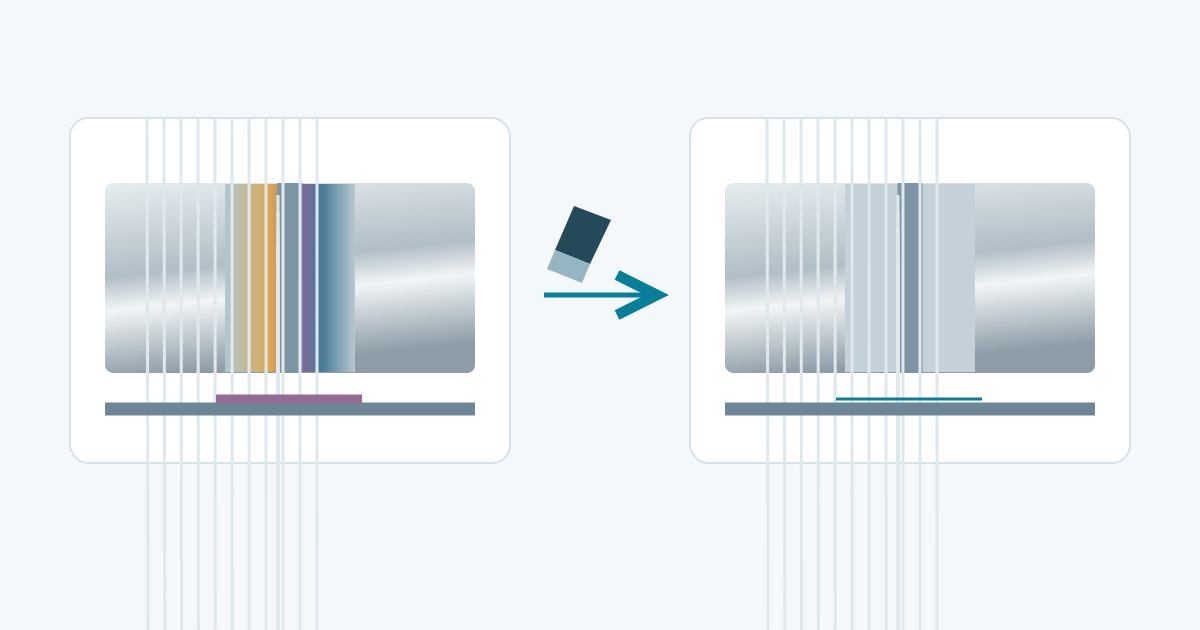
Mechanical cleaning, pickling, electrochemical cleaning and passivation are different operations. ASTM A380/A380M-25 covers cleaning, descaling, pickling and passivation practices; ASTM A967/A967M-25 covers chemical passivation treatments for stainless steel parts. Use a method compatible with the alloy, required finish and safety controls.
Do not use an ordinary carbon-steel wire brush to “clean” a stainless weld.
9. Dissimilar stainless-to-carbon-steel joints need dilution control
Austenitic stainless can be welded to carbon or low-alloy steel, but the filler is normally selected to tolerate dilution from the less-alloyed side. 309L-family consumables are widely used for many such combinations, subject to the WPS and service conditions.
Also consider what happens after welding. A stainless-to-carbon joint can create coating, corrosion and appearance issues outside the fusion zone. If the carbon-steel side is painted or coated, the transition detail belongs in the fabrication specification.
10. Ferritic, martensitic and duplex grades are not “304 with different chemistry”
This guide’s simple workflow applies broadly, but the thermal limits do not.
- Ferritic stainless: grain growth and embrittlement risks can drive filler and heat-control decisions.
- Martensitic stainless: preheat, hydrogen control and post-weld heat treatment may be essential for some grades and thicknesses.
- Duplex stainless: heat input, interpass control and filler/shielding practice are used to preserve an acceptable ferrite-austenite balance and corrosion performance.
- Precipitation-hardening stainless: welding and subsequent heat treatment depend on the alloy and required final condition.
If the job is not a common 304/316 austenitic fabrication, move to the grade-specific procedure rather than extrapolating from an austenitic recipe.
11. Welding fume is a process hazard, not a quality detail
Stainless welding fume can contain chromium and nickel compounds, including hexavalent chromium under some processes and conditions. Use the applicable workplace exposure controls, local exhaust ventilation and respiratory protection program required by your jurisdiction and risk assessment. Process selection and shielding practice can also change fume generation.
This is one reason shop qualification includes more than bead appearance.
A compact pre-weld checklist
| Check | Question |
|---|---|
| Material | What exact stainless grade and product condition am I joining? |
| Joint | What thickness, fit-up, penetration and position are required? |
| Procedure | Which WPS/code/customer requirement governs the weld? |
| Consumable | Does the filler match both base metals and the service condition? |
| Cleanliness | Are oil, oxides and carbon-steel contamination controlled? |
| Shielding | Is face shielding correct, and does the root need purging? |
| Heat | How will the sequence limit distortion and excessive heat input? |
| Finish | What heat-tint removal, cleaning, passivation and inspection are specified? |
Scroll within the table to see all columns →
See the stainless welding references for the source set used for this guide.
Can I weld 304 stainless with 308L filler?
ER308L is a common bare-wire/rod family for 304/304L austenitic fabrication. The approved filler still depends on the WPS, service and joint combination.
Can I weld 316 stainless with 308L?
A qualified procedure may permit different combinations, but ER316L is the usual matching bare filler family when the weld is intended to retain the molybdenum-bearing 316L weld-metal chemistry. Do not substitute only because both fillers will make a bead.
Do I always need to back-purge stainless steel?
No. The need depends on joint type, penetration, process, service and acceptance criteria. For single-sided full-penetration welds where the root surface matters, inert back purging is commonly used to prevent severe root oxidation.