
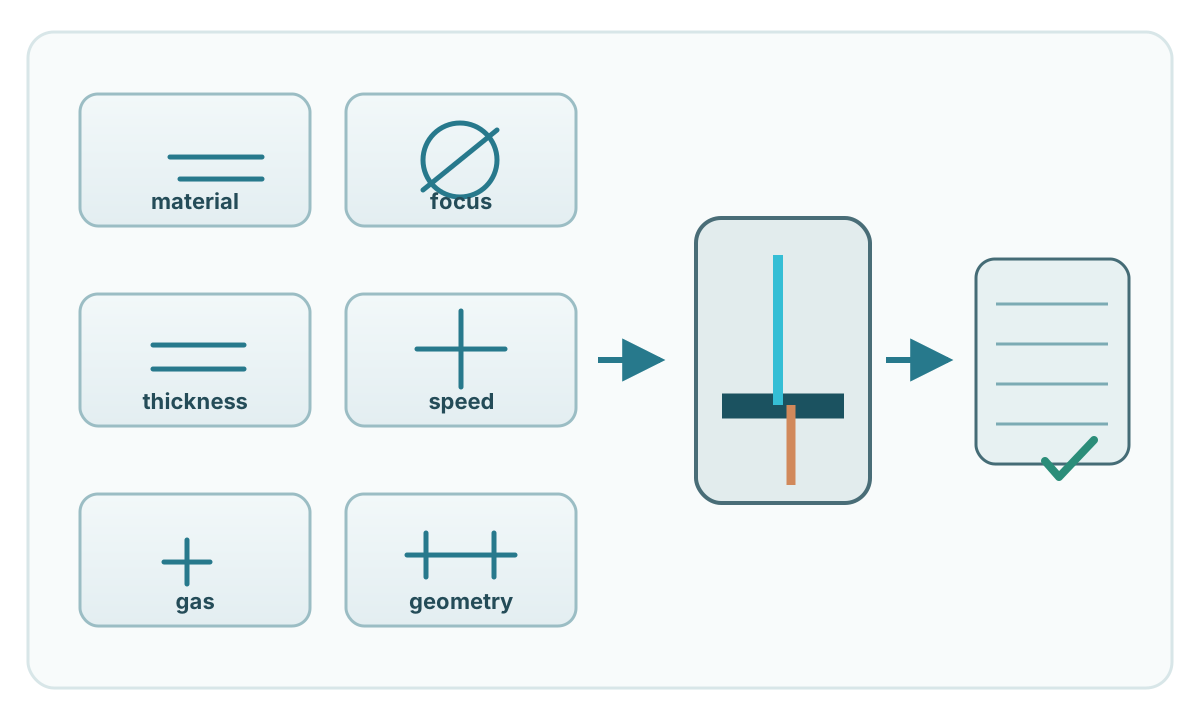
Laser cutting can produce accurate contours and small features in steel sheet, yet the result depends on the complete process window. Grade, coating, actual thickness, laser power, focus, nozzle condition, assist gas, speed, piercing strategy and part geometry all influence the edge. Downstream welding, bending, painting or visible-finish requirements then determine whether that edge is acceptable.
A useful specification therefore starts with the finished part. Define the material and thickness, identify the edge condition needed by the next operation, and let the laser process be qualified to those requirements.
Quick process selector
| Decision | Typical options | What it changes |
|---|---|---|
| Material | Low-carbon steel, stainless steel, coated steel, high-strength steel | Absorption, oxidation behavior, cut recipe, edge treatment and forming sensitivity |
| Assist gas | Oxygen, nitrogen, argon, qualified mixed-gas process | Cutting speed, oxidation, gas cost, edge chemistry and downstream cleaning |
| Thickness | Within the qualified range of the specific machine and process | Power density, speed, piercing, kerf evacuation and achievable quality |
| Geometry | Outside contours, holes, slots, narrow webs, sharp corners | Heat accumulation, motion limits, pierce location and dimensional control |
| Acceptance | Burr/dross, edge angle, striation, oxidation, dimensional tolerance | Need for deburring, grinding, cleaning or a different process recipe |
Scroll within the table to see all columns →
1. Start with the actual steel product
Identify the grade, delivery condition, actual thickness range and surface condition before selecting a cutting recipe. Low-carbon sheet, stainless sheet, galvanized sheet, prepainted products and high-strength steels can respond differently to heat and assist gas.
Nominal gauge is weak process information. Program and qualify the cut against measured thickness in millimetres or inches and the relevant product tolerance. When coated or decorative surfaces are involved, confirm which face must remain protected and whether film, scale, zinc, oil or paint changes the cutting or cleaning plan.
If material choice is still open, use the steel sheet thickness guide before finalizing the cutting specification.
2. Choose assist gas from the required edge condition
TRUMPF describes two common sheet-metal modes. In laser flame cutting, oxygen reacts with heated steel and adds chemical energy to the process. This is widely used for low-carbon steel and leaves an oxidized cut surface. In laser fusion cutting, nitrogen or argon expels molten metal while shielding the kerf from air, which can produce an oxide-free edge.
The practical decision depends on the next operation:
- Low-carbon steel: oxygen may provide an efficient cutting window on many machines, especially as thickness increases. Nitrogen or qualified mixed-gas processes can be selected where an oxide-free edge, painting, welding or reduced edge preparation has higher value.
- Stainless steel: nitrogen is commonly selected when a clean, oxide-free edge is required. The exact pressure and recipe remain machine- and thickness-specific.
- Coated steel: the coating, cut face and downstream corrosion requirement need separate review. A clean-looking edge does not restore the metallic coating on the cut surface.
Gas type, purity, pressure, nozzle design and stand-off belong to the machine recipe. Published values from one machine should not be copied into another system.
3. Treat thickness as a machine-process qualification
Laser power does not create a universal maximum thickness. Beam delivery, wavelength, optics, nozzle, gas supply, machine dynamics, material condition and the required quality all matter.
ISO 9013:2017 classifies geometrical quality and tolerances for thermal cuts, including laser cuts within the standard’s stated dimensional scope. That scope is a quality-standard scope. It is not a capacity rating for an individual laser system.
For purchasing or subcontracting, ask the supplier to qualify the specific material/thickness combination and the required edge condition. A machine may physically separate a thicker plate while failing the burr, angularity, roughness, hole or productivity requirement of the job.
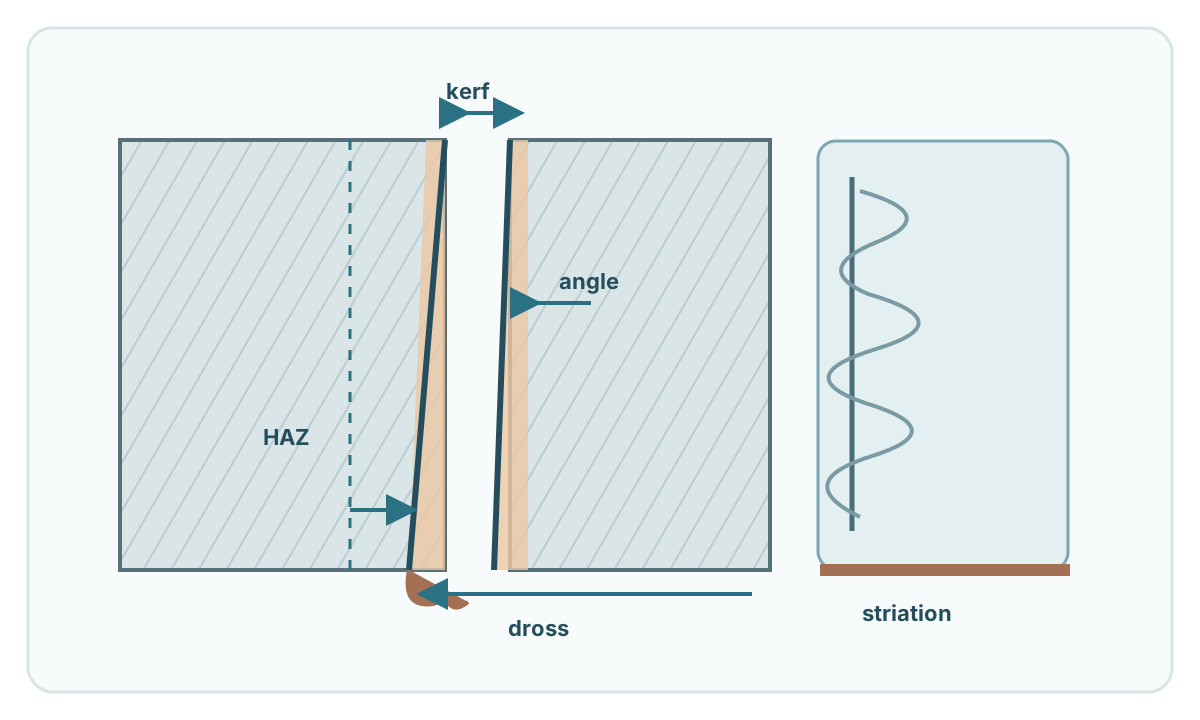
4. Define edge quality in measurable terms
“Laser quality” is too vague for acceptance. The drawing or purchase requirement should state the features that matter, for example:
- maximum burr or adherent dross;
- allowable edge angularity or taper;
- surface-profile or striation requirement where relevant;
- visible oxidation or scale condition;
- dimensional and profile tolerance;
- acceptable heat discoloration;
- whether the edge must be ready for welding, bending, coating or cosmetic finishing.
ISO 9013 can provide a common language for thermal-cut geometry when it is explicitly invoked by the drawing or delivery document. If the standard is not invoked, define the required acceptance criteria directly.
5. Holes, slots and sharp corners need their own capability check
Small holes, narrow webs and sharp corners concentrate process sensitivity because the beam, motion system and gas jet have less geometric margin. Piercing can also add local heat and spatter near the start point.
Avoid one universal minimum-hole-diameter rule. Hole quality depends on thickness, laser type, power, material, assist gas, piercing strategy and the machine’s control system. Critical holes can be laser-cut undersize and finished by drilling, reaming or machining when the tolerance, cylindricity or surface requirement exceeds the qualified laser capability.
For nested parts, verify common-line cutting, lead-in placement and heat accumulation around small bridges or closely spaced contours.
6. Account for the heat-affected edge before bending
Laser cutting is a thermal process. The width and significance of the heat-affected edge vary with material and process parameters. For many ordinary sheet-metal parts the affected zone is narrow, yet high-strength or bend-critical applications may be sensitive to cut-edge condition.
When a laser-cut edge lies on or very near a tight bend line, check the steel producer’s forming guidance. Burrs, sharp edge defects, work hardening from earlier operations and thermally affected material can all reduce bendability. A qualified route may require edge dressing, a larger bend radius, a different cut orientation or additional distance between the cut edge and bend.
The sheet-metal bending guide covers the forming setup after cutting.
7. Protect visible surfaces and coated products
Polished stainless, prepainted sheet and finished architectural panels can be damaged by spatter, debris, handling or unsuitable protective film. Confirm whether the film is laser-compatible and whether it remains on during cutting.
For galvanized sheet, the cut edge exposes the substrate and zinc-rich layers at the edge. The corrosion plan should consider edge exposure, part geometry and the intended environment. For painted parts, verify whether any oxide, residue or protective film interferes with pretreatment or coating adhesion.
8. Separate dimensional accuracy from edge appearance
A smooth-looking edge can still miss a dimensional requirement, and a dimensionally accurate part can still carry dross or oxidation that creates problems later. Inspection should therefore cover geometry and edge condition separately.
Measure critical dimensions from the drawing datum scheme. For repeat work, record the qualified material, thickness, gas, program revision and machine family so that a later batch can be reproduced with less trial adjustment.
9. Specify from the downstream operation backward
A laser-cut blank that will be welded needs fit-up, edge cleanliness and joint preparation suitable for the welding procedure. A blank that will be press-brake formed needs edge condition and bend-line placement compatible with the material’s bendability. A painted component may require oxide removal or a process that leaves the edge ready for pretreatment.
This downstream view prevents a cut from being accepted at the laser while creating extra work in the next cell.
10. What to put on a laser-cutting RFQ or drawing
Include:
- steel grade and product standard where applicable;
- actual nominal thickness and tolerance basis;
- coating, finish and protected face;
- drawing revision and CAD geometry;
- critical dimensions and datums;
- required edge condition, burr/dross limit and oxidation requirement;
- holes or features that need special tolerance;
- whether the part is subsequently bent, welded, painted, plated or left visible;
- quantity and repeatability expectations;
- any invoked thermal-cut standard or inspection class.
For a broader comparison with shearing, sawing, plasma and waterjet, see How to Cut Sheet Metal .
Standards and safety context
ISO 9013:2017 covers classification and geometrical quality/tolerance terminology for specified thermal cuts, including laser cutting. It applies when referenced in drawings or relevant delivery documents.
Laser systems also require machine guarding, interlocks, fume extraction and operating controls appropriate to the laser class, material and jurisdiction. Follow the machine manufacturer’s safety instructions and the site’s applicable workplace requirements. Zinc-containing coatings, stainless alloys and painted surfaces can change the fume-control requirement.
A robust laser-cut specification defines the material, geometry and edge needed by the finished part, then verifies that the selected machine, gas and recipe can deliver that result consistently.