
Temper rolling, often called skin passing, is a finishing rolling operation that introduces a controlled amount of plastic deformation into steel strip. It can change the onset of yielding, transfer the work-roll texture and improve flatness. Steel grade, incoming condition and mill controls determine the result.
Where the operation fits
For annealed cold-rolled strip, skin passing commonly follows annealing, either in a separate mill or within a continuous line. It can also follow the coating stage on a galvanizing line; hot-rolled and stainless strip have their own processing routes. In sheet-and-strip production, temper rolling and skin passing are often used for the same finishing operation; a supplier’s process description establishes the exact scope.
| Operation | Main mechanism | Distinction |
|---|---|---|
| Temper rolling / skin pass | Controlled plastic deformation between rolls | Adjusts mechanical response, texture and flatness |
| Bulk cold reduction | Larger thickness reduction through rolling | Establishes gauge and introduces substantial cold work |
| Annealing | Controlled heating and cooling | Can restore ductility through recovery and recrystallization, depending on cycle |
| Thermal tempering | Heat treatment, commonly after hardening | Changes the structure and properties of hardened steel |
| Roller or tension leveling | Repeated bending, with tension in tension leveling | Primarily addresses strip shape; can also alter yielding |
Scroll within the table to see all columns →
A skin-pass mill and a tension leveler can work in the same line. Their settings and effects remain distinct. The annealed-steel overview explains the incoming heat-treated product, while hot-rolled and cold-rolled steel covers the broader production routes.
Why yielding becomes more continuous
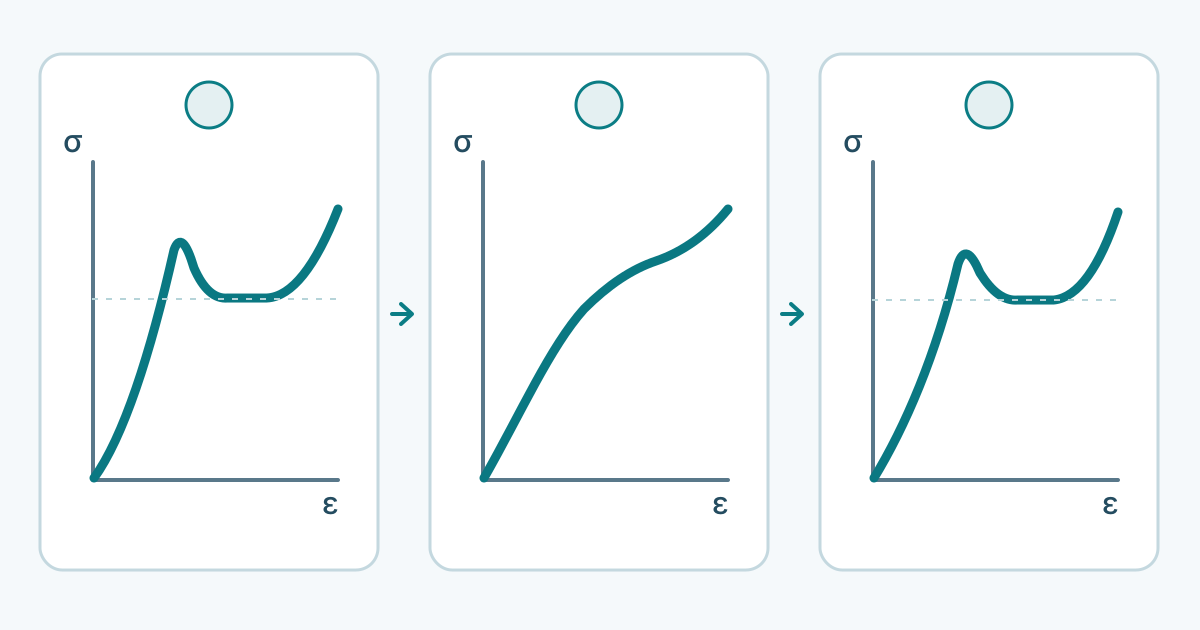
Some annealed low-carbon steels show an upper yield point followed by a lower-stress plateau. Plastic deformation spreads through localized Lüders bands during this yield-point elongation. Subsequent pressing can leave visible stretcher-strain markings.
A controlled skin pass introduces plastic strain before forming and can suppress the sharp yield transition in susceptible steel. This helps reduce the risk of those markings. Yield-point elongation is a particular part of the tensile curve; it differs from total elongation at fracture and from the elongation imposed by the mill. See yield strength of steel .
Texture and flatness are separate outcomes
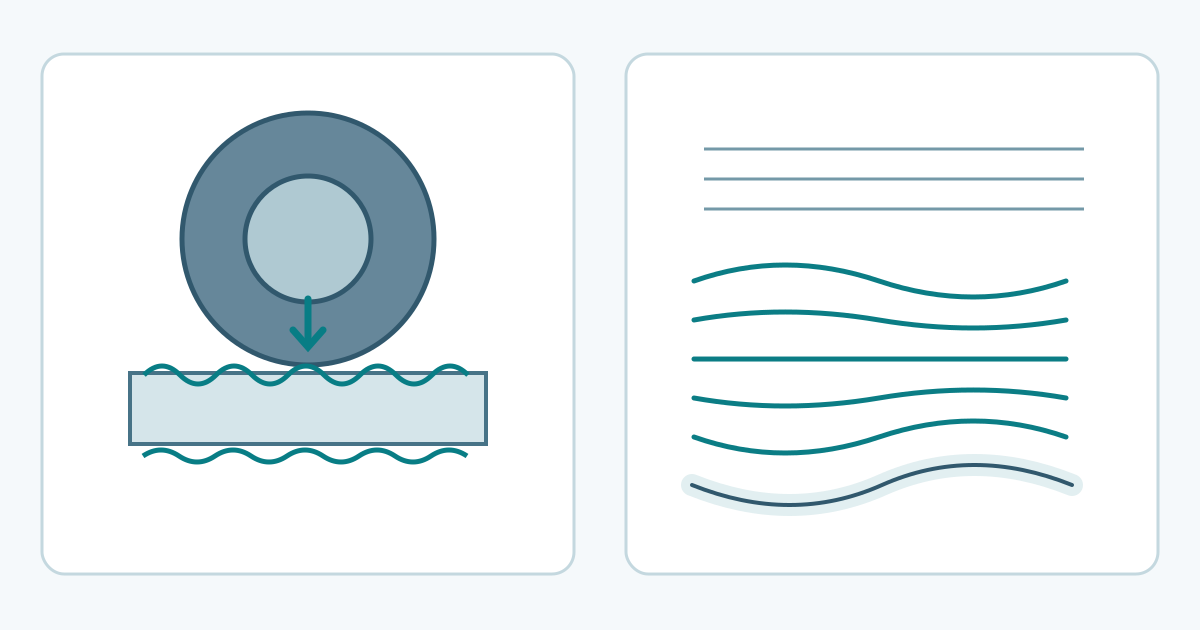
Contact with the work rolls changes the strip’s surface texture. How much texture transfers depends on the incoming strip, lubrication, contact pressure and the condition of the textured rolls. A specified roughness value alone does not describe every feature relevant to painting or forming; peak distribution and waviness may also matter.
Flatness depends on the distribution of longitudinal extension across strip width. Roll geometry, bending controls and strip tension influence that distribution. Skin passing can improve strip shape, but no guarantee of stress-free material follows from the name. Later slitting or cutting may reveal distortion that was restrained in the coil.
Why steel grade and storage change the result
In susceptible ferritic steels, interstitial carbon and nitrogen can interact with dislocations. After prior deformation, time and temperature can allow renewed pinning: strain ageing may raise the flow stress and restore discontinuous yielding. The duration of the skin-pass effect depends on chemistry, prior processing and the subsequent time–temperature history.
Interstitial-free steels use chemistry and processing to reduce dissolved interstitials; their behaviour differs from conventional ageing-prone mild steels. Stainless and advanced high-strength grades also require their own assessment. A mechanism illustrated for annealed low-carbon steel cannot describe every steel passed through the same mill.
Prior reduction, annealing history, phase structure and any coating affect the incoming material. A later thermal exposure can change its response again. There is no single storage lifetime or reduction percentage that guarantees the same forming behaviour across these products.
How to interpret a skin-pass description
“Skin passed” identifies a processing step. Interpreting a coil requires the grade and delivery condition, specified mechanical properties, surface requirements and flatness requirements. The test date, storage history and planned forming operation also matter where ageing is relevant.
A mill elongation target is not interchangeable with a thickness-reduction percentage. They are related through volume conservation only after width change and the relevant measurement conditions are considered. Roll force, tension and speed require a process validated for the particular grade and line.
For a formed panel with visible bands, compare current tensile behaviour and processing/storage history before attributing the defect solely to surface roughness. For a strip that changes shape after cutting, examine the shape and residual-stress history as a separate question. Neither observation establishes a mill adjustment on its own.
Sources and scope
This explanation uses equipment-manufacturer descriptions for process functions, steelmaker guidance for product differences, and university teaching material for yield-point and strain-ageing mechanisms. Diagrams are qualitative and carry no numerical operating limits. Source notes identify the checked references; product specifications and agreed acceptance methods govern an actual coil.