
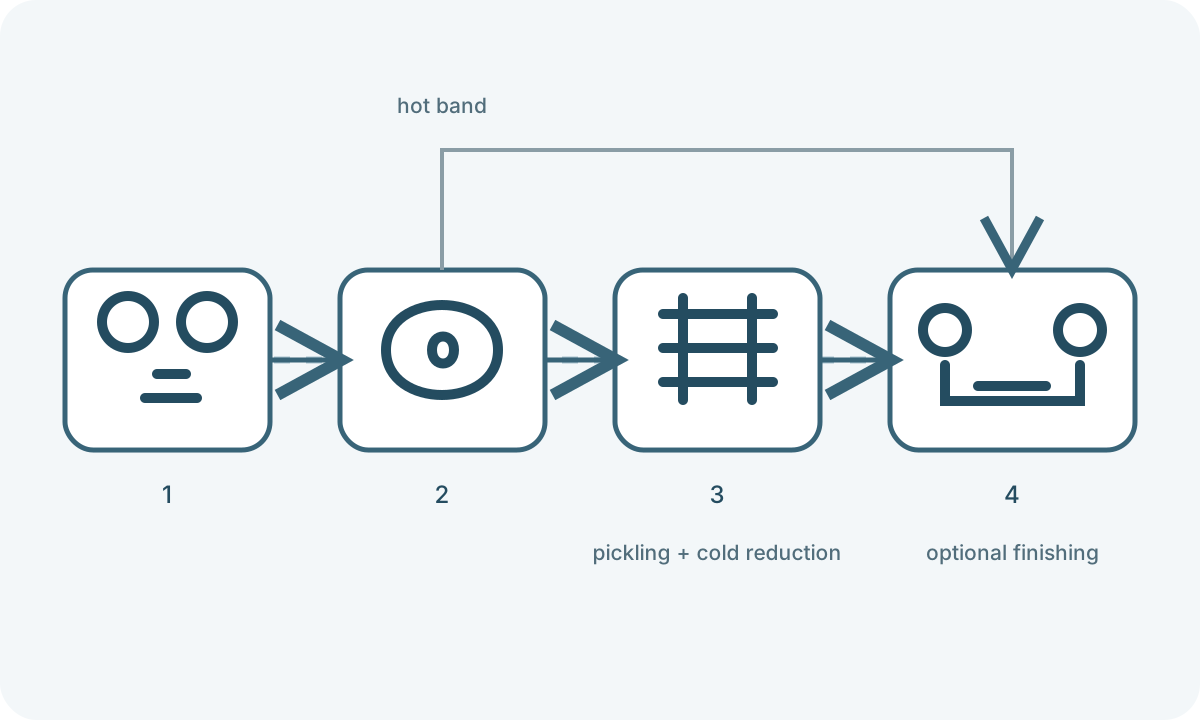
Hot rolled and cold rolled steel describe processing routes and delivery conditions, not single steel grades. A useful comparison starts with the product form, grade, thickness, surface requirement and fabrication route. Cold-rolled sheet commonly begins as hot-rolled strip that is pickled to remove scale, then reduced at room temperature or below the steel’s recrystallization temperature. The additional reduction and finishing stages change surface condition, dimensional control and mechanical response.
Quick comparison
| Factor | Hot rolled steel | Cold rolled steel |
|---|---|---|
| Process route | Rolled at high temperature; may be supplied as-rolled or pickled/oiled | Usually starts from hot-rolled strip, then pickled and cold reduced; annealing and temper rolling may follow |
| Surface | As-rolled material can show mill scale and a more variable texture; pickled products are cleaner | Generally smoother and better suited to exposed or finish-sensitive sheet applications |
| Dimensional control | Suitable for a wide range of structural and fabricated products; tolerances depend on specification and mill capability | Commonly selected when tighter thickness, flatness or shape control is important in thinner sheet |
| Mechanical response | Properties depend on grade and delivery condition | Cold reduction introduces work hardening; later annealing can restore ductility and set the required property range |
| Typical use | Frames, welded fabrications, structural parts, heavier-gauge components | Appliance panels, enclosures, automotive parts, precision-formed and visible sheet components |
Scroll within the table to see all columns →
How the processing routes differ
Hot rolling reduces steel at temperatures high enough for the material to deform readily. After the final passes, the strip cools and coils. The cooling stage, scale formation, grade chemistry and rolling schedule all influence the finished product.
Cold-rolled sheet normally adds several downstream steps. Hot-rolled strip is pickled to remove oxide scale, then passed through cold-reduction mills. Cold deformation raises dislocation density and can increase strength while reducing ductility. Many commercial cold-rolled grades are subsequently annealed and may receive a light temper or skin pass to obtain the specified formability, flatness and surface condition.
This sequence explains why the label alone cannot predict strength. A cold-worked condition can be stronger than its starting hot band, while an annealed cold-rolled grade may be engineered for deep drawing and high ductility.
Surface finish and scale
As-rolled hot steel can carry mill scale and a visibly less uniform surface. Pickled and oiled hot-rolled material removes most scale and gives fabricators a cleaner starting surface, so “hot rolled” does not always mean a heavily scaled finish.
Cold-rolled sheet is commonly chosen where the surface will remain visible, receive a thin coating, or pass through precision forming. The smoother surface also supports appearance-sensitive stamping and finishing. Surface-quality classes still matter; purchasing documents should specify the finish or surface requirement instead of relying on the words “cold rolled.”
Tolerances, thickness and flatness
Cold rolling is widely used for thin sheet that needs close thickness control, consistent shape and repeatable forming. Hot-rolled products cover broader thickness ranges and are often appropriate where fabrication tolerance is driven by welding, machining or structural fit-up.
There is no universal tolerance value for either family. Standards, grade, width, thickness and mill capability define the actual limits. Specialized hot-rolled strip can achieve close tolerances, so procurement should compare the applicable standard and mill data rather than use a generic rule.
Strength, hardness and formability
Cold reduction can increase yield strength and hardness through strain hardening. That effect depends on reduction ratio and later heat treatment. Annealed cold-rolled sheet can be supplied specifically for forming, including demanding draw operations.
Hot-rolled grades also span a wide property range, from general-purpose low-carbon sheet to high-strength low-alloy products. For design work, compare the specified grade and delivery condition. The words “hot rolled” and “cold rolled” describe processing; the mechanical-property table in the relevant specification governs design values.
Welding and fabrication
Both product families can be weldable when the selected grade, thickness and welding procedure are suitable. Carbon equivalent, alloy content, coating, joint restraint and section thickness can matter more than the rolling route.
For bending and stamping, cold-rolled sheet often provides more predictable surface and dimensional behavior. Hot-rolled sheet can be attractive for welded frames, brackets and thicker parts where surface appearance is secondary or where later blasting, coating or machining is planned.
Cost and purchasing
Hot-rolled products often require fewer downstream processing steps, which can support a lower mill conversion cost for comparable commodity products. Actual purchase price varies with grade, dimensions, order volume, surface treatment, market conditions and local availability. Cold-rolled sheet may reduce downstream finishing or improve yield in precision parts, so part cost should be evaluated across the manufacturing route.
A purchase specification should state at least the standard and grade, product form, nominal thickness and width, tolerance or shape requirements, surface condition, coating if any, and required mechanical properties.
Which one should you choose?
Choose hot-rolled steel when the part is relatively thick, structural or fabrication-focused, when an as-rolled or pickled surface is acceptable, and when downstream welding, machining or coating controls the final geometry.
Choose cold-rolled steel when thin-gauge dimensional consistency, smooth surface, appearance, stamping repeatability or close-fitting formed geometry has high value.
If the application sits between these groups, compare an actual hot-rolled and cold-rolled specification at the required grade and thickness. The correct decision comes from the finished-part requirements and the mill specification.