
Carbon steel and stainless steel are both large steel families. The useful comparison starts with the service condition and the specific grade. Carbon steel is widely used for structures, machinery and general fabrication because it offers broad grade availability and economical processing. Stainless steel adds enough chromium to form a protective passive surface film, giving it a major advantage where corrosion resistance, hygiene or reduced coating maintenance matters.
A family name does not tell you which material is stronger, easier to form or cheaper over the life of a part. Those answers depend on grade, product form, thickness, condition, fabrication route and exposure.
Carbon steel vs stainless steel at a glance
| Decision point | Carbon steel | Stainless steel |
|---|---|---|
| Corrosion strategy | Often relies on paint, zinc coating, plating, oil or corrosion allowance in wet service | Chromium-rich passive film provides inherent corrosion resistance; grade still has to match the environment |
| Grade range | Low-, medium- and high-carbon grades plus product-specific structural, sheet, bar and tube grades | Austenitic, ferritic, martensitic, duplex, precipitation-hardening and other grades |
| Typical first-cost trend | Usually lower for common commodity grades | Usually higher, with alloy content and grade having a strong effect |
| Welding | Low-carbon grades are often straightforward; higher carbon/equivalent and restraint can increase cracking controls | Procedure depends on stainless family, filler, heat input, shielding and corrosion-service requirements |
| Magnetic response | Most common carbon steels are strongly ferromagnetic | Varies by family; ferritic and martensitic grades are magnetic, while annealed austenitic grades are usually weakly magnetic and may become more magnetic after cold work |
| Maintenance | Protective systems may require inspection and renewal | Can reduce coating maintenance in a suitable environment, while cleaning and corrosion control may still be required |
Scroll within the table to see all columns →
What makes stainless steel “stainless”?
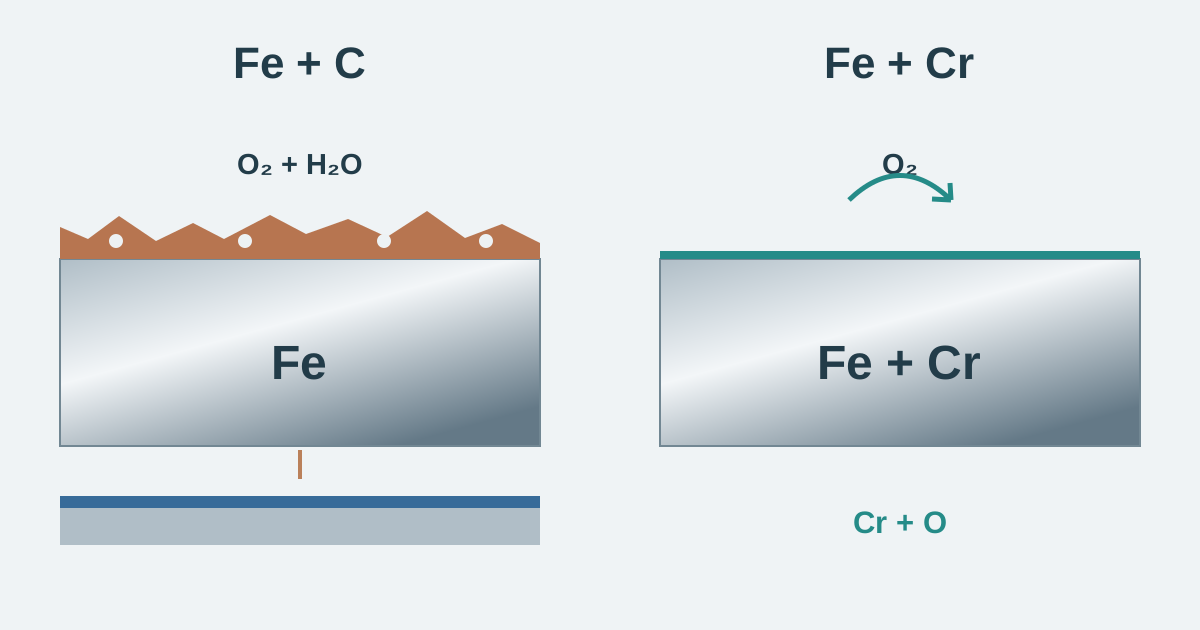
worldstainless defines stainless steels as iron-base alloys containing at least 10.5% chromium. Chromium reacts with oxygen to form a very thin, chromium-rich passive film. When the surface is clean and oxygen is available, that film can reform after minor damage.
This mechanism changes the corrosion strategy. Bare carbon steel commonly forms iron-oxide corrosion products in wet, oxygenated conditions, so designers often use paint, metallic coatings such as zinc, plating, inhibitors or corrosion allowance. Stainless steel places more of the protection in the alloy itself.
Corrosion resistance still has limits. Chlorides, acids, temperature, crevices, deposits, surface condition and grade selection can cause pitting, crevice corrosion, stress-corrosion cracking or other attack on stainless steel. The Does Stainless Steel Rust? page covers those mechanisms in more detail.
Strength and hardness: compare grades, not families
A broad claim such as “stainless is stronger” or “carbon steel is stronger” creates bad specifications. Both families include soft, formable products and high-strength grades.
A low-carbon drawing sheet is selected for ductility. A structural carbon-steel plate is selected to a specified strength system. Martensitic stainless can be heat treated to high hardness. Austenitic stainless can gain substantial strength through cold work. Duplex stainless combines a different strength/corrosion profile again.
For engineering work, compare the required yield strength, tensile strength, elongation, hardness, toughness, fatigue behavior and temperature capability in the governing product standard. Product form and thickness can change specified values even when the grade name stays the same.
Fabrication: carbon content, alloy family and condition matter
Common low-carbon steels are widely used for bending, stamping and welding. As carbon content, hardenability, section thickness and joint restraint rise, welding procedure controls such as preheat and hydrogen management can become more important.
Stainless fabrication has a different set of priorities. Austenitic grades such as 304 and 316 are generally formable and weldable, but their higher thermal expansion and lower thermal conductivity can increase distortion during welding. Clean tooling matters because embedded carbon-steel contamination can create rust staining. Heat tint and root oxidation can reduce corrosion performance where service is demanding.
Machining behavior also varies. Many austenitic stainless grades work-harden readily, so tooling, feed, rigidity and heat removal need attention. Carbon steels span free-machining grades, soft sheet grades and hard heat-treated grades; the family label gives no universal machining rule.
For stainless welding details, see How to Weld Stainless Steel .
Physical properties can change the design
Density is close enough that it rarely drives a carbon-versus-stainless decision by itself. A representative non-alloy steel is about 7.8 kg/dm³ and 304 stainless about 7.9 kg/dm³ in Outokumpu’s comparison data.
Thermal behavior can matter much more. The same source lists room-temperature thermal conductivity around 55 W/(m·K) for a representative non-alloy steel and around 15 W/(m·K) for 304-family austenitic stainless. Austenitic stainless also has a higher coefficient of thermal expansion than typical non-alloy steel. These differences affect heat exchangers, welded assemblies, hot components and dimensional control.
Use grade-specific data for calculations. Ferritic stainless, duplex stainless and other carbon-steel grades can differ substantially from the 304-versus-non-alloy example.
Corrosion protection and total cost
Common carbon steel usually has the lower raw-material cost. The installed cost can change once surface preparation, galvanizing, painting, touch-up, inspection, shutdowns and recoating are included.
Stainless can justify a higher initial material price where access for maintenance is poor, cleanliness is important, repeated coating renewal is costly, or contamination from coating breakdown is unacceptable. Carbon steel can remain the economical choice in dry indoor service, protected structures and applications where a coating system is already part of the design.
The useful comparison is life-cycle cost for the actual environment, not price per kilogram alone.
Which should you choose?
| Service need | Practical starting point | What to verify |
|---|---|---|
| Dry indoor frame or general fabrication | Carbon steel often gives the lowest-cost starting point | Strength grade, finish and any paint requirement |
| Outdoor structure with planned coating maintenance | Coated carbon steel is often practical | Exposure category, coating system, edges, drainage and maintenance interval |
| Food, pharmaceutical or cleanable equipment | Stainless is often favored | Grade, surface finish, cleaning chemistry and hygienic design |
| Chloride-bearing or coastal exposure | Stainless may offer lower maintenance, but grade selection is critical | Chloride level, temperature, crevices and whether 304, 316 or a higher alloy is required |
| High-hardness wear part | Either family may work | Heat treatment, target hardness, toughness and corrosion requirement |
| Welded production component | Choose from grade + procedure + service | Weldability, distortion, filler, post-weld finish and corrosion protection |
Scroll within the table to see all columns →
Specify the material beyond the family name
“Carbon steel” and “stainless steel” are procurement starting points. A purchase specification should identify the applicable product standard and grade, product form, dimensions and tolerances, delivery condition, surface finish or coating, mechanical requirements, testing and any fabrication-critical requirements.
Likewise, “mild steel” is a common low-carbon description and does not identify a complete grade. The existing Carbon Steel reference explains that naming issue and remains the owner of the broad mild-steel definition intent.
Bottom line
Choose carbon steel when its grade can meet the mechanical requirement and the planned corrosion-control system is practical. Choose stainless when corrosion resistance, cleanability or reduced coating maintenance provides enough value to justify the alloy and fabrication requirements. For either family, the final decision belongs at grade-and-service level.