
Steel leveling and flattening overlap in workshop and supplier terminology. “Flattening” describes making a sheet or part flatter; it does not identify one exclusive machine. “Leveling” often names a controlled process, such as roller leveling, but the label alone proves neither a flatness tolerance nor freedom from residual stress. A useful comparison separates the method, the measured shape and the behaviour after further processing.
Why the names are not a specification
A supplier may call its roller leveler a flattening machine. Another may use flattening for local press correction. Both descriptions can be legitimate. Ask which operation was performed and what result was checked, rather than assigning an automatic quality ranking to the two words.
| Description | What it identifies | What remains to be established |
|---|---|---|
| Flattened sheet | A claimed improvement in shape | Method, inspection condition and acceptance limit |
| Roller-leveled sheet | Alternating bending through offset rolls | Capability for the grade and dimensions; actual result |
| Stretcher-leveled sheet | Tensile plastic extension | Applicable product range and subsequent processing behaviour |
| Flatness inspection | Geometry under a stated condition | Residual-stress distribution and stability after cutting |
Scroll within the table to see all columns →
What roller leveling changes
Offset rolls bend the material successively in opposite directions. Where bending exceeds the elastic range, part of the thickness undergoes plastic deformation. Controlled alternating bending can correct shape and redistribute residual stresses; it does not establish that every location is stress-free.
Roll diameter and spacing, support stiffness, penetration, material thickness and yield strength affect the response. A machine’s maximum thickness is therefore incomplete without its strength and width basis. Reusing a mild-steel setting for a higher-strength sheet of equal thickness requires validation, not assumption.
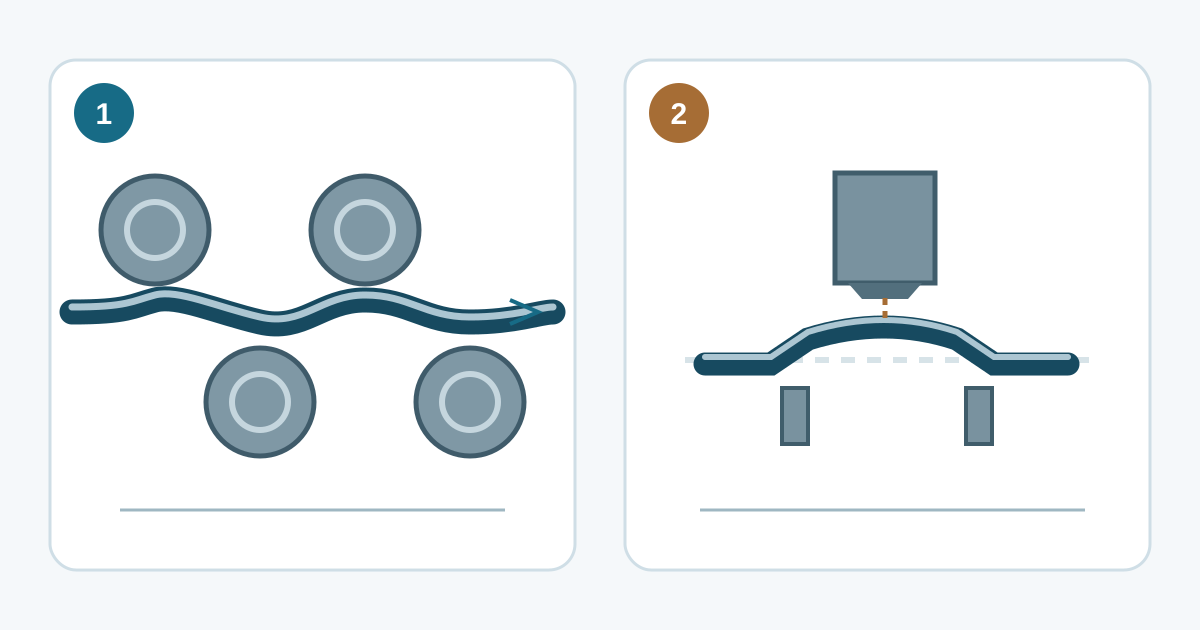
These are mechanical corrections, distinct from thermal stress-relief heat treatment. Low ductility, hardening, perforations and delicate coatings can limit an otherwise plausible process; assess the actual material and part rather than relying on thickness alone.
A local press correction can address a particular bend. Precision roller leveling treats material through a sequence of bends. Their suitability depends on the part geometry, quantity, incoming condition and required result; this is not a universal ranking of presses against rolls.
Shape has more than one form
Coil set is curvature along the former coiling direction. Crossbow is curvature across the width. Edge wave and centre buckle involve unequal longitudinal lengths across the strip. A process that visibly removes coil set may leave other shape defects unresolved.
Longitudinal tension can hold a strip apparently flat and hide waviness that returns when tension is released. Support, clamping and self-weight also affect what is observed. Compare results under the same agreed measurement conditions. A photograph of a supported stack cannot substitute for that inspection.
Stretching, tension leveling and skin passing
Stretcher leveling applies tensile extension beyond yielding to a gripped length. Tension leveling combines strip tension with bending rolls. These terms describe different arrangements; confirm the actual equipment rather than treating them as interchangeable.
Skin passing is a separate finishing rolling operation with mechanical-response and surface-texture effects. It can improve shape too. No process name, including “precision,” supplies a universal tolerance, zero residual stress or a guarantee that later heat input will leave the part unchanged.
Flat now and stable after cutting are separate questions
Imagine two sheets that both meet the agreed delivery flatness limit. Narrow strips cut from one sheet curl more than strips from the other. The original inspection need not have been wrong: removing material changes the balance of residual stresses, while thermal cutting adds its own heat effects.
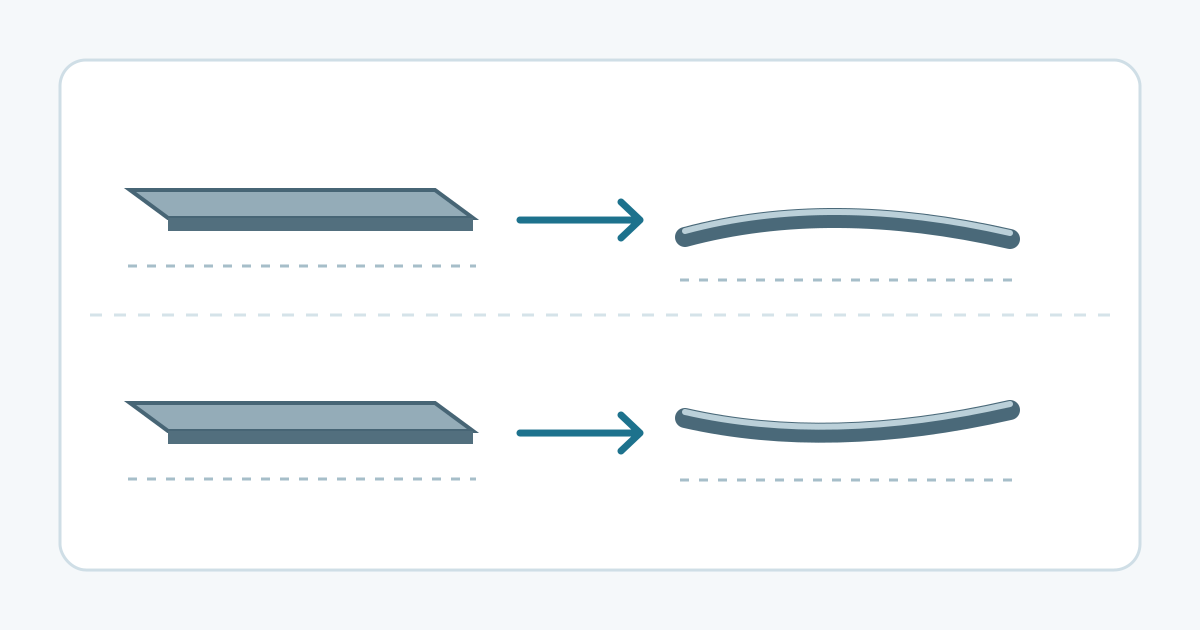
For a stability-sensitive application, specify a representative trial: material identity, cutting route, part geometry, orientation, support condition and the point at which shape is assessed. Record the delivery-flatness result separately from the post-processing result. A trial demonstrates performance within its tested conditions, not every possible nest, weld sequence or future operation.
Information that makes a leveling claim useful
A meaningful record connects the coil or heat, grade and condition, thickness and width, process used, inspection method and measured result. Surface-sensitive material also needs a finish or coating check. If a supplier promises a numerical limit, establish the applicable product specification and measurement basis; this article assigns no universal ASTM or EN tolerance.
The cut-to-length explanation covers how leveling can sit within a coil-to-sheet line. Steel sheet and plate covers product forms. Setup, roll access and handling require the equipment’s trained-operator, guarding and isolation procedures; this comparison is not an operating recipe.