
304 and 316 are both austenitic stainless steels with good forming and welding characteristics. The practical difference is not that one is “good” and the other “premium.” It is whether the service environment justifies the extra corrosion margin provided by 316.
For many indoor, food-service, appliance and general fabrication applications, 304 is the economical default. When the part will see meaningful chloride exposure, aggressive cleaning chemicals, coastal salt, process fluids or persistent wet crevices, 316 is often the safer starting point because its molybdenum addition improves resistance to localized corrosion.
Neither grade is corrosion-proof. Temperature, chloride concentration, deposits, crevices, surface finish, cleaning frequency and fabrication quality can matter as much as the grade name.
304 vs 316 at a glance
| Question | 304 | 316 |
|---|---|---|
| Stainless family | Austenitic Cr-Ni | Austenitic Cr-Ni-Mo |
| Common UNS | S30400 | S31600 |
| Common EN cross-reference | 1.4301 | 1.4401 |
| Typical producer chemistry | About 18.1% Cr, 8.1% Ni | About 17.2% Cr, 10.1% Ni, 2.1% Mo |
| Chloride pitting resistance | Good for many mild environments | Higher than 304 in many chloride-bearing environments |
| Forming and welding | Very good | Very good |
| Material cost | Usually lower | Usually higher because of alloy content |
| Typical choice | General purpose | More corrosive or chloride-exposed service |
Scroll within the table to see all columns →
The values above are identification and typical-producer references, not universal acceptance limits. If material is being purchased to a specification, use the chemistry and mechanical-property limits in that specification and edition.
The main metallurgical difference is molybdenum
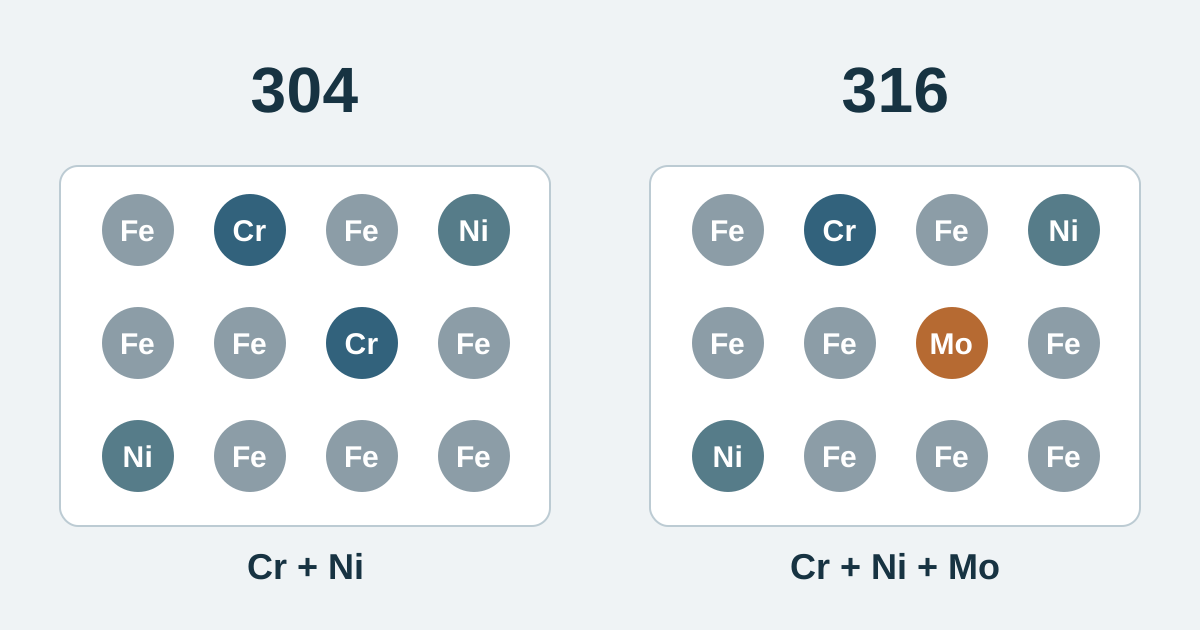
304 is the classic chromium-nickel “18/8” stainless family. 316 adds molybdenum—commonly 2–3% in the Type 316 composition range. That addition strengthens resistance to local breakdown of the passive film, especially pitting and crevice corrosion in many chloride-containing environments.
A useful way to visualize the difference is the Pitting Resistance Equivalent Number (PREN). A common expression is:
PREN = %Cr + 3.3 × %Mo + 16 × %N
Because 316 contains molybdenum and 304 generally does not, 316 normally has the higher PREN. worldstainless lists typical PREN ranges around 17.5–20.8 for 304 and 23.1–28.5 for 316/316L. PREN is a comparison tool; it does not by itself determine whether a grade will survive a particular chemical, temperature or crevice condition.
When 304 is usually the better choice
Choose 304 when the environment is mild enough that extra chloride resistance is not needed. Common examples include:
- indoor architectural components away from salt contamination;
- kitchen equipment and appliances with controlled cleaning;
- dry or frequently cleaned food-processing components where the product chemistry is compatible;
- tanks, guards, covers and fabricated sheet-metal parts in ordinary atmospheric service;
- projects where 304 already has a proven service history under the same conditions.
The economic advantage matters. Nickel and molybdenum are major alloy-cost drivers, so 316 commonly carries a material premium. Paying that premium adds value only when the service environment uses the extra corrosion margin.
When 316 is usually worth the extra cost
Move toward 316 when chloride exposure or corrosive process conditions are more demanding. Typical triggers include:
- coastal or salt-spray exposure that is difficult to wash down;
- equipment exposed to chloride-containing cleaners or process fluids;
- pharmaceutical, chemical and food-processing duties where product chemistry or cleaning regimes are more aggressive;
- wet crevices, deposits or sheltered areas that retain contaminated moisture;
- applications where corrosion consequences are expensive even if the probability is moderate.
Do not translate “316” into “seawater-proof.” Warm seawater, stagnant crevices, deposits and high chloride concentration can attack 316 as well. More highly alloyed stainless steels or other materials may be needed for severe service.
304L vs 316L follows the same corrosion logic
The “L” versions reduce the carbon limit. 304L and 316L are commonly preferred for welded fabrication because lower carbon helps reduce sensitization risk in critical thermal exposure.
The L suffix does not create the main chloride-resistance difference. The key comparison remains the alloy family: 316L retains molybdenum while 304L does not. For a welded chloride-exposed fabrication, 316L is therefore often considered before 304L when corrosion margin is the deciding factor.
Mechanical strength is usually not the deciding factor
At room temperature, common annealed 304 and 316 flat products have broadly similar strength ranges. Exact minimum tensile strength, yield strength and elongation depend on the governing product standard, thickness and condition.
Do not choose 316 simply because it is assumed to be “stronger.” If structural capacity drives the selection, compare the actual certified properties and design rules. If corrosion drives the selection, focus on environment and surface condition.
Forming, machining and welding
Both grades work harden during deformation and both are widely formed and welded. Fabricators should control heat input, contamination and post-weld surface condition in either grade.
For common austenitic welding consumables, ER308L is a frequent starting family for 304/304L and ER316L for 316/316L, subject to the qualified WPS and service conditions. The separate How to Weld Stainless Steel guide owns the full welding workflow.
For machining, the exact condition, tool geometry, rigidity, cutting speed and coolant strategy matter more than a simple “304 easy / 316 hard” rule. Both can work-harden if the tool rubs instead of cutting.
Surface finish can change real corrosion performance
Grade is only one variable. Rough surfaces, embedded carbon-steel contamination, weld heat tint, deep scratches and deposits can create local corrosion sites. A clean, smooth, well-drained surface may outperform a poorly fabricated higher alloy in some practical environments.
This is why a grade decision should include fabrication and maintenance, not just the mill certificate.
A practical selection sequence
| Step | Ask | Implication |
|---|---|---|
| 1. Environment | Is the part dry, atmospheric, process-wet or continuously immersed? | More persistent wetting raises corrosion demand. |
| 2. Chlorides | Salt spray, brine, chlorinated cleaners or chloride process fluid? | Meaningful chloride exposure pushes selection toward 316 or higher. |
| 3. Geometry | Are there gaskets, laps, deposits or stagnant crevices? | Crevices make localized corrosion more severe. |
| 4. Temperature | Will the chloride environment be warm? | Higher temperature usually increases corrosion severity. |
| 5. Fabrication | Welded, heavily formed, polished or exposed to carbon-steel tooling? | Plan grade variant, consumables and surface restoration. |
| 6. Consequence | What happens if staining, pitting or leakage occurs? | High consequence justifies more conservative material selection. |
Scroll within the table to see all columns →
Bottom line
Use 304 as the general-purpose default when the environment is mild and proven, and use 316 when chloride exposure or process corrosion makes localized attack a credible risk. For severe marine, chemical or crevice service, the choice may need to move beyond both grades.
For grade-specific details, see 304 Stainless Steel and 316 Stainless Steel .