
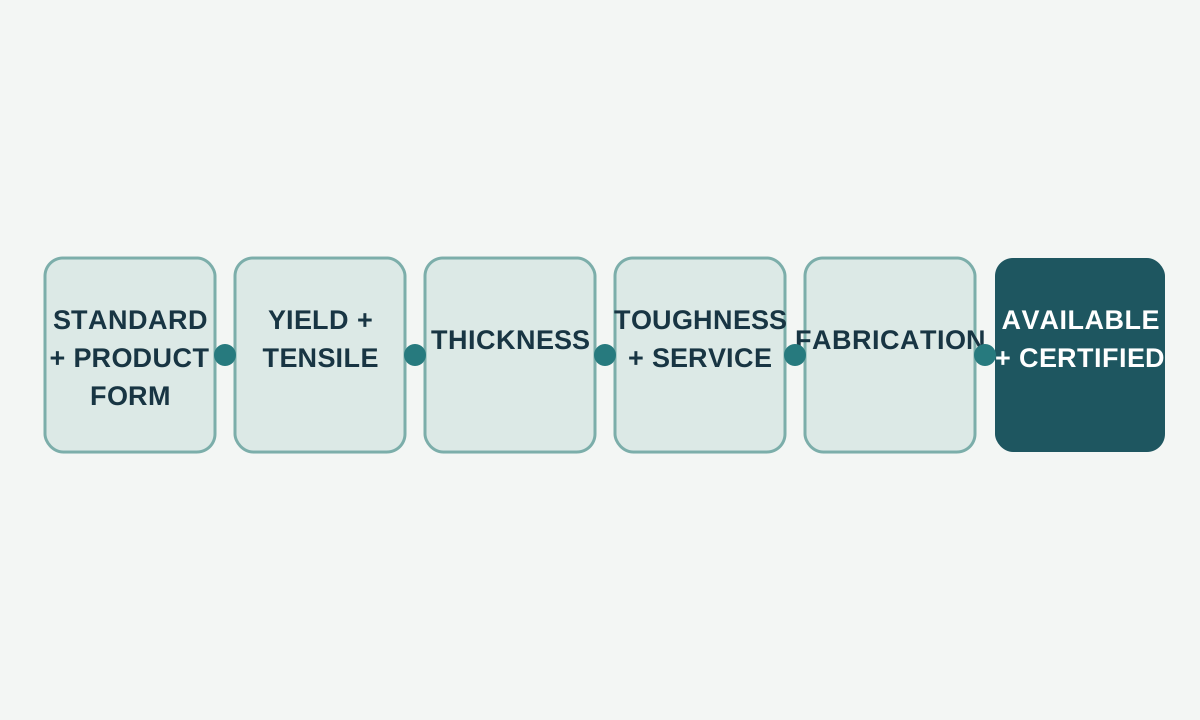
Choosing a steel strength grade starts with the governing design and product standard, the required mechanical properties, product form and thickness. A larger grade number may indicate a higher minimum yield strength within one standard family, yet the complete designation can also carry toughness, delivery-condition, chemistry and testing requirements.
Treat the grade as a specification package. Confirm what the structural design requires, then verify that the chosen product is available in the required dimensions and can be fabricated, inspected and certified for the intended service.
Start with the governing standard and product form
Identify the standard that applies to the actual product before comparing grade numbers. Plate, sheet, hot-rolled sections, hollow sections and bars can fall under different specifications even when their familiar grade names look similar.
For example, BS EN 10025-2:2019 covers hot-rolled non-alloy structural flat and long products within its stated scope; structural hollow sections and tubes use other product standards. ASTM A36/A36M covers structural carbon-steel shapes, plates and bars. ASTM A572/A572M covers several HSLA structural grades and product forms. Australia and New Zealand use separate AS/NZS standards for plate, hot-rolled bars/sections and welded I sections. Canada’s CSA G40.20/G40.21 covers multiple structural-quality product forms and grade types.
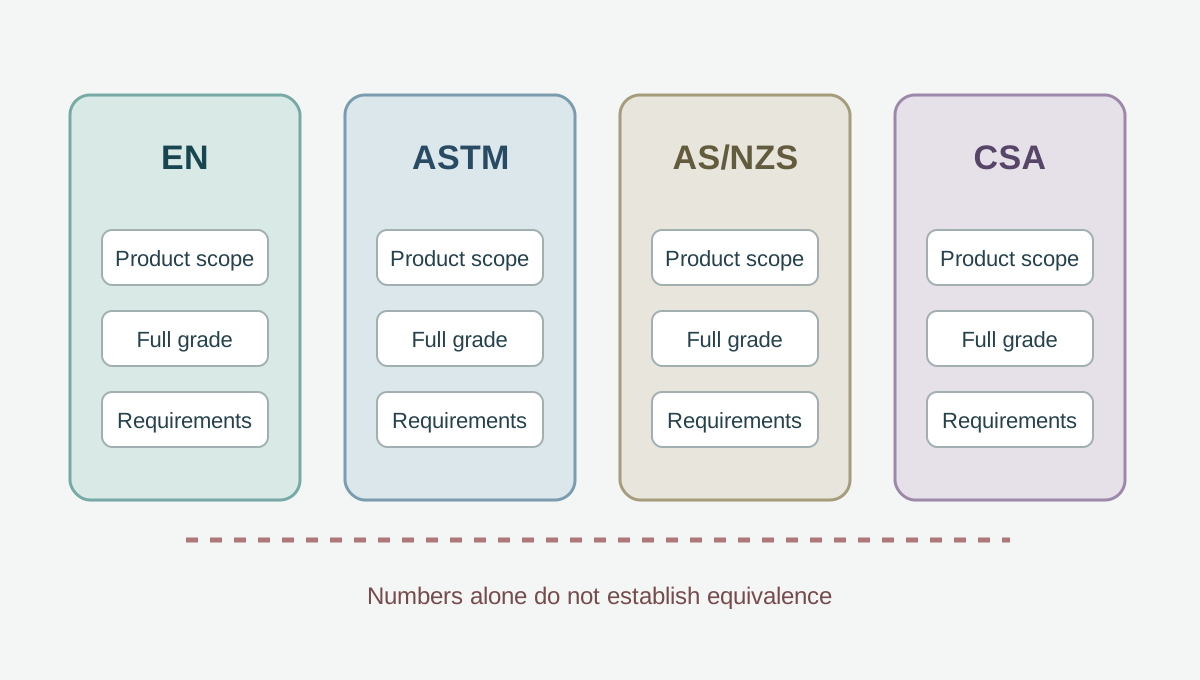
Write the standard and full grade designation together. A bare number such as 350 or 50 does not identify a complete material across different systems.
Define the strength required by the design
Use the applicable design calculation and code to establish the required strength. The key properties usually include yield strength and tensile strength, with elongation or other ductility requirements also relevant.
Yield strength defines the stress level associated with the onset of permanent deformation under the specified test method. Tensile strength is the maximum engineering stress reached during the tensile test. They serve different design and acceptance functions.
Higher strength can reduce the required section in some designs, but it does not automatically improve every part. Stiffness is governed primarily by elastic modulus and section geometry, while fatigue, buckling, deflection, connection design, local stability and code limits may control the member.
Use the designer’s required minimum properties and the applicable code instead of selecting the strongest commercially available grade by default.
Check the thickness-dependent requirements
Guaranteed strength can change with thickness. The same nominal grade may have different minimum yield values across thickness bands or product forms.
KnowSteel’s S275 vs S355 comparison shows this explicitly for selected EN 10025-2 plate ranges: the guaranteed minimum yield strength falls as thickness increases within the producer tables used for that article. The full standard and the ordered product remain the acceptance basis.
This makes thickness part of grade selection. Before freezing a grade, verify:
- actual nominal thickness or section size;
- the applicable thickness band in the product standard;
- minimum yield and tensile requirements for that band;
- any thickness-dependent chemistry, toughness or delivery requirements;
- producer availability in the required dimensions.
Do not copy a headline yield-strength value from a thin-product datasheet onto a thicker plate or a different product form.
Include toughness and service conditions
Low-temperature service, dynamic loading, fracture-critical details and some bridge or offshore applications can require specified notch toughness. The grade suffix, impact category or supplementary requirement may carry this information.
In EN 10025-2, familiar JR, J0 and J2 qualities identify different Charpy V-notch test conditions. Canada’s CSA G40.21 similarly separates strength level from steel type and, where applicable, Charpy category. ASTM specifications can use supplementary or project requirements for toughness depending on the product and application.
A Charpy test temperature is a material test condition. It does not directly establish the minimum service temperature of a finished structure. Structural code provisions, stress state, section thickness, detail category and project requirements still govern the design decision.
Check fabrication before raising the strength level
The selected grade must remain practical for welding, forming, cutting, drilling and other fabrication steps.
For welding, check the actual chemical composition or permitted limits, carbon-equivalent guidance where applicable, thickness, restraint, hydrogen control, heat input, preheat requirements and qualified WPS. A higher-strength grade may require different welding consumables or procedure controls.
For bending and forming, verify minimum bend radius, rolling direction, surface condition and the supplier’s product guidance. For thermal cutting, consider edge quality and any project-specific requirements for cut surfaces or heat-affected regions.
Strength grade, fabrication method and final geometry should be reviewed together before procurement.
Keep regional grade systems separate
| System | Examples | Selection point |
|---|---|---|
| EN 10025-2 | S275, S355 and other grades/qualities | Full designation, product form, thickness, toughness quality and delivery condition |
| ASTM A36/A36M | A36 | Use the complete specification and applicable product/size requirements |
| ASTM A572/A572M | Grades 42 [290], 50 [345], 55 [380], 60 [415], 65 [450] | Grade, product scope, thickness/size, mechanical properties and required toughness |
| AS/NZS 3678 / 3679 | Structural plate, bars/sections and welded-section grade families | Use the standard matching the product form; confirm grade, dimensions and impact option |
| CSA G40.20/G40.21 | Multiple strength levels and steel types | Specify strength level together with the required type/category and product requirements |
Scroll within the table to see all columns →
Similar nominal yield values do not establish grade equivalence. Two grades can differ in chemistry, tensile range, elongation, toughness, thickness limits, weldability controls, product tolerances, inspection and certification.
When a project needs an alternative grade, use an approved substitution process. Compare the actual standard clauses and design requirements rather than relying on an internet equivalence chart.
Confirm availability and certification
A technically suitable grade still needs to be purchasable in the required thickness, width, length, section and delivery condition. Mill and service-centre ranges can be narrower than a standard’s theoretical scope.
BlueScope’s current XLERPLATE range provides a useful example: AS/NZS 3678 grades and impact-testing options have product-specific thickness and availability limits. Other producers publish different ranges.
Before ordering, confirm:
- grade and complete standard designation;
- product form and dimensions;
- delivery condition;
- required mechanical and impact properties;
- surface/tolerance requirements;
- inspection certificate type and traceability;
- supplementary tests or ultrasonic examination where specified;
- fabrication and welding requirements;
- approved alternatives if the preferred grade is unavailable.
For the purchase-document workflow, use How to Specify Steel Sheet and Coil Correctly and the KnowSteel standards reference .
A practical selection sequence
- Identify the governing design code and product standard.
- Confirm the product form and required dimensions.
- Determine the design minimum yield and tensile properties.
- Check the standard’s thickness-dependent mechanical requirements.
- Add the required toughness or impact category.
- Check welding, forming, cutting and other fabrication constraints.
- Verify corrosion, temperature, fatigue and other service conditions.
- Confirm producer availability and any dimension limits.
- Specify the complete grade, delivery condition and test/certificate requirements.
- Review any proposed substitution against both the design basis and the material standard.
A well-chosen strength grade satisfies the full design, product, fabrication and verification chain. The final designation should be specific enough that the supplier and fabricator can deliver and document the material the design actually requires.
BSI, ASTM, Standards Australia, BlueScope, CSA, SCI/BCSA and TWI are documented in the source scope and edition notes .