
S275 and S355 are non-alloy structural steel grades in EN 10025-2. For the 5–16 mm products compared here, their minimum yield strengths are 275 and 355 MPa. Choosing between them also requires the actual thickness, toughness quality and fabrication conditions. This comparison concerns hot-rolled EN 10025-2 products, with numerical examples from the selected producer plate tables; it excludes structural hollow sections and tubes.
BSI’s BS EN 10025-2:2019 page confirms the standard’s scope and current, under-review status at the research date. Its public page does not reproduce the numerical requirements; use the contractual standard edition and the ordered product specification for acceptance.
S275 vs S355 at a glance
| Item | S275 | S355 |
|---|---|---|
| Standard family | EN 10025-2 non-alloy structural steel | EN 10025-2 non-alloy structural steel |
| Minimum yield strength, 5–16 mm | 275 MPa | 355 MPa |
| Minimum yield strength, >16–40 mm | 265 MPa | 345 MPa |
| Minimum yield strength, >40–63 mm | 255 MPa | 335 MPa |
| Tensile strength, 5–100 mm | 410–560 MPa | 470–630 MPa |
| Common toughness qualities | JR, J0, J2 | JR, J0, J2; S355K2 is also available in the producer range cited below |
| Main selection driver | Moderate strength with broad structural use | Higher yield and tensile strength where strength can reduce required section or increase capacity |
Scroll within the table to see all columns →
The numerical comparison uses the ArcelorMittal H30 producer tables, including S275J0/J2 and S355JR/J0/J2 flat-product entries. These are specified minima or ranges for that product scope, not typical measurements or universal values for every S275/S355 product. The inspection certificate records the delivered heat and product; check its results and identification against the order.
Thickness changes the comparison
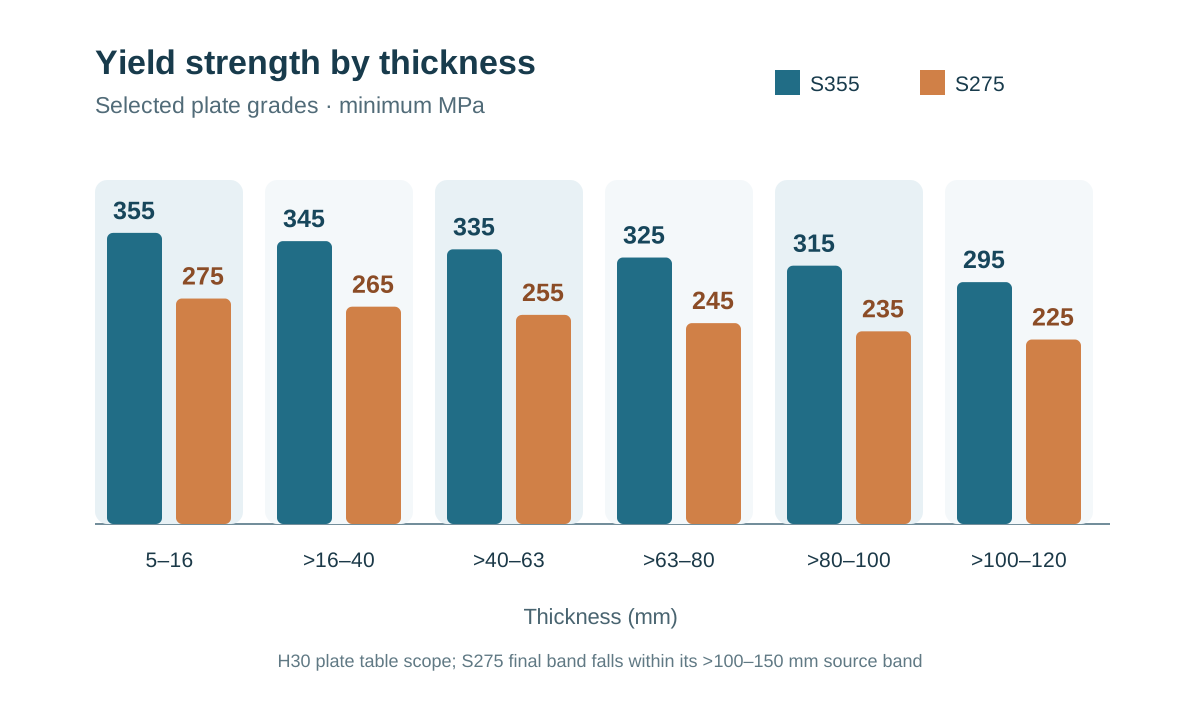
The grade number matches the minimum yield strength in the selected 5–16 mm band. The H30 plate tables reduce the guaranteed minimum as thickness increases; the general meaning of yield strength remains the same.
For a common comparison range:
- 5–16 mm: S275 ≥275 MPa; S355 ≥355 MPa.
-
16–40 mm: S275 ≥265 MPa; S355 ≥345 MPa.
-
40–63 mm: S275 ≥255 MPa; S355 ≥335 MPa.
-
63–80 mm: S275 ≥245 MPa; S355 ≥325 MPa.
-
80–100 mm: S275 ≥235 MPa; S355 ≥315 MPa.
-
100–120 mm: S275 ≥225 MPa; S355 ≥295 MPa.
These are selected comparison bands from H30. The S275 value in >100–120 mm falls within its broader >100–150 mm band; S355J2 is listed through 120 mm. Other ranges and availability depend on product form and quality. Procurement must use the applicable product table, thickness and full grade.
What JR, J0 and J2 mean
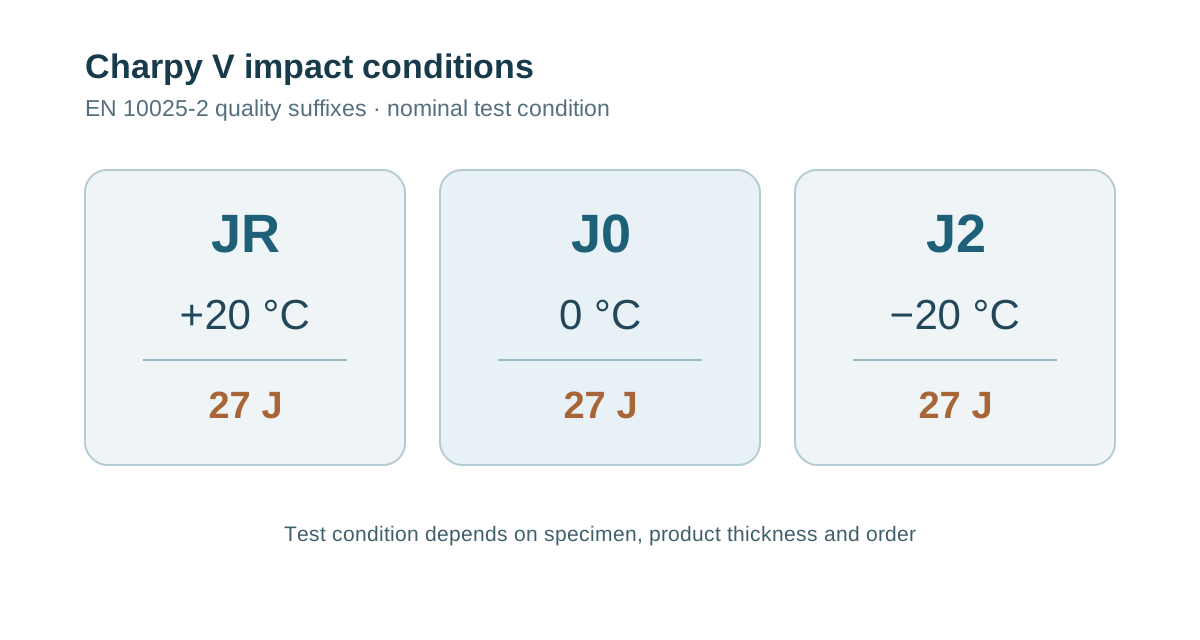
The toughness suffix is a separate part of the grade designation. For the familiar EN 10025-2 qualities:
- JR: 27 J Charpy V-notch impact energy at +20 °C.
- J0: 27 J at 0 °C.
- J2: 27 J at −20 °C.
Retain the suffix when service temperature or toughness matters. S275J2 and S355J2 share the nominal impact condition above while retaining different strength levels. ArcelorMittal’s S355 grade overview also lists S355K2: 40 J at −20 °C in its stated longitudinal test and product scope. Availability must be confirmed for the required product and dimensions.
Charpy values require the applicable specimen size and orientation, product thickness and ordered inspection/test provisions. A suffix alone does not prove that a particular delivered item was individually tested; check the order and certificate. The test temperature is not, by itself, a permitted minimum service temperature.
Tensile strength and ductility
For the selected H30 5–100 mm product range compared here, specified tensile-strength ranges are 410–560 MPa for S275 and 470–630 MPa for S355. These ranges must not be extended to thinner or thicker material without checking its table. Elongation requirements also vary with thickness and test-piece orientation; use the applicable gauge length and specimen requirements when comparing certificates.
Higher strength does not automatically improve every design limit. Deflection, vibration, local buckling, fatigue, connection behavior and serviceability may control a member before yield strength does. A switch from S275 to S355 should therefore be checked in the governing design calculation.
Weldability and fabrication
Both families are widely welded structural steels. Welding procedure, preheat and heat-input decisions depend on thickness, chemical composition, carbon equivalent, restraint, hydrogen control, joint geometry and the governing fabrication code. TWI’s hydrogen-cracking guidance explains why material and joint conditions must be considered together. Neither grade name supplies a universal preheat temperature.
S355 should not be treated as a universal drop-in replacement simply because its yield strength is higher. Confirm the specified quality, delivery condition, product dimensions, toughness requirement and fabrication procedure. For cold forming or other demanding fabrication, order the required suitability explicitly where the product standard or supplier provides that option.
When S355 can reduce steel weight
S355 can allow a smaller section when member capacity is governed by yield strength and the design code permits the reduction. The benefit is strongest where section resistance is strength-controlled and available S355 sections or plate thicknesses fit the design efficiently.
The saving can be small where stiffness, buckling, fatigue, fire design, minimum thickness, connection geometry or standardized section availability controls the design. Material cost per tonne also needs to be compared with fabrication, transport and erection effects.
When S275 remains a sensible choice
S275 can be efficient for lightly or moderately loaded members, general fabrication, secondary steelwork, or projects where a suitable S275 product is readily available and strength is not the governing constraint. The correct decision uses the complete member design and supply specification.
Specification checklist
Use the steel specification guide to organize the order. For either grade, state:
- EN 10025-2 and the contractual edition, cross-checked against the applicable standards .
- Full grade including toughness suffix, such as S275J2 or S355J2.
- Product form, dimensions and thickness.
- Delivery condition where required.
- Inspection document and certificate requirements.
- Additional testing, through-thickness properties, ultrasonic testing or surface requirements when applicable.
- Fabrication-critical requirements such as weldability or forming suitability.
- Any project-specific design or regulatory requirements.
Practical selection rule
Choose S355 when the higher guaranteed strength creates a measurable design benefit after checking serviceability, stability, connections and fabrication. Choose S275 when its lower strength still satisfies the full design and supply requirements. In both cases, use the full EN designation and verify the delivered certificate against the ordered product.