Austenitic, ferritic and martensitic stainless steels are three major stainless families. Their characteristic microstructures and alloy/heat-treatment design help explain magnetic response, hardenability, forming behavior and toughness. The exact grade and condition determine chemistry, corrosion performance and specified mechanical properties.
For a broader five-family overview that also includes duplex and precipitation-hardening stainless steel, see Stainless Steel .
Austenitic vs ferritic vs martensitic at a glance
| Characteristic | Austenitic | Ferritic | Martensitic |
|---|---|---|---|
| Typical grade examples | 304, 316 | 430 | 410, 420, 431 |
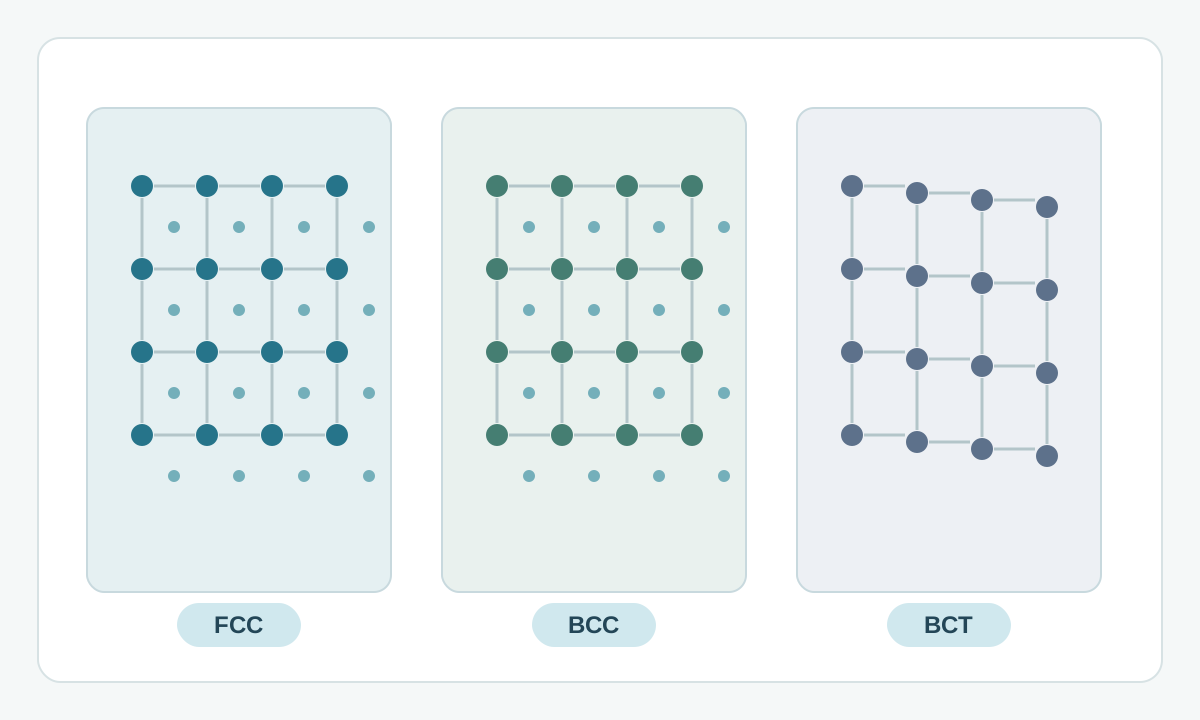
| Room-temperature structure | Face-centred cubic (FCC) austenite | Body-centred cubic (BCC) ferrite | Body-centred tetragonal (BCT) martensite after hardening |
| Magnetic response | Usually low in the fully annealed condition; can increase after cold work or welding | Ferromagnetic | Ferromagnetic |
| Conventional heat hardening | No; strength can rise substantially through cold work in suitable grades | No | Yes; grade-specific hardening and tempering are central to the property set |
| General fabrication character | High ductility and broad forming/welding capability | Useful sheet formability, with grade- and thickness-dependent stretch forming, toughness and welding limits | Often fabricated or machined in a softer condition, then heat treated when high hardness or strength is required |
| Common selection reason | Broad corrosion resistance, formability, weldability and toughness | Chromium-based corrosion resistance, magnetic response and often lower nickel exposure/cost | Hardness, wear resistance and high strength with stainless corrosion resistance appropriate to the grade |
Scroll within the table to see all columns →
These are family-level tendencies. Purchase specifications and design checks must use the actual grade, product form, thickness, condition and governing standard.
Microstructure controls the biggest family differences
Austenitic stainless steels retain an FCC structure at room temperature. Nickel, manganese and nitrogen can stabilize austenite, while chromium provides the basis for the passive corrosion-resistant surface. Common 304 and 316 grades belong to this family.
Ferritic stainless steels have a BCC structure and use chromium as the principal alloying element. Many ferritic grades contain little or no nickel. Grade 430 is a familiar example.
Martensitic stainless steels are designed so heat treatment can transform the structure and produce a hardened martensitic condition. Their carbon content is an important part of this response. Grades such as 410, 420 and 431 are common examples.
Martensitic grades may be supplied annealed for machining or forming. The family name therefore describes metallurgical behavior as well as the intended hardened structure; it does not guarantee that a delivered part is already martensitic or hardened.
FCC, BCC and BCT here are simplified descriptions of characteristic lattices; actual phase balance and lattice distortion depend on composition and processing.
Heat treatment separates martensitic stainless most clearly
Austenitic stainless steels cannot be through-hardened by the conventional quench-and-temper route used for martensitic grades. Cold work can raise their strength markedly, and solution annealing is used for purposes such as restoring a softened austenitic condition and controlling effects from prior processing.
Ferritic stainless steels also do not gain hardness through conventional quench-and-temper treatment. Annealing is used to control condition and restore properties after suitable processing, subject to the grade and product specification.
Martensitic grades are specifically used when heat treatment is part of the required property route. Hardening can provide high strength and hardness; tempering adjusts the balance among hardness, strength, ductility and toughness. The required heat-treatment condition belongs in the material specification.
Magnetism is useful for classification, with limits
Ferritic and martensitic stainless steels normally respond strongly to a hand magnet because ferrite and martensite are ferromagnetic phases.
Fully annealed austenitic stainless steels usually have low magnetic permeability. Cold forming can create strain-induced martensite in some austenitic grades, and weld metal can contain ferrite, so a formed corner, sheared edge or weld may attract a magnet more strongly than an annealed flat area.
A magnet can therefore support a family-level screening check when the expected materials are known. It cannot identify a specific grade or verify corrosion resistance. The dedicated stainless steel magnetism guide covers that distinction in more detail.
Corrosion resistance follows chemistry and service conditions
The three families all contain enough chromium to form the passive film associated with stainless steel, yet their corrosion performance spans a wide range.
Austenitic grades include widely used 304 and molybdenum-bearing 316, along with much more highly alloyed grades. Ferritic grades also cover a broad range; stabilized ferritic grades can approach common austenitic grades in some corrosion environments. Martensitic grades are frequently chosen for mechanical performance, with corrosion resistance depending strongly on chromium level, carbon, heat-treated condition, surface condition and environment.
Family name alone cannot rank corrosion resistance. Chlorides, temperature, crevices, deposits, cleaning chemistry, surface finish and the actual alloy composition all matter. Use grade-specific data for the service environment.
Molybdenum helps 316 resist chloride pitting better than 304 under comparable conditions; see 304 vs 316 stainless steel for grade-level limits.
Forming and welding behavior differs by family
Austenitic stainless steels are highly ductile and generally have strong forming capability. They also work harden, so tooling, forming sequence and intermediate condition can matter in severe operations. Their welding behavior is broadly favorable when the filler, heat input, joint design and post-fabrication surface treatment suit the grade and service.
Ferritic grades can perform well in deep drawing, while stretch-forming capability and weld toughness can be more limiting for some grades and thicker sections. Modern stabilized ferritic grades can have much better fabrication performance than broad older stereotypes suggest. Grade-specific producer data is the safer basis for tooling and welding decisions.
Martensitic stainless is often machined or formed before final hardening. Welding requires closer grade-level control because carbon content, hardenability, section thickness and heat treatment affect cracking risk and final properties. Qualified procedures may require preheat, controlled heat input or post-weld heat treatment depending on the grade and application.
Toughness and temperature behavior also diverge
Austenitic stainless steels retain very good toughness at low temperatures and are widely used in cryogenic service when the selected grade and product specification meet the design requirements.
Ferritic and martensitic stainless steels can show a ductile-to-brittle transition. Their low-temperature suitability therefore needs explicit verification from the relevant grade, thickness, condition and code or product data.
At elevated temperature, oxidation resistance, creep behavior, thermal expansion and strength retention must be checked separately. Family identity is a starting point rather than an allowable-temperature rating.
Ferritic stainless generally expands less with temperature than common austenitic stainless. This can matter in thermal cycling, but the actual expansion coefficient and allowable service temperature still require grade-specific data.
Use the family to narrow the search, then specify the grade
Typical applications illustrate these tendencies: austenitic grades are common in food-processing equipment and tanks; ferritic grades appear in appliances and automotive exhaust systems; martensitic grades are used for blades, shafts and selected turbine components. Each application still needs a suitable grade, condition and design.
Start with the property that drives the application:
| Primary need | Family commonly considered first | Next checks |
|---|---|---|
| General-purpose sheet with strong forming and welding needs | Austenitic | Corrosion environment, grade, finish, strength and fabrication route |
| Magnetic sheet with chromium-based corrosion resistance and reduced nickel dependence | Ferritic | Grade-specific corrosion resistance, forming mode, weldability and toughness |
| High hardness, wear resistance or heat-treatable strength | Martensitic | Hardening/tempering condition, toughness, corrosion exposure and joining method |
Scroll within the table to see all columns →
The final specification should state the governing standard and edition, exact grade, product form, dimensions, delivery or heat-treatment condition, surface requirements and any fabrication-critical or test requirements. ASTM A240/A240M-26 is one current specification for stainless plate, sheet and strip within its stated scope; other product forms and markets use different standards.