
Steel’s thermal conductivity describes how readily heat passes through the metal under a temperature gradient. It is written as k or λ, usually in W/(m·K). The value changes with grade, temperature and material condition. At 20°C, published reference values include 52 W/(m·K) for carbon steel UNS G10200, 15 for 304 and 316, and 25 for ferritic 430. These are scoped comparison data, not guaranteed values for every supplied product.
A useful heat-transfer calculation also needs geometry and boundary conditions. A thin stainless sheet can offer little resistance to heat flowing through its thickness even though its conductivity is lower than that of many carbon steels.
What conductivity tells you
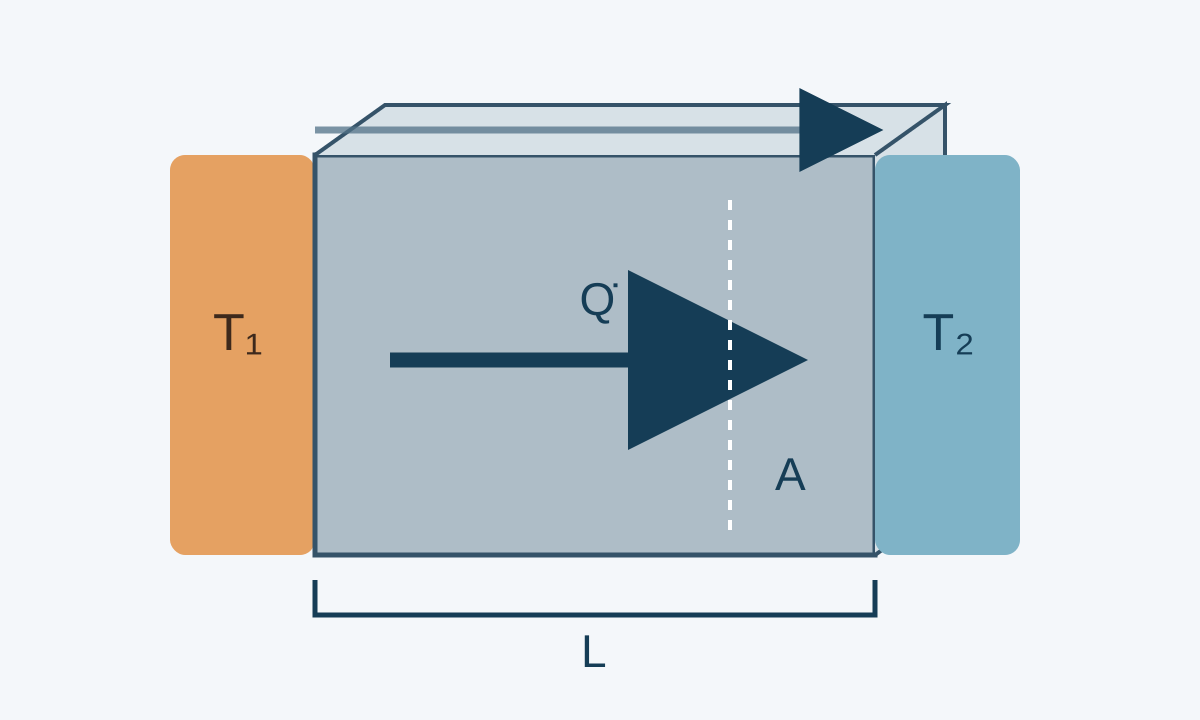
Conductivity relates local heat flux to the temperature gradient. For one-dimensional conduction, Fourier’s law is q″ = −k(dT/dx), where q″ is heat flow per unit area in W/m² and dT/dx is the temperature gradient in K/m. The minus sign indicates flow toward lower temperature.
For a uniform flat plate with constant k, the steady heat-transfer rate is Q̇ = kA(T₁ − T₂)/L. Here A is area normal to heat flow, L is conduction-path length and T₁ and T₂ are the hot and cold face temperatures. This simplified form assumes one-dimensional flow, no internal heat generation and negligible edge losses. Its units reduce to W; it gives a rate, not an amount of stored energy.
Compare values at the same temperature
| Material | k, W/(m·K) | Temperature | Reference basis |
|---|---|---|---|
| Carbon steel, UNS G10200 | 52 | 20°C | SSINA physical-property table |
| 304 / EN 1.4301, austenitic | 15 | 20°C | worldstainless technical tables |
| 316 / EN 1.4401, austenitic | 15 | 20°C | worldstainless technical tables |
| 430 / EN 1.4016, ferritic | 25 | 20°C | worldstainless technical tables |
Scroll within the table to see all columns →
The table supports a comparison between named entries. It supplies neither a batch certificate nor a grade-independent design value. The cited entries do not fully identify the delivered product’s processing history or measurement direction; obtain those details when they affect the calculation. Designation pairs follow the source cross-references and do not certify interchangeability under purchasing standards.
304 and 316 have the same rounded value here, yet their composition and corrosion performance differ. Conductivity alone cannot decide between them. The ferritic example also shows why “stainless steel” is too broad a label for a single coefficient.
Why the value changes
Heat transport in metals involves electrons and lattice vibrations. Alloying and changes in structure alter the scattering of those heat carriers. Composition, heat treatment, cold work and defects can therefore affect conductivity; a strength grade or a polished appearance does not determine k.
Temperature trends depend on the material. SSINA lists UNS G10200 at 52 W/(m·K) at 20°C and 43 at 400°C, while its 304 entry increases from 16.2 at 100°C to 21.4 at 500°C. Those examples do not establish one temperature correction for all steels. Use a grade-specific curve within its stated range, with the material condition retained.
NIST’s 304 conductivity correlation uses kelvin; its data span 4–300 K and its equation is listed for 1–300 K. A low-temperature fit should not be extended into furnace service. If k varies appreciably across a plate, integrate the validated k(T) relation over the face-temperature interval or use an appropriate numerical model; an arithmetic average of two values needs justification.
Work through a plate calculation
Consider a hypothetical 304 plate with A = 0.10 m² and L = 10 mm = 0.010 m. Hold one face at 30°C and the other at 20°C. For this teaching example, assume k = 15 W/(m·K) is constant over that interval; the 20°C table alone does not verify that interval average.
- Temperature difference: ΔT = 10 K.
- Heat-transfer rate: Q̇ = 15 × 0.10 × 10 / 0.010 = 1,500 W.
- Heat flux: q″ = Q̇/A = 15,000 W/m².
- Plate resistance: R = L/(kA) = 0.00667 K/W.
Doubling thickness halves Q̇ under the same assumptions. Doubling area doubles it. The large result requires both face temperatures to remain fixed. Substituting room-air temperatures for these surface temperatures would omit the resistance between air and metal.
A kelvin difference and a Celsius difference have equal numerical values. Use metres with k in W/(m·K); entering 10 as the thickness in this example would produce a thousandfold error. Keep W/m² heat flux separate from W total rate.
Conductivity, conductance and diffusivity
For this plate, thermal conductance G = kA/L = 150 W/K includes geometry. Conductivity k is a material property; G describes the particular heat path. The area-normalized resistance is R″ = L/k = 0.000667 m²·K/W. Check whether a quoted resistance includes area before adding it to other terms.
Thermal diffusivity a = k/(ρcₚ), in m²/s, combines conductivity with density ρ and specific heat cₚ. It helps describe how temperature changes spread through a material. Heating time still depends on size, surface heat exchange and initial conditions. Thermal expansion describes dimensional change with temperature; its coefficient cannot replace k. See thermal expansion of steel for movement calculations.
Include layers, contacts and surroundings
For steady one-dimensional flow through plane layers of common area A, with no internal heat generation and constant conductivity within each layer, add resistances in series: R_total = 1/(h₁A) + Σ[Lᵢ/(kᵢA)] + ΣR_contact + 1/(h₂A). Then Q̇ = (T∞,₁ − T∞,₂)/R_total. T∞,₁ and T∞,₂ are the bulk-fluid temperatures on the two sides. The h terms describe convection between each surface and its adjacent fluid, in W/(m²·K). Every resistance term here has units K/W.
An area-normalized contact resistance supplied in m²·K/W must be divided by A before entering this expression. Contact pressure, gaps and surface condition matter. Insulation or a poorly conducting interface may dominate the total, making a change of steel grade less influential than a comparison of k alone suggests.
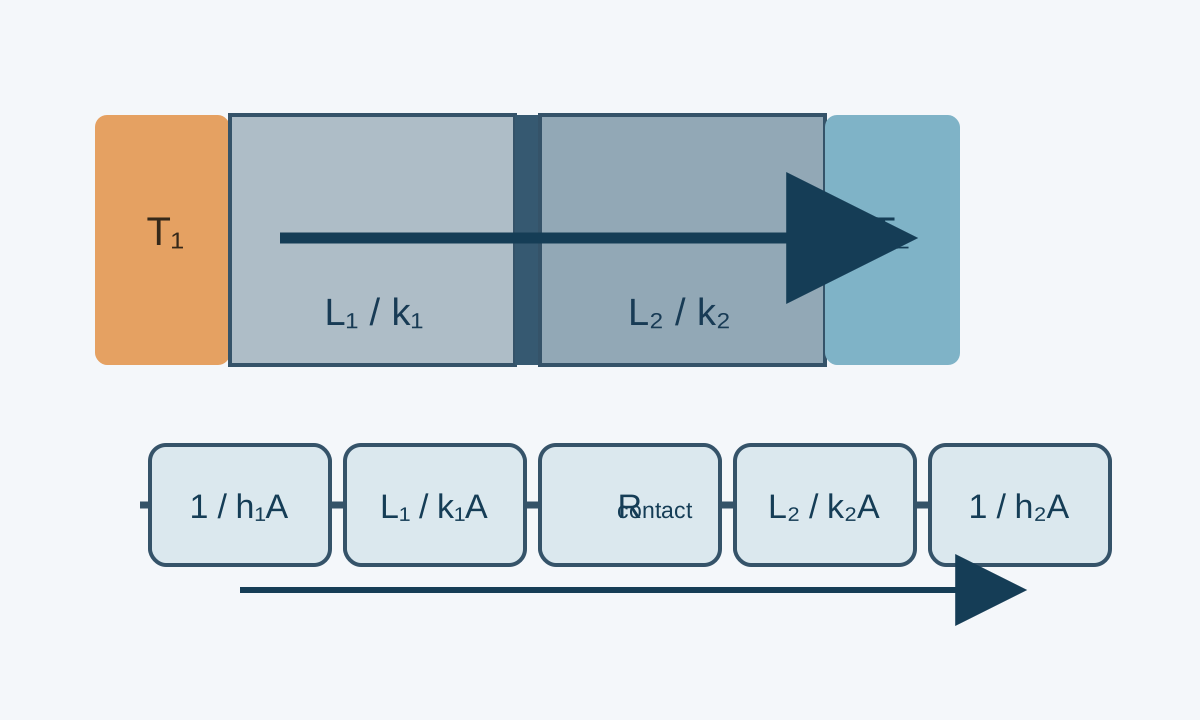
Fasteners and frames can create parallel heat paths. Radiation, curved walls, spreading heat flow, changing contact area and transient storage may need a different model. A coated steel panel’s overall U-value also depends on its construction and surroundings; the base steel’s conductivity does not supply that U-value.
Record the inputs before using the result
- Identify grade, product form, condition and heat-flow direction.
- Record the source, units, temperature coverage and whether data are typical, measured or specified.
- Define actual surface or fluid temperatures and the relevant geometry.
- Include interfaces, coatings, insulation and external heat exchange.
- Check whether steady, one-dimensional, constant-property assumptions are adequate.
- For consequential design, verify the adopted data and method against project requirements, including uncertainty.
Ask a test provider to report specimen condition, measurement method, temperature range and uncertainty. When conductivity is derived from diffusivity, density and heat capacity, all inputs must describe compatible material states and temperatures. A handbook number cannot replace that traceable record.