
Galvanized coating weight belongs in the product specification. Choose it from the governing product standard, then check exposure, service-life target, fabrication, cut edges and any downstream paint or barrier coating.
A heavier zinc coating normally provides more sacrificial zinc reserve in atmospheric service. Real service life also depends on salt deposition, time of wetness, drainage, industrial pollutants, sheltering, scratches, formed areas and maintenance.
Quick selection framework
| Decision | Check | Why it matters |
|---|---|---|
| Product standard | ASTM A653/A653M, EN 10346, or the contract standard | The designation and acceptance test belong to that standard |
| Exposure | Dry interior, ordinary exterior, coastal, industrial, sheltered wet zones | More aggressive exposure consumes zinc faster |
| Durability target | Required maintenance interval and replacement consequence | Coating reserve should match the service objective |
| Fabrication | Forming severity, welds, cut edges, punched holes and abrasion | Fabrication can locally change or remove the coating |
| Downstream finish | Bare galvanized, painted, powder coated or duplex system | A barrier layer changes the corrosion-control strategy |
Scroll within the table to see all columns →
1. Start with the product standard
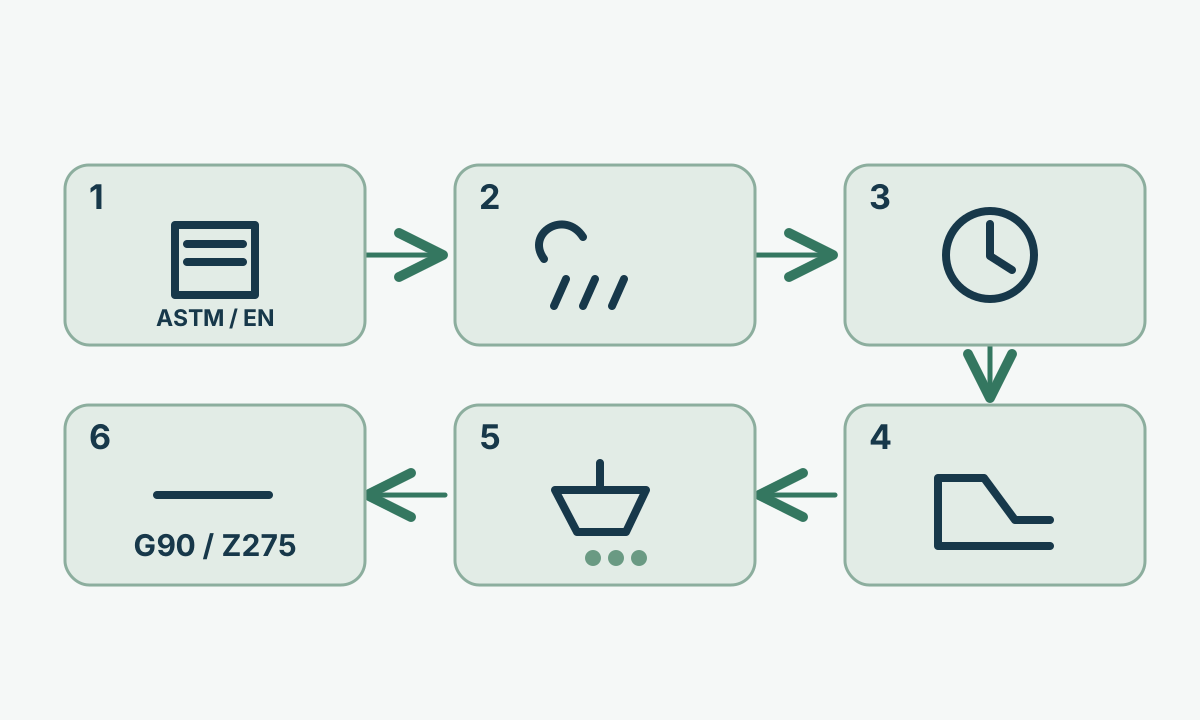
Write the product standard before the coating designation. ASTM A653/A653M covers hot-dip zinc-coated and zinc-iron alloy-coated steel sheet in coils and cut lengths. EN 10346 uses its own designation framework for continuously hot-dip coated flat products.
The standard controls the basis of coating mass, sampling, test method and minimum acceptance. A purchase order that says only “G90” or “Z275” leaves important context unstated. Also define steel grade, thickness, surface condition and required finish.
2. Read G and Z designations correctly
In ASTM A653/A653M inch-pound practice, G90 refers to a minimum triple-spot average coating weight of 0.90 oz/ft², total for both sides. In the SI table, Z275 refers to 275 g/m² total for both sides on the same triple-spot basis.
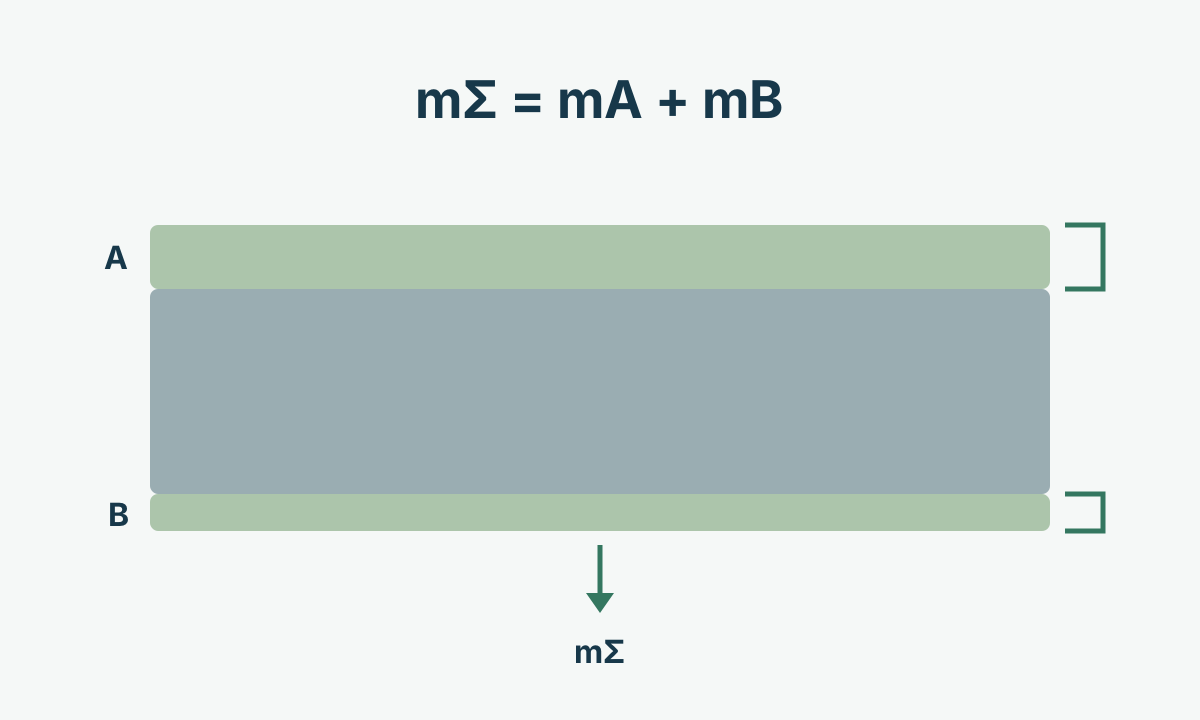
Total-both-sides mass does not require an exact 50/50 split. Continuous coating lines can produce allowed face-to-face and edge-to-edge variation. If a component needs controlled coating on each face, specify a suitable single-side requirement.
For EN 10346 products, Z100, Z140, Z200, Z225, Z275, Z350, Z450 and Z600 are common. ArcelorMittal lists Z275 as 275 g/m² total double-sided mass with about 20 µm typical zinc thickness per side. That thickness is a physical interpretation; formal acceptance remains tied to the applicable specification.
3. Match coating reserve to exposure and durability
Zinc protects steel through barrier and sacrificial action. As zinc is consumed, the available reserve decreases. ASTM commentary links atmospheric corrosion performance of galvanized sheet closely to coating thickness or mass.
Exterior components that remain wet, collect salt, trap debris or sit in industrial fallout generally need more corrosion reserve than dry interior parts. Coastal severity also changes with wind, orientation, shelter and washing. Use project exposure guidance, supplier data and local experience where failure consequences are high.
4. Include fabrication and exposed edges
Cutting, punching, drilling and welding expose steel or locally disturb the metallic coating. Zinc next to a small exposed area can provide limited sacrificial protection; its useful range decreases as exposed geometry grows or the environment becomes more aggressive.
Tight bends also strain the coating. For demanding forming, confirm the specific product’s bendability and coating behavior. Welded assemblies need a defined repair or finishing strategy for heat-affected and damaged areas.
5. Coordinate metallic coating with paint or powder coating
Galvanized substrate may be used bare or beneath a compatible organic coating. Paint or powder can reduce direct zinc exposure when surface preparation, adhesion and edge coverage are controlled.
Treat the metallic and organic layers as one corrosion-control system. Prepainted products should follow the relevant prepainted specification rather than selecting zinc mass in isolation.
6. Use conversions for checking
A practical approximation is:
1.00 oz/ft² ≈ 305 g/m²
This helps reviewers compare unit systems. Keep the original designation in the purchase specification because unit systems, rounding and test requirements remain attached to the governing standard.
7. Worked check: G90 and 275 g/m²
0.90 oz/ft² × 305 ≈ 274.5 g/m²
The value is numerically close to 275 g/m². GalvInfo therefore presents G90 and Z275 as comparable total-both-sides coating-mass designations within ASTM A653/A653M.
If a drawing says ASTM A653 G90, a metric conversion can be shown for engineering review. Changing the purchase requirement to EN 10346 Z275 requires a formal review of the complete product standard, grade, testing and delivery requirements.
8. What to put on the purchase specification
State the product standard, steel grade, delivery condition, nominal thickness and width, zinc coating designation, total-both-sides or defined single-side basis, post-treatment, fabrication constraints, paint system and inspection/certification requirements.
For unit checking, use the zinc coating weight converter . For product-family context, see galvanized steel coil . For service corrosion, see Does Galvanized Steel Rust? .